Salt is quietly strangling one of the world’s most important food crops. Rice, the staple grain for billions of people, is notoriously sensitive to salinity, and the damage begins before a seedling ever breaks the soil. Now researchers at Vellore Institute of Technology in India report that a humble marine organism may hold the key to protecting rice at its most vulnerable stage. In a study published in Frontiers in Nanotechnology, the team fabricated zinc oxide nanoparticles using three different biological extracts and found that seaweed-derived particles outperformed even commercial formulations, rescuing germination and early growth under salt stress at lower doses than conventional materials.
The research tackles a question that has long lingered in agricultural nanotechnology: does it matter which living organism you use to build a nanoparticle? Green synthesis, in which plant or algal extracts act as natural reducing and stabilizing agents, has surged in popularity as an alternative to chemical manufacturing. But most studies have tested a single synthesis route against untreated controls, leaving the link between biological source, particle properties, and real-world plant performance largely unexplored. The new work systematically compared zinc oxide nanoparticles made from sorghum leaf extract, seaweed blade extract, and sugar beet leaf extract against commercially available particles, all evaluated under identical salt-stressed conditions.
The choice of biological feedstock was deliberate. Sorghum leaves are rich in alkaloids, flavonoids, phenols, tannins, and proteins; seaweed contains bioactive compounds known to aid nanoparticle formation and stabilization; and sugar beet is packed with betacyanins and betaxanthins that can coordinate with zinc ions during particle formation. The researchers ground dried plant material into powder, extracted it in hot deionized water, and mixed the filtrate with a zinc acetate solution. Distinct color changes signaled that nanoparticles were forming, and after washing, drying, and calcination at 450 degrees Celsius, fine white powders of zinc oxide emerged from each extract.
A battery of characterization techniques then revealed striking differences between the batches. X-ray diffraction confirmed that all samples possessed the characteristic hexagonal wurtzite crystal structure of zinc oxide, with crystallite sizes ranging from about 13.7 nanometers for the commercial material to 27.4 nanometers for the sugar beet-derived particles. Ultraviolet-visible spectroscopy showed absorption peaks between 355 and 364 nanometers, with band gap energies of roughly 3.11 to 3.19 electronvolts for the biogenic particles, slightly lower than the 3.48 electronvolts measured for the commercial sample. Fourier-transform infrared spectroscopy detected biomolecular signatures on the green-synthesized particles, evidence that phytochemicals from the extracts had capped the particle surfaces during synthesis.
The seaweed-derived nanoparticles emerged as the standout formulation. Transmission electron microscopy showed an average particle size of approximately 23.7 nanometers with a comparatively narrow size distribution, suggesting more uniform nucleation and crystal growth than in the sorghum or sugar beet batches. Most tellingly, the seaweed particles carried a zeta potential of minus 24.85 millivolts, the most negative surface charge among the biogenic samples, indicating superior colloidal stability. The researchers attribute this to anionic functional groups from polysaccharides, sulfated metabolites, and phenolic compounds in the seaweed extract, which generate electrostatic repulsion and keep particles from clumping in aqueous suspension. Stable, well-dispersed nanoparticles interact more effectively with seed tissues, and that advantage translated directly into plant performance.
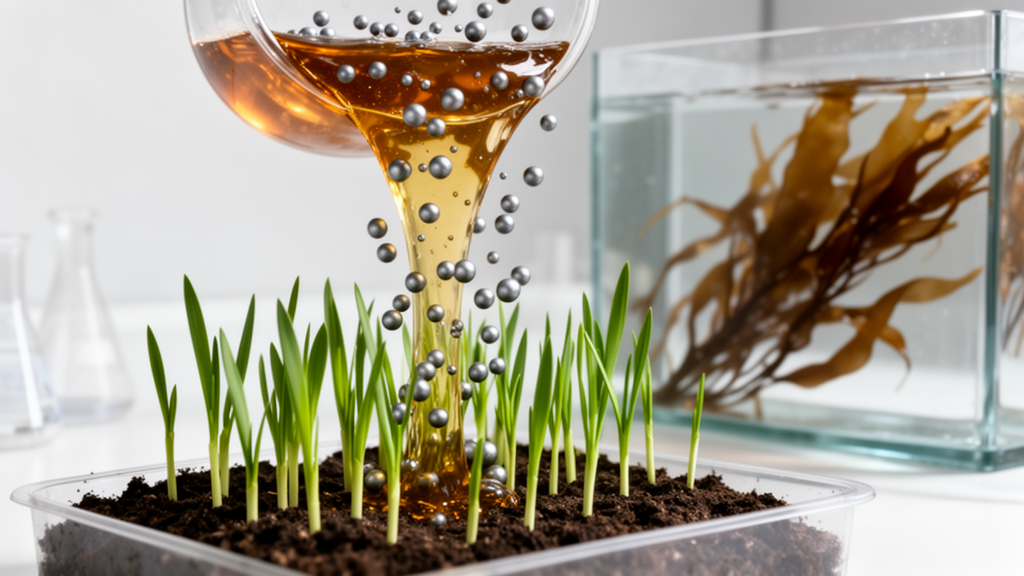
To test efficacy, the team primed seeds of CO-51, a salt-sensitive rice variety, by soaking them in nanoparticle suspensions at concentrations of 25, 50, 75, and 100 parts per million, then germinating them under 100 millimolar sodium chloride stress. Salt alone was devastating: germination fell by 33 percent, seedling length by 46 percent, and seedling vigour index by 64 percent relative to unstressed controls. Simple hydropriming offered partial relief, but the zinc oxide nanoparticles transformed the picture. Green-synthesized particles at 50 parts per million achieved complete germination, boosted seedling length by 96 percent, and increased dry matter production by 80 percent compared with salt-stressed untreated seeds.
Remarkably, the seaweed-derived nanoparticles at 50 to 75 parts per million produced physiological and biochemical responses comparable to those achieved with commercial particles at 100 parts per million. Both treatments enhanced water uptake and hydrolytic enzyme activity, accelerating the mobilization of stored starch that fuels embryo growth. They also strengthened the seedlings’ antioxidant arsenal: activities of superoxide dismutase, peroxidase, and catalase rose sharply, while levels of malondialdehyde, a marker of membrane lipid peroxidation, dropped to their lowest values. Total chlorophyll content, which collapsed to 0.86 milligrams per gram under salt stress alone, climbed to 2.79 milligrams per gram with the best green treatments, reflecting zinc’s role in chlorophyll biosynthesis and photosystem protection.
Multivariate statistics reinforced the story. Hierarchical clustering separated the salt-stressed control into its own cluster of uniformly negative responses, while the nanoparticle-primed treatments grouped with positive improvements across germination, growth, and physiological traits. Principal component analysis explained 94.2 percent of total variance in the first two components, with the 75 parts per million green-synthesized treatment showing the strongest association with growth, antioxidant, and stress-tolerance vectors. Inductively coupled plasma mass spectrometry confirmed that nanopriming also boosted zinc accumulation in seedlings, pointing to a dual benefit of stress protection and nutritional biofortification in saline environments.
The implications extend beyond the laboratory. Because biogenic particles achieve commercial-grade results at lower concentrations, they could reduce the quantity of nanomaterial released into agricultural systems while cutting costs, an alignment with green chemistry principles that the authors emphasize. The study does have limits: it was conducted under controlled conditions on seedlings, without direct measurements of reactive oxygen species dynamics, molecular-level analyses, or field-scale trials. Still, the central finding stands as a provocative one for nanotechnology and agriculture alike. The organism that builds a nanoparticle shapes its surface chemistry, stability, and ultimately its power to protect a crop, and in this case, a brown seaweed collected from the Indian coast proved to be the finest nanoscale architect of all.
Subject of Research: Biogenic synthesis of zinc oxide nanoparticles for improving rice germination and seedling establishment under salinity stress
Article Title: Biogenic fabrication of zinc oxide nanoparticles for enhanced germination and early seedling establishment of rice under salinity stress
Article References: Flora, J., & Firdous, S. (2026). Biogenic fabrication of zinc oxide nanoparticles for enhanced germination and early seedling establishment of rice under salinity stress. Frontiers in Nanotechnology, 8, Article 1944557. https://doi.org/10.3389/fnano.2026.1944557
Image Credits: AI Generated
DOI: 10.3389/fnano.2026.1944557
Keywords: zinc oxide nanoparticles, green synthesis, seaweed, rice, salinity stress, seed priming, germination, antioxidant enzymes, nanotechnology, agriculture, food security, plant stress
News Source: Alan Morgan. (October 15, 2026). Seaweed-Grown Zinc Nanoparticles Shield Rice Seedlings From Salt Stress. Scienmag.