


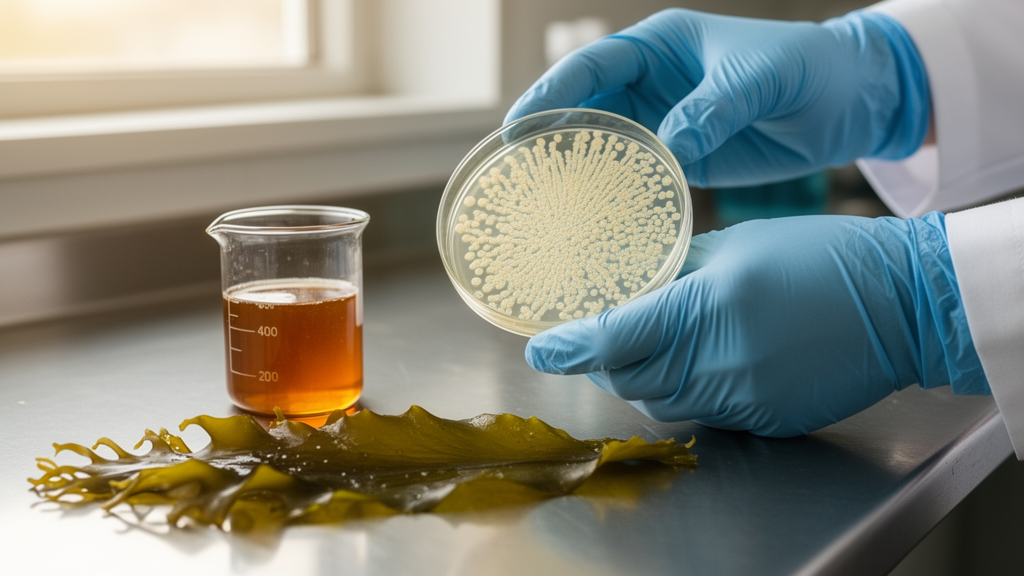
Biofilm formation by the aquatic pathogen Aeromonas hydrophila complicates infection control and is linked with reduced antibiotic susceptibility, and a new study in Molecular Biology Reports examines whether marine seaweed metabolites can interfere with the quorum sensing pathways that help drive that resilience. The research compared three seaweed extracts, from Ecklonia cava, Codium fragile and Grateloupia elliptica, for antibacterial, antibiofilm and quorum sensing inhibitory activities, framing quorum sensing interference as a potential anti-virulence strategy rather than a conventional bactericidal approach.
The study combined computational docking with laboratory assays. Representative compounds reported from the three seaweeds were docked against AhyR, the quorum sensing receptor of A. hydrophila, and the docking predicted possible interactions with the receptor. Biological assays then assessed how environmental conditions affect biofilm formation and antibiotic susceptibility, and how the extracts influence biofilms and swarming motility in A. hydrophila. Quorum sensing inhibition was additionally tested through violacein inhibition in Chromobacterium violaceum, a standard reporter system for this type of activity.
The environmental experiments produced several notable findings. Sub-inhibitory exposure to the antibiotic florfenicol enhanced biofilm formation by A. hydrophila, an effect that was particularly pronounced at 35 degrees Celsius. In salinity assays, biofilm biomass peaked at 1 percent NaCl. These results indicate that common environmental variables can shift how readily this pathogen builds surface-associated communities.
Antibiotic tolerance differences between growth modes were substantial. Florfenicol minimum inhibitory concentrations were 128-fold higher in biofilm-derived cells than in planktonic cells, while amoxicillin MICs were eightfold higher. The comparison quantifies how much protection the biofilm lifestyle confers against two clinically relevant antibiotics, underscoring why anti-biofilm and anti-virulence approaches are being explored alongside conventional treatment.
Among the three extracts, Ecklonia cava showed the strongest antibacterial and antibiofilm activities and the strongest inhibition of swarming motility. Grateloupia elliptica produced the largest violacein inhibition zone at half the minimum inhibitory concentration, measuring 14.13 plus or minus 1.30 millimeters, indicating the strongest quorum sensing inhibitory signal of the set. The distinct activity profiles suggest that different seaweed species may contribute different anti-virulence mechanisms against the same pathogen.
Gene expression analysis added a molecular dimension to the comparison. The researchers examined expression by quantitative real-time PCR after seven days of repeated exposure to the extracts at half the MIC. Under those conditions, G. elliptica reduced the expression of luxS, hcp, recA, rpoS, ompA and acrB, genes associated with quorum sensing, secretion, stress response and efflux. Biofilm biomass in the antibiofilm assays was quantified by crystal violet staining, a standard method for measuring attached biomass.
The authors conclude that the extracts showed distinct activity profiles, with E. cava exhibiting the strongest antibiofilm effects and G. elliptica the strongest quorum sensing inhibition. On that basis, they identify G. elliptica as warranting further investigation as an anti-virulence candidate. The conclusions are framed carefully: the docking results predict possible AhyR interactions but do not establish them, and the study’s own summary notes that the active constituents of G. elliptica and its direct effects on AhyR require validation.
The work fits into a broader research direction in which seaweed-derived metabolites are screened not for killing bacteria outright but for dampening the behaviors, such as biofilm formation and quorum sensing-dependent signaling, that make infections difficult to clear. Because anti-virulence strategies aim to disarm pathogens rather than eradicate them, they are of interest as potential complements to antibiotics, particularly for organisms like A. hydrophila whose biofilm mode of life is associated with markedly reduced antibiotic susceptibility.
For now, the findings are at the stage of in vitro characterization and computational prediction. The measured effects, from the florfenicol-associated increase in biofilm formation to the extract-specific differences in antibiofilm and quorum sensing inhibitory activity, come from laboratory assays on A. hydrophila and the C. violaceum reporter system, and the gene expression changes were observed after repeated sub-inhibitory extract exposure. The study establishes a comparative baseline for three marine extracts and defines the next experimental steps: identifying the active constituents of G. elliptica and validating whether its predicted AhyR interactions account for the observed quorum sensing inhibition.
Subject of Research: Marine seaweed extracts as quorum sensing inhibitors and anti-virulence candidates against biofilm formation and antibiotic tolerance in Aeromonas hydrophila
Article Title: Marine-derived quorum sensing inhibition as an anti-virulence strategy against biofilm formation and antibiotic tolerance in Aeromonas hydrophila
Article References: Lee, H.-J., & Lee, E.-B. (2026). Marine-derived quorum sensing inhibition as an anti-virulence strategy against biofilm formation and antibiotic tolerance in Aeromonas hydrophila. Molecular Biology Reports, 53(1), Article 1840. https://doi.org/10.1007/s11033-026-13072-3
Image Credits: AI Generated
DOI: 10.1007/s11033-026-13072-3
Keywords: Aeromonas hydrophila, quorum sensing inhibition, biofilm formation, antibiotic tolerance, seaweed extracts, Ecklonia cava, Grateloupia elliptica, Codium fragile, anti-virulence strategy, violacein inhibition, florfenicol, AhyR docking
News Source: Drew Townsend. (October 30, 2026). Seaweed extracts show anti-biofilm and quorum sensing blocking activity against Aeromonas hydrophila. Scienmag.



