• HOME
  • NEWS
  • EXPLORE
    • CAREER
      • Companies
      • Jobs
    • EVENTS
    • iGEM
      • News
      • Team
    • PHOTOS
    • VIDEO
    • WIKI
  • BLOG
  • COMMUNITY
    • FACEBOOK
    • INSTAGRAM
    • TWITTER
Friday, May 15, 2026
BIOENGINEER.ORG
No Result
View All Result
  • Login
  • HOME
  • NEWS
  • EXPLORE
    • CAREER
      • Companies
      • Jobs
        • Lecturer
        • PhD Studentship
        • Postdoc
        • Research Assistant
    • EVENTS
    • iGEM
      • News
      • Team
    • PHOTOS
    • VIDEO
    • WIKI
  • BLOG
  • COMMUNITY
    • FACEBOOK
    • INSTAGRAM
    • TWITTER
  • HOME
  • NEWS
  • EXPLORE
    • CAREER
      • Companies
      • Jobs
        • Lecturer
        • PhD Studentship
        • Postdoc
        • Research Assistant
    • EVENTS
    • iGEM
      • News
      • Team
    • PHOTOS
    • VIDEO
    • WIKI
  • BLOG
  • COMMUNITY
    • FACEBOOK
    • INSTAGRAM
    • TWITTER
No Result
View All Result
Bioengineer.org
No Result
View All Result
Home NEWS Science News Chemistry

Scratching the surface of perovskites

Bioengineer by Bioengineer
November 25, 2019
in Chemistry
Reading Time: 2 mins read
0
IMAGE
Share on FacebookShare on TwitterShare on LinkedinShare on RedditShare on Telegram

Scientists characterize microscopic defects in next generation solar devices
IMAGE

Credit: OIST


Versatile compounds called perovskites are valued for their application in next generation solar energy technologies. Despite their efficiency and relative cheapness, perovskite devices have yet to be perfected; they often contain atomic-level structural defects.

Professor Yabing Qi and his team in the Energy Materials and Surface Sciences Unit at OIST, in collaboration with researchers at the University of Pittsburgh, USA, have, for the first time, characterized the structural defects that prompt the movement of ions, destabilizing the perovskite materials. The researchers’ findings, published in ACS Nano, may inform future engineering approaches to optimize perovskite solar cells.

“For a long time, scientists have known structural defects exist, but didn’t understand their precise chemical nature,” said Collin Stecker, an OIST PhD student and the first author of the study. “Our study delves into fundamental characteristics of perovskite materials to help device engineers further improve them.”

Surface-level issues

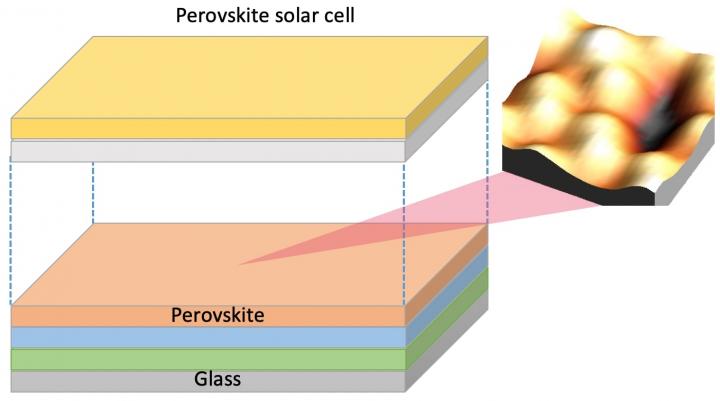
Perovskite compounds share a unique structure that makes them useful in electronics, engineering, and photovoltaics. They are exceptional at absorbing light, as well as generating and transporting charge carriers responsible for current in semiconductor materials. Sandwiching perovskite materials between other functional layers forms perovskite solar cells. However, defects in the perovskite layer can disrupt charge transfer between the perovskite and adjacent layers of the cell, hindering the device’s overall performance and stability.

To understand the electronic and dynamic properties of these perovskite defects, the OIST researchers used a method called scanning tunneling microscopy to take high-resolution images of the movements of individual ions on the perovskite surfaces.

Upon analyzing these images, Stecker and his colleagues noticed groups of vacant spaces across the surfaces where atoms were missing. In addition, they saw that pairs of Br- (bromide) ions on the perovskite surfaces were shifting and changing direction. The researchers’ collaborators at the University of Pittsburgh performed a series of theoretical calculations to model the pathways these ions took, supporting these experimental observations.

The OIST scientists concluded that the surface vacancies were likely causing these ions to move across the perovskite materials. Understanding this mechanism of ion movement may later help scientists and engineers mitigate the structural and functional consequences of these defects.

The researchers acknowledged that, although perovskites are promising alternatives to the widely used silicon, the technology needs to be refined before it’s commercialized.

“These perovskite surfaces are much more dynamic than we previously anticipated,” said Stecker. “Now, with these new findings, we hope engineers can better account for the effect of defects and their motion in order to improve devices.”

###

Media Contact
Tomomi Okubo
[email protected]

Original Source

https://www.oist.jp/news-center/news/2019/11/21/scratching-surface-perovskites

Related Journal Article

http://dx.doi.org/10.1021/acsnano.9b06585

Tags: Chemistry/Physics/Materials SciencesEnergy/Fuel (non-petroleum)Materials
Share12Tweet8Share2ShareShareShare2

Related Posts

Personalized beverages offer vital nutrients for space missions, new study reveals — Chemistry

Personalized beverages offer vital nutrients for space missions, new study reveals

May 15, 2026
Synthetic Cell Microreactor with Dual Dynamic DNA Pores — Chemistry

Synthetic Cell Microreactor with Dual Dynamic DNA Pores

May 15, 2026

Hanyang University Researchers Pinpoint 2.5 Nanometers as Minimum Coating Thickness for Durable Solid-State EV Batteries

May 15, 2026

Smart Hydrogels Revolutionize Information Security with Photo-Patterning and Multi-Stimuli Responsive Structural Colors

May 15, 2026
Please login to join discussion

POPULAR NEWS

  • Research Indicates Potential Connection Between Prenatal Medication Exposure and Elevated Autism Risk

    843 shares
    Share 337 Tweet 211
  • New Study Reveals Plants Can Detect the Sound of Rain

    729 shares
    Share 291 Tweet 182
  • Salmonella Haem Blocks Macrophages, Boosts Infection

    62 shares
    Share 25 Tweet 16
  • Breastmilk Balances E. coli and Beneficial Bacteria in Infant Gut Microbiomes

    58 shares
    Share 23 Tweet 15

About

We bring you the latest biotechnology news from best research centers and universities around the world. Check our website.

Follow us

Recent News

Personalized beverages offer vital nutrients for space missions, new study reveals

Innovative Ultrasonic Framework Enhances Real-Time Measurement of Oil Film Thickness in Rolling Bearings

HESpotEx: Deep Learning Predicts Gene Expression from Histology

Subscribe to Blog via Email

Enter your email address to subscribe to this blog and receive notifications of new posts by email.

Join 82 other subscribers
  • Contact Us

Bioengineer.org © Copyright 2023 All Rights Reserved.

Welcome Back!

Login to your account below

Forgotten Password?

Retrieve your password

Please enter your username or email address to reset your password.

Log In
No Result
View All Result
  • Homepages
    • Home Page 1
    • Home Page 2
  • News
  • National
  • Business
  • Health
  • Lifestyle
  • Science

Bioengineer.org © Copyright 2023 All Rights Reserved.