• HOME
  • NEWS
  • EXPLORE
    • CAREER
      • Companies
      • Jobs
    • EVENTS
    • iGEM
      • News
      • Team
    • PHOTOS
    • VIDEO
    • WIKI
  • BLOG
  • COMMUNITY
    • FACEBOOK
    • INSTAGRAM
    • TWITTER
Saturday, May 16, 2026
BIOENGINEER.ORG
No Result
View All Result
  • Login
  • HOME
  • NEWS
  • EXPLORE
    • CAREER
      • Companies
      • Jobs
        • Lecturer
        • PhD Studentship
        • Postdoc
        • Research Assistant
    • EVENTS
    • iGEM
      • News
      • Team
    • PHOTOS
    • VIDEO
    • WIKI
  • BLOG
  • COMMUNITY
    • FACEBOOK
    • INSTAGRAM
    • TWITTER
  • HOME
  • NEWS
  • EXPLORE
    • CAREER
      • Companies
      • Jobs
        • Lecturer
        • PhD Studentship
        • Postdoc
        • Research Assistant
    • EVENTS
    • iGEM
      • News
      • Team
    • PHOTOS
    • VIDEO
    • WIKI
  • BLOG
  • COMMUNITY
    • FACEBOOK
    • INSTAGRAM
    • TWITTER
No Result
View All Result
Bioengineer.org
No Result
View All Result
Home NEWS Science News Chemistry

Scorpions make a fluorescent compound that could help protect them from parasites

Bioengineer by Bioengineer
March 4, 2020
in Chemistry
Reading Time: 2 mins read
0
IMAGE
Share on FacebookShare on TwitterShare on LinkedinShare on RedditShare on Telegram

IMAGE

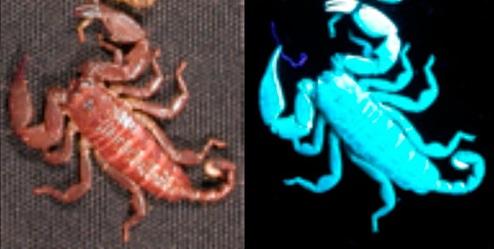
Credit: Adapted from Journal of Natural Products 2020, DOI: 10.1021/acs.jnatprod.9b00972


Most scorpions glow a blue-green color when illuminated by ultraviolet light or natural moonlight. Scientists aren’t sure how this fluorescence benefits the creatures, but some have speculated that it acts as a sunscreen, or helps them find mates in the dark. Now, researchers reporting in ACS’ Journal of Natural Products have identified a new fluorescent compound from scorpion exoskeletons. The team says that the compound could protect these arachnids from parasites.

More than 60 years ago, scientists first recognized scorpions’ propensity to glow under UV light. Until now, only two fluorescent compounds, β-carboline and 7-hydroxy-4-methylcoumarin, had been identified in scorpions’ hard outer shell, or exoskeleton. Masahiro Miyashita and colleagues wondered if there might be other fluorescent molecules with different chemical properties that were missed in previous studies.

To find out, the researchers extracted compounds from molted exoskeletons of the scorpion Liocheles australasiae, using chemical conditions different from those used in prior experiments. They purified the compound showing the most intense fluorescence and identified its structure, which was a phthalate ester previously shown to have antifungal and anti-parasitic properties in other organisms. This finding suggests that the new molecule, which the researchers found in several additional scorpion species, could help guard against parasitic infections in these creatures. Compared with the two previously identified fluorescent compounds, the new molecule likely contributes more weakly to scorpion fluorescence, the scientists say.

###

The authors acknowledge funding from the Sasakawa Scientific Research Grant from The Japan Science Society.

The abstract that accompanies this study is available here.

For more research news, journalists and public information officers are encouraged to apply for complimentary press registration for the ACS Spring 2020 National Meeting & Exposition in Philadelphia.

The American Chemical Society (ACS) is a nonprofit organization chartered by the U.S. Congress. ACS’ mission is to advance the broader chemistry enterprise and its practitioners for the benefit of Earth and its people. The Society is a global leader in providing access to chemistry-related information and research through its multiple research solutions, peer-reviewed journals, scientific conferences, eBooks and weekly news periodical Chemical & Engineering News. ACS journals are among the most cited, most trusted and most read within the scientific literature; however, ACS itself does not conduct chemical research. As a specialist in scientific information solutions (including SciFinder® and STN®), its CAS division powers global research, discovery and innovation. ACS’ main offices are in Washington, D.C., and Columbus, Ohio.

To automatically receive news releases from the American Chemical Society, contact [email protected].

Follow us on Twitter | Facebook

Media Contact
Katie Cottingham
[email protected]
301-775-8455

Related Journal Article

http://dx.doi.org/10.1021/acs.jnatprod.9b00972

Tags: Chemistry/Physics/Materials SciencesParasitologyZoology/Veterinary Science
Share16Tweet10Share3ShareShareShare2

Related Posts

New Drexel Study Reveals Key to Keeping Students on Track in Physics Learning — Chemistry

New Drexel Study Reveals Key to Keeping Students on Track in Physics Learning

May 15, 2026
Reversible Glue Technology Powers Up with Electric Activation — Chemistry

Reversible Glue Technology Powers Up with Electric Activation

May 15, 2026

Sweet as Honey: Unveiling a New Heat Transport Regime in Ultrathin Semiconductors

May 15, 2026

High-Precision Boltzmann Luminescent Nanothermometry Achieved Through Predictive Rules

May 15, 2026
Please login to join discussion

POPULAR NEWS

  • Research Indicates Potential Connection Between Prenatal Medication Exposure and Elevated Autism Risk

    843 shares
    Share 337 Tweet 211
  • New Study Reveals Plants Can Detect the Sound of Rain

    730 shares
    Share 291 Tweet 182
  • Salmonella Haem Blocks Macrophages, Boosts Infection

    62 shares
    Share 25 Tweet 16
  • Breastmilk Balances E. coli and Beneficial Bacteria in Infant Gut Microbiomes

    58 shares
    Share 23 Tweet 15

About

We bring you the latest biotechnology news from best research centers and universities around the world. Check our website.

Follow us

Recent News

New Kitasatospora Species and Synonym Proposed

Mental Health in Older Adults: Impact of Loneliness

Vertical Migration and Oceanography Shape Antarctic Krill Plastic Exposure

Subscribe to Blog via Email

Enter your email address to subscribe to this blog and receive notifications of new posts by email.

Join 82 other subscribers
  • Contact Us

Bioengineer.org © Copyright 2023 All Rights Reserved.

Welcome Back!

Login to your account below

Forgotten Password?

Retrieve your password

Please enter your username or email address to reset your password.

Log In
No Result
View All Result
  • Homepages
    • Home Page 1
    • Home Page 2
  • News
  • National
  • Business
  • Health
  • Lifestyle
  • Science

Bioengineer.org © Copyright 2023 All Rights Reserved.