

• HOME
  • NEWS
  • EXPLORE
    • CAREER
      • Companies
      • Jobs
    • EVENTS
    • iGEM
      • News
      • Team
    • PHOTOS
    • VIDEO
    • WIKI
  • BLOG
  • COMMUNITY
    • FACEBOOK
    • INSTAGRAM
    • TWITTER
Wednesday, August 5, 2026
BIOENGINEER.ORG
No Result
View All Result
  • Login
  • HOME
  • NEWS
  • EXPLORE
    • CAREER
      • Companies
      • Jobs
        • Lecturer
        • PhD Studentship
        • Postdoc
        • Research Assistant
    • EVENTS
    • iGEM
      • News
      • Team
    • PHOTOS
    • VIDEO
    • WIKI
  • BLOG
  • COMMUNITY
    • FACEBOOK
    • INSTAGRAM
    • TWITTER
  • HOME
  • NEWS
  • EXPLORE
    • CAREER
      • Companies
      • Jobs
        • Lecturer
        • PhD Studentship
        • Postdoc
        • Research Assistant
    • EVENTS
    • iGEM
      • News
      • Team
    • PHOTOS
    • VIDEO
    • WIKI
  • BLOG
  • COMMUNITY
    • FACEBOOK
    • INSTAGRAM
    • TWITTER
No Result
View All Result
Bioengineer.org
No Result
View All Result
Home NEWS Science News Health

Scientists visualize the connections between eye and brain

Bioengineer by Bioengineer
July 2, 2018
in Health
Reading Time: 2 mins read
0
Share on FacebookShare on TwitterShare on LinkedinShare on RedditShare on Telegram

Most of the human brain's estimated 86 billion nerve cells, or neurons, can ultimately engage in a two-way dialogue with any other neuron. To shed more light on how neurons in this labyrinthine network integrate information – that is, precisely how multiple neurons send and combine their messages to a target neuron – a team of researchers at BIDMC and Boston Children's Hospital (BCH) focused on a rare case in which information only travels in one direction: from the retina to the brain.

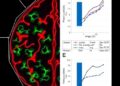
In this study published May 31 in the journal Cell, Mark Andermann, PhD, Chinfei Chen, MD, PhD, and colleagues developed a means of tracking the activity of the far-reaching ends of retinal neurons (called boutons) as they deliver visual information to the thalamus, a brain region involved in image processing.

As they relay discrete bits of visual information to the brain, different types of retinal neurons respond to distinct features of visual content such as an object's direction of motion, brightness, or size. Conventional wisdom held that these lines of information remained separated in the thalamus. Instead, Andermann and Chen's team found that boutons from different types of retinal neurons were often organized in local clusters and that boutons in a cluster typically make contact with a common target neuron, leading to a mixing of different lines of information. However, this mixing was not random – boutons in a cluster tended to share a common sensitivity to one or more visual features.

"The selective mixing of information from this arrangement of nearby boutons may be the retina's version of Pointillism, the neo-expressionist art technique in which nearby dots of different colors are fused together to create new and diverse colors," said Andermann, a member of the Division of Endocrinology, Diabetes and Metabolism at BIDMC and an Associate Professor of Medicine at Harvard Medical School. "In this way, this first interface between eye and brain is surprisingly sophisticated." (May 2018)

###

Other co-investigators included Rohan N. Ramesh, and Arthur U. Sugden, also of BIDMC's Division of Endocrinology, Diabetes and Metabolism. L. Liang was co-mentored by C. Chen at BCH. RNR, MA and CC also hold appointments in the Program in Neuroscience at Harvard Medical School.

Support was provided by a Simons Collaboration on the Global Brain Postdoctoral Fellowship (LL), a Bertarelli Foundation Fellowship (AF), NIH F31 105678 (RNR), T32 DK007516 (AUS), R01EY013613 and U54 HD090255 (CC), the Harvard/MIT Joint Research Grants Program in Basic Neuroscience (CC and MA), an NIH Director's New Innovator Award DP2DK105570, R01 DK109930, and grants from the Smith Family Foundation, the Pew Scholars Program in the Biomedical Sciences (MA), the IDDRC Cellular Imaging Core, and the BCH Viral Core (supported by NIH P30 EY012196).

Media Contact

Lindsey Diaz-MacInnis
[email protected]
617-667-7372
@BIDMCNews

http://www.bidmc.harvard.edu

https://www.bidmc.org/about-bidmc/news/2018/05/scientists-visualize-the-connections-between-eye-and-brain

Share12Tweet8Share2ShareShareShare2

Related Posts

Dementia Risk and Patterns After Age 90

August 5, 2026
Parkinson’s-linked LRRK2 mutation disrupts astrocyte development and induces senescence-like changes

Parkinson’s-linked LRRK2 mutation disrupts astrocyte development and induces senescence-like changes

August 5, 2026

Study links fitness, barriers, and health beliefs to activity among older adults

August 5, 2026

Occupational pesticide exposure linked to 60–70% higher motor neuron disease risk

August 5, 2026
Please login to join discussion

POPULAR NEWS

  • Ten Frontiers Shaping the Global Future of Intelligent Remote Sensing

    29 shares
    Share 12 Tweet 7
  • Sylvester Cancer Center Ranks First in Florida, 23rd Nationally for Cancer Care

    29 shares
    Share 12 Tweet 7
  • World’s Largest Detector Joins Search for Elusive Dark Matter

    29 shares
    Share 12 Tweet 7
  • Dementia Risk and Patterns After Age 90

    29 shares
    Share 12 Tweet 7

About

We bring you the latest biotechnology news from best research centers and universities around the world. Check our website.

Follow us

Recent News

Ten Frontiers Shaping the Global Future of Intelligent Remote Sensing

Sylvester Cancer Center Ranks First in Florida, 23rd Nationally for Cancer Care

World’s Largest Detector Joins Search for Elusive Dark Matter

Subscribe to Blog via Email

Enter your email address to subscribe to this blog and receive notifications of new posts by email.

Join 86 other subscribers
  • Contact Us

Bioengineer.org © Copyright 2023 All Rights Reserved.

Welcome Back!

Login to your account below

Forgotten Password?

Retrieve your password

Please enter your username or email address to reset your password.

Log In
No Result
View All Result
  • Homepages
    • Home Page 1
    • Home Page 2
  • News
  • National
  • Business
  • Health
  • Lifestyle
  • Science

Bioengineer.org © Copyright 2023 All Rights Reserved.