• HOME
  • NEWS
  • EXPLORE
    • CAREER
      • Companies
      • Jobs
    • EVENTS
    • iGEM
      • News
      • Team
    • PHOTOS
    • VIDEO
    • WIKI
  • BLOG
  • COMMUNITY
    • FACEBOOK
    • INSTAGRAM
    • TWITTER
Wednesday, May 13, 2026
BIOENGINEER.ORG
No Result
View All Result
  • Login
  • HOME
  • NEWS
  • EXPLORE
    • CAREER
      • Companies
      • Jobs
        • Lecturer
        • PhD Studentship
        • Postdoc
        • Research Assistant
    • EVENTS
    • iGEM
      • News
      • Team
    • PHOTOS
    • VIDEO
    • WIKI
  • BLOG
  • COMMUNITY
    • FACEBOOK
    • INSTAGRAM
    • TWITTER
  • HOME
  • NEWS
  • EXPLORE
    • CAREER
      • Companies
      • Jobs
        • Lecturer
        • PhD Studentship
        • Postdoc
        • Research Assistant
    • EVENTS
    • iGEM
      • News
      • Team
    • PHOTOS
    • VIDEO
    • WIKI
  • BLOG
  • COMMUNITY
    • FACEBOOK
    • INSTAGRAM
    • TWITTER
No Result
View All Result
Bioengineer.org
No Result
View All Result
Home NEWS Science News Chemistry

Scientists use photons as threads to weave novel forms of matter

Bioengineer by Bioengineer
August 17, 2020
in Chemistry
Reading Time: 2 mins read
0
IMAGE
Share on FacebookShare on TwitterShare on LinkedinShare on RedditShare on Telegram

IMAGE

Credit: University of Southampton

New research from the University of Southampton has successful discovered a way to bind two negatively charged electron-like particles which could create opportunities to form novel materials for use in new technological developments.

Positive and negative electric charges attract each other, forming atoms, molecules, and all that we usually refer as matter. However, negative charges repel each other, and in order to form atom-like bound objects some extra glue is needed to compensate this electrostatic repulsion and bind the particles together.

In this latest study, published in the journal Nature Physics, an international team, led by Professor Simone De Liberato from the School of Physics and Astronomy at the University of Southampton, demonstrated for the first time that photons, the particles which compose light, can be used to glue together negative charges, creating a novel form of matter they named a Photon Bound Exciton

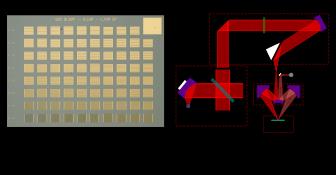
Implementing a theoretical prediction published last year by the same team, Prof De Liberato and co-workers fabricated a nano-device, trapping electrons into nanoscopic wells. They started by showing that photons that struck the device with high enough energy extracted electrons from the wells, an expected manifestation of the photoelectric effect, whose discovery earned Einstein his 1921 Nobel prize.

Prof De Liberato and his team then enclosed the device between two gold mirrors, which trapped the photons and focussed the luminous energy close to the electrons, dramatically increasing the interaction between light and matter. They observed that a negatively-charged electron kicked out by a photon then remains instead trapped in the well, bound to the other negatively-charged electrons in a novel electronic configuration stabilised by the photon.

This result demonstrates the possibility of engineering novel artificial atoms with designer electronic configurations, dramatically expanding the list of materials available for scientific and technological applications.

Explaining the significance of his team’s discovery, Prof De Liberato said: “We demonstrated how to use light as a sort of subatomic ziptie, binding together electrons to create novel atom-like objects. Doing so we broadened the catalogue of materials available to design photonic devices. I look forward to see how the many colleagues working in photonics will exploit this extra leeway to engineer novel amazing devices.”

###

The paper “Excitons bound by photon exchange” has been published in Nature Physics with DOI 10.1038/s41567-020-0994-6

Media Contact
Steve Bates
[email protected]

Related Journal Article

http://dx.doi.org/10.1038/s41567-020-0994-6

Tags: Atomic PhysicsAtomic/Molecular/Particle PhysicsChemistry/Physics/Materials SciencesNanotechnology/Micromachines
Share12Tweet8Share2ShareShareShare2

Related Posts

Harnessing Neural Networks for Advances in Nonlinear Optics — Chemistry

Harnessing Neural Networks for Advances in Nonlinear Optics

May 12, 2026
Innovative Method Unveiled to Detect Signs of Dark Matter — Chemistry

Innovative Method Unveiled to Detect Signs of Dark Matter

May 12, 2026

Illuminating the Science Behind Historical Featherwork Art

May 12, 2026

Humans and Zebra Finches Share Similar Speech Learning Techniques #ASA190

May 11, 2026
Please login to join discussion

POPULAR NEWS

  • Research Indicates Potential Connection Between Prenatal Medication Exposure and Elevated Autism Risk

    842 shares
    Share 337 Tweet 211
  • New Study Reveals Plants Can Detect the Sound of Rain

    728 shares
    Share 290 Tweet 182
  • Salmonella Haem Blocks Macrophages, Boosts Infection

    62 shares
    Share 25 Tweet 16
  • Breastmilk Balances E. coli and Beneficial Bacteria in Infant Gut Microbiomes

    57 shares
    Share 23 Tweet 14

About

We bring you the latest biotechnology news from best research centers and universities around the world. Check our website.

Follow us

Recent News

Study Finds Sustained Weight Loss Possible by Transitioning from Injectable Obesity Drugs to Daily Oral Orforglipron (ATTAIN-MAINTAIN)

Weight Loss Maintained Seven Times More Effectively with Continued Maximum Dose of Tirzepatide, Study Finds

Immune Protein Identified as Potential Target to Slow Parkinson’s Disease Progression

Subscribe to Blog via Email

Enter your email address to subscribe to this blog and receive notifications of new posts by email.

Join 82 other subscribers
  • Contact Us

Bioengineer.org © Copyright 2023 All Rights Reserved.

Welcome Back!

Login to your account below

Forgotten Password?

Retrieve your password

Please enter your username or email address to reset your password.

Log In
No Result
View All Result
  • Homepages
    • Home Page 1
    • Home Page 2
  • News
  • National
  • Business
  • Health
  • Lifestyle
  • Science

Bioengineer.org © Copyright 2023 All Rights Reserved.