Breakthrough could help lead to the development of new low-power semiconductors or quantum devices.
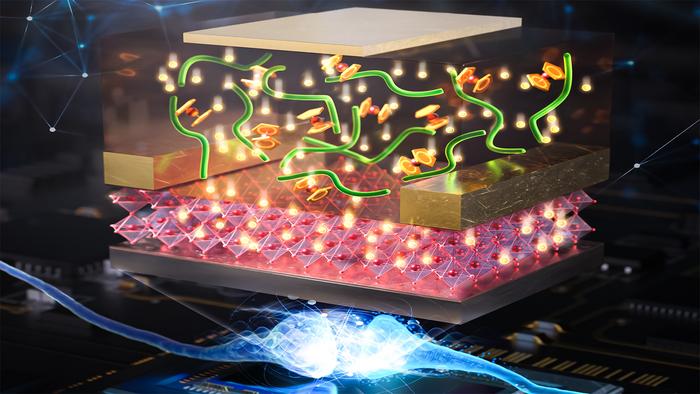
Credit: (Image by Argonne National Laboratory.)
Breakthrough could help lead to the development of new low-power semiconductors or quantum devices.
As the integrated circuits that power our electronic devices get more powerful, they are also getting smaller. This trend of microelectronics has only accelerated in recent years as scientists try to fit increasingly more semiconducting components on a chip.
Microelectronics face a key challenge because of their small size. To avoid overheating, microelectronics need to consume only a fraction of the electricity of conventional electronics while still operating at peak performance.
Researchers at the U.S. Department of Energy’s (DOE) Argonne National Laboratory have achieved a breakthrough that could allow for a new kind of microelectronic material to do just that. In a new study published in Advanced Materials, the Argonne team proposed a new kind of “redox gating” technique that can control the movement of electrons in and out of a semiconducting material.
“The subvolt regime, which is where this material operates, is of enormous interest to researchers looking to make circuits that act similarly to the human brain, which also operates with great energy efficiency.” — Argonne materials scientist Wei Chen
“Redox” refers to a chemical reaction that causes a transfer of electrons. Microelectronic devices typically rely on an electric “field effect” to control the flow of electrons to operate. In the experiment, the scientists designed a device that could regulate the flow of electrons from one end to another by applying a voltage — essentially, a kind of pressure that pushes electricity — across a material that acted as a kind of electron gate. When the voltage reached a certain threshold, roughly half of a volt, the material would begin to inject electrons through the gate from a source redox material into a channel material.
By using the voltage to modify the flow of electrons, the semiconducting device could act like a transistor, switching between more conducting and more insulating states.
“The new redox gating strategy allows us to modulate the electron flow by an enormous amount even at low voltages, offering much greater power efficiency,” said Argonne materials scientist Dillon Fong, an author of the study. “This also prevents damage to the system. We see that these materials can be cycled repeatedly with almost no degradation in performance.”
“Controlling the electronic properties of a material also has significant advantages for scientists seeking emergent properties beyond conventional devices,” said Argonne materials scientist Wei Chen, one of the study’s co-corresponding authors.
“The subvolt regime, which is where this material operates, is of enormous interest to researchers looking to make circuits that act similarly to the human brain, which also operates with great energy efficiency,” he said.
The redox gating phenomenon could also be useful for creating new quantum materials whose phases could be manipulated at low power, said Argonne physicist Hua Zhou, another co-corresponding author of the study. Moreover, the redox gating technique may extend across versatile functional semiconductors and low-dimensional quantum materials composed of sustainable elements.
Work done at Argonne’s Advanced Photon Source, a DOE Office of Science user facility, helped characterize the redox gating behavior.
Additionally, Argonne’s Center for Nanoscale Materials, also a DOE Office of Science user facility, was used for materials synthesis, device fabrication and electrical measurements of the device.
A paper based on the study, “Redox Gating for Colossal Carrier Modulation and Unique Phase Control,” appeared in the Jan. 6, 2024 issue of Advanced Materials. In addition to Fong, Chen and Zhou, contributor authors include Le Zhang, Changjiang Liu, Hui Cao, Andrew Erwin, Dillon Fong, Anand Bhattacharya, Luping Yu, Liliana Stan, Chongwen Zou and Matthew V. Tirrell.
The work was funded by DOE’s Office of Science, Office of Basic Energy Sciences, and Argonne’s laboratory-directed research and development program.
About Argonne’s Center for Nanoscale Materials
The Center for Nanoscale Materials is one of the five DOE Nanoscale Science Research Centers, premier national user facilities for interdisciplinary research at the nanoscale supported by the DOE Office of Science. Together the NSRCs comprise a suite of complementary facilities that provide researchers with state-of-the-art capabilities to fabricate, process, characterize and model nanoscale materials, and constitute the largest infrastructure investment of the National Nanotechnology Initiative. The NSRCs are located at DOE’s Argonne, Brookhaven, Lawrence Berkeley, Oak Ridge, Sandia and Los Alamos National Laboratories. For more information about the DOE NSRCs, please visit https://science.osti.gov/User-Facilities/User-Facilities-at-a-Glance.
Argonne National Laboratory seeks solutions to pressing national problems in science and technology. The nation’s first national laboratory, Argonne conducts leading-edge basic and applied scientific research in virtually every scientific discipline. Argonne researchers work closely with researchers from hundreds of companies, universities, and federal, state and municipal agencies to help them solve their specific problems, advance America’s scientific leadership and prepare the nation for a better future. With employees from more than 60 nations, Argonne is managed by UChicago Argonne, LLC for the U.S. Department of Energy’s Office of Science.
The U.S. Department of Energy’s Office of Science is the single largest supporter of basic research in the physical sciences in the United States and is working to address some of the most pressing challenges of our time. For more information, visit https://energy.gov/science.
Journal
Advanced Materials
DOI
10.1002/adma.202308871
Article Title
Redox Gating for Colossal Carrier Modulation and Unique Phase Control
Article Publication Date
6-Jan-2024