• HOME
  • NEWS
  • EXPLORE
    • CAREER
      • Companies
      • Jobs
    • EVENTS
    • iGEM
      • News
      • Team
    • PHOTOS
    • VIDEO
    • WIKI
  • BLOG
  • COMMUNITY
    • FACEBOOK
    • INSTAGRAM
    • TWITTER
Wednesday, May 20, 2026
BIOENGINEER.ORG
No Result
View All Result
  • Login
  • HOME
  • NEWS
  • EXPLORE
    • CAREER
      • Companies
      • Jobs
        • Lecturer
        • PhD Studentship
        • Postdoc
        • Research Assistant
    • EVENTS
    • iGEM
      • News
      • Team
    • PHOTOS
    • VIDEO
    • WIKI
  • BLOG
  • COMMUNITY
    • FACEBOOK
    • INSTAGRAM
    • TWITTER
  • HOME
  • NEWS
  • EXPLORE
    • CAREER
      • Companies
      • Jobs
        • Lecturer
        • PhD Studentship
        • Postdoc
        • Research Assistant
    • EVENTS
    • iGEM
      • News
      • Team
    • PHOTOS
    • VIDEO
    • WIKI
  • BLOG
  • COMMUNITY
    • FACEBOOK
    • INSTAGRAM
    • TWITTER
No Result
View All Result
Bioengineer.org
No Result
View All Result
Home NEWS Science News Biology

Scientists use algorithm to peer through opaque brains

Bioengineer by Bioengineer
June 26, 2017
in Biology
Reading Time: 2 mins read
0
Share on FacebookShare on TwitterShare on LinkedinShare on RedditShare on Telegram
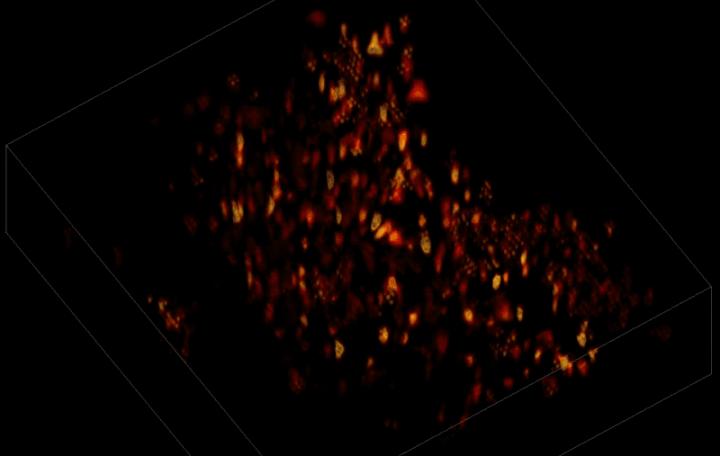
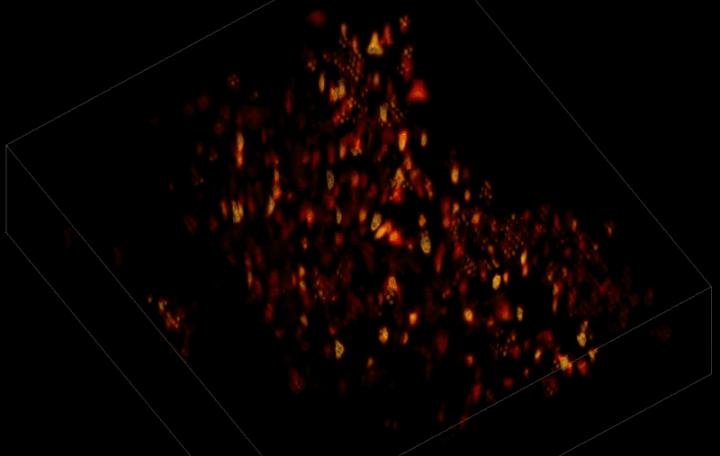
IMAGE

Credit: Laboratory of Neurotechnology and Biophysics at The Rockefeller University

Trying to pinpoint signals from individual neurons within a block of brain tissue is like trying to count headlights in thick fog. A new algorithm, developed by researchers based at The Rockefeller University, brings this brain activity into focus.

In research described June 26 in Nature Methods, the team, led by Rockefeller's Alipasha Vaziri, used a light microscope-based technique to capture neural activity within a volume of mouse brain tissue at unprecedented speed. The algorithm allowed them to pinpoint the signals from hundreds of individual neurons in a single recording.

"Our goal is to better understand brain function by monitoring the dynamics within densely interconnected, three-dimensional networks of neurons," says Vaziri, head of the Laboratory of Neurotechnology and Biophysics.

For this research, Vaziri and his colleagues engineered the animals' neurons to fluoresce; the stronger the signal, the brighter the cells shine. To capture this activity, they used a technique known as light field microscopy, in which an array of lenses generates views from a variety of perspectives. These images are then combined to create a three-dimensional rendering.

When used to look down into a mouse brain, this method has a major challenge: To record the activity of all neurons at the same time, their images have to be captured on a camera simultaneously. But this makes it difficult to distinguish the signals emitted by all cells as the light from the mouse's neurons bounces off the surrounding, opaque tissue. With an earlier version of this and other similar approaches, the neurons therefore typically show up as an indistinct, flickering mass–not much help to scientists who want to see how individual cells behave.

Vaziri and his colleagues devised a solution: a sophisticated algorithm that makes it possible to simultaneously capture both the location of the individual neurons and the timing of their signals.

In this way, Vaziri and his colleagues tracked the precise coordinates of hundreds of active neurons over an extended period in mice that were awake and had the option of walking on a customized treadmill. What's more, they were able to capture signals within a three-dimensional section of brain containing multiple layers of neurons.

By dramatically reducing the time and computational resources required to generate such an image, the algorithm opens the door to more sophisticated experiments. "It may now be possible to alter stimuli in real time based on what we see going on in the animal's brain," Vaziri says.

###

Media Contact

Wynne Parry
[email protected]
212-327-7789
@rockefelleruniv

http://www.rockefeller.edu

Original Source

http:// https://www.rockefeller.edu/news/20045-scientists-use-algorithm-to-peer-through-opaque-brains http://dx.doi.org/10.1038/nmeth.4341

############

Story Source: Materials provided by Scienmag

Share12Tweet8Share2ShareShareShare2

Related Posts

Brookfield Zoo Chicago Achieves Major Milestone in Puerto Rican Crested Toad Conservation with Over 12,000 Tadpoles — Biology

Brookfield Zoo Chicago Achieves Major Milestone in Puerto Rican Crested Toad Conservation with Over 12,000 Tadpoles

May 19, 2026
Decoding p53 Vulnerability: Unraveling Why the Genome Guardian Often Fails — Biology

Decoding p53 Vulnerability: Unraveling Why the Genome Guardian Often Fails

May 19, 2026

New Imaging Technique Simultaneously Maps Brain Activity in Nine Cell Types — Over Four Times the Previous Limit

May 19, 2026

Decoding the Tumor Microenvironment Chemokine Network: From Immune Evasion to Innovative Multi-Target Therapies

May 19, 2026
Please login to join discussion

POPULAR NEWS

  • blank

    New Study Reveals Plants Can Detect the Sound of Rain

    732 shares
    Share 292 Tweet 183
  • Research Indicates Potential Connection Between Prenatal Medication Exposure and Elevated Autism Risk

    846 shares
    Share 338 Tweet 212
  • Breastmilk Balances E. coli and Beneficial Bacteria in Infant Gut Microbiomes

    58 shares
    Share 23 Tweet 15
  • ESMO 2025: mRNA COVID Vaccines Enhance Efficacy of Cancer Immunotherapy

    245 shares
    Share 98 Tweet 61

About

We bring you the latest biotechnology news from best research centers and universities around the world. Check our website.

Follow us

Recent News

Faecal Transplants Show Promise for Parkinson’s Safety, Efficacy

Kynurenic Acid Links Epicardial Fat to Atrial Dysfunction

ELMO1 Boosts Kidney Repair After Toxic Injury

Subscribe to Blog via Email

Enter your email address to subscribe to this blog and receive notifications of new posts by email.

Join 82 other subscribers
  • Contact Us

Bioengineer.org © Copyright 2023 All Rights Reserved.

Welcome Back!

Login to your account below

Forgotten Password?

Retrieve your password

Please enter your username or email address to reset your password.

Log In
No Result
View All Result
  • Homepages
    • Home Page 1
    • Home Page 2
  • News
  • National
  • Business
  • Health
  • Lifestyle
  • Science

Bioengineer.org © Copyright 2023 All Rights Reserved.