• HOME
  • NEWS
  • EXPLORE
    • CAREER
      • Companies
      • Jobs
    • EVENTS
    • iGEM
      • News
      • Team
    • PHOTOS
    • VIDEO
    • WIKI
  • BLOG
  • COMMUNITY
    • FACEBOOK
    • INSTAGRAM
    • TWITTER
Wednesday, May 6, 2026
BIOENGINEER.ORG
No Result
View All Result
  • Login
  • HOME
  • NEWS
  • EXPLORE
    • CAREER
      • Companies
      • Jobs
        • Lecturer
        • PhD Studentship
        • Postdoc
        • Research Assistant
    • EVENTS
    • iGEM
      • News
      • Team
    • PHOTOS
    • VIDEO
    • WIKI
  • BLOG
  • COMMUNITY
    • FACEBOOK
    • INSTAGRAM
    • TWITTER
  • HOME
  • NEWS
  • EXPLORE
    • CAREER
      • Companies
      • Jobs
        • Lecturer
        • PhD Studentship
        • Postdoc
        • Research Assistant
    • EVENTS
    • iGEM
      • News
      • Team
    • PHOTOS
    • VIDEO
    • WIKI
  • BLOG
  • COMMUNITY
    • FACEBOOK
    • INSTAGRAM
    • TWITTER
No Result
View All Result
Bioengineer.org
No Result
View All Result
Home NEWS Science News Chemistry

Scientists unravel the mystery of genes that are key to brain development

Bioengineer by Bioengineer
June 16, 2022
in Chemistry
Reading Time: 2 mins read
0
Nerve cell development
Share on FacebookShare on TwitterShare on LinkedinShare on RedditShare on Telegram

Scientists are starting to understand the precise workings of a type of gene that, unlike other genes, does not code for proteins – the building blocks of life.
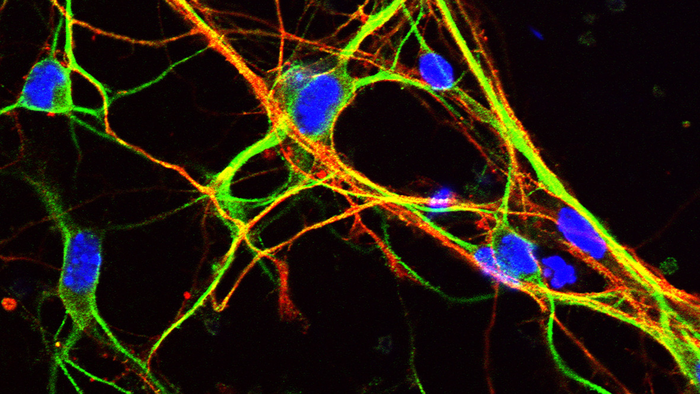
Nerve cell development

Credit: Dr Robert Williams, University of Bath

Scientists are starting to understand the precise workings of a type of gene that, unlike other genes, does not code for proteins – the building blocks of life.

New research led by the University of Bath shows the mechanism by which genes coding for a subset of long non-coding RNA (lncRNA) interact with neighbouring genes to regulate the development and function of essential nerve cells.

Despite their prevalence on genes coding for lncRNA in the genome (estimates range from 18,000-60,000 lncRNA genes in the human genome compared to 20,000 protein-coding genes), these segments of DNA were once written-off as junk precisely because the information contained within them does not result in the production of a protein. However, it is now clear that some lncRNAs are anything but scrap, and these may come to play a key role in restoring physical function in people who have suffered serious nerve damage.

Although the function of most lncRNA genes remains a mystery, a subset are co-expressed in the brain along with neighbouring genes that code for proteins involved in gene expression control. In other words, genes for these lncRNAs and their protein-coding neighbours work as a pair. Together, they regulate the development and function of essential nerve cells, particularly in the brain during embryonic development and in early life.

The new study describes the regulatory pathway involved in controlling the levels of one of these gene pairs. Their location and quantity in the genome need to be carefully coordinated, as does the timing of their activity.

“We previously defined one of the most profound functions for lncRNA in the brain and our new study identifies an important signalling pathway that acts to coordinate the expression of this lncRNA and the key protein coding gene that it is paired with,” explains Dr Keith Vance, lead author of the study from the Department of Biology & Biochemistry at Bath.

“This new research takes us closer to understanding the basic biology of nerve cells and how they are produced. Regenerative medicine is the end-game and with further research we hope to develop a deeper understanding of how lncRNA genes operate in the brain.”

He adds: “This knowledge could be important for scientists looking for ways to replace defective neurons and restore nerve function – for instance in people who have had strokes.”

The research was funded by the Biotechnology and Biological Sciences Research Council (BBSRC) and is published today in PLOS Genetics.


Journal

PLoS Genetics

DOI

10.1371/journal.pgen.1010230

Method of Research

Experimental study

Subject of Research

People

Article Title

Chromatin interaction maps identify Wnt responsive cis-regulatory elements coordinating Paupar-Pax6 expression in neuronal cells

Article Publication Date

16-Jun-2022

Share12Tweet8Share2ShareShareShare2

Related Posts

Sunspot Peaks Speed Up Space Junk Reentry, Aiding Satellite Collision Prevention

May 6, 2026
OpenBind’s Inaugural Data and Model Release Sets a New Benchmark in AI-Driven Drug Discovery — Chemistry

OpenBind’s Inaugural Data and Model Release Sets a New Benchmark in AI-Driven Drug Discovery

May 6, 2026

Step Aside Cassette Tapes, Adhesive Tape Holds Memory Too

May 5, 2026

Astronomers Trace the Origins of a Peculiar Planetary Pair

May 5, 2026

POPULAR NEWS

  • Research Indicates Potential Connection Between Prenatal Medication Exposure and Elevated Autism Risk

    836 shares
    Share 334 Tweet 209
  • New Study Reveals Plants Can Detect the Sound of Rain

    722 shares
    Share 288 Tweet 180
  • Scientists Investigate Possible Connection Between COVID-19 and Increased Lung Cancer Risk

    68 shares
    Share 27 Tweet 17
  • Salmonella Haem Blocks Macrophages, Boosts Infection

    61 shares
    Share 24 Tweet 15

About

We bring you the latest biotechnology news from best research centers and universities around the world. Check our website.

Follow us

Recent News

FBXL6 Drives Bladder Cancer via ENO1 Stabilization

Steering Cathodoluminescence via Generalized Smith–Purcell Effect

Caregiver Training Boosts Quality of Life in Sri Lanka

Subscribe to Blog via Email

Enter your email address to subscribe to this blog and receive notifications of new posts by email.

Join 82 other subscribers
  • Contact Us

Bioengineer.org © Copyright 2023 All Rights Reserved.

Welcome Back!

Login to your account below

Forgotten Password?

Retrieve your password

Please enter your username or email address to reset your password.

Log In
No Result
View All Result
  • Homepages
    • Home Page 1
    • Home Page 2
  • News
  • National
  • Business
  • Health
  • Lifestyle
  • Science

Bioengineer.org © Copyright 2023 All Rights Reserved.