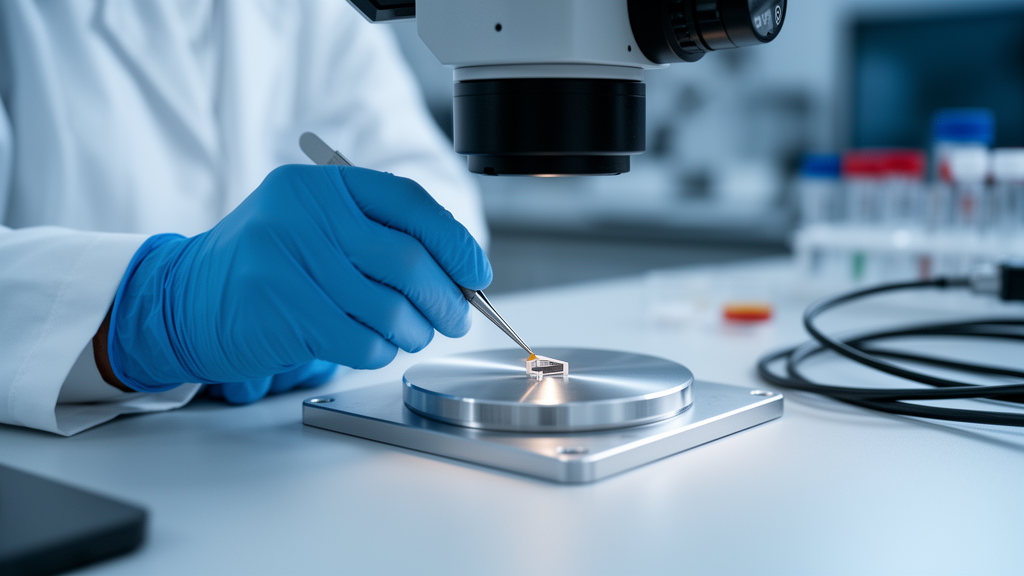
The atomic force microscope has spent decades earning its reputation as one of the most reliable eyes in nanoscience, tracing the hills and valleys of surfaces with atomic-scale precision. But a new study published in the journal iScience suggests the instrument’s most exciting role may not be as a camera at all, but as a scale. Researchers Sangwoo Kwon and Kyung Sook Kim report a systematic workflow that transforms a commercially available AFM cantilever into a quantitative mass sensor capable of detecting nanogram-level changes, a sensitivity range that conventional analytical balances can only dream of approaching. By carefully marrying experimental calibration with computational validation, the team demonstrates that an instrument found in virtually every nanotechnology lab can be repurposed, without exotic hardware, to weigh objects far too small for any ordinary balance.
The underlying physics is elegantly simple. An AFM cantilever is essentially a microscopic diving board, and like any spring, it has a natural frequency at which it prefers to oscillate. When additional mass attaches to the cantilever, the effective mass of the vibrating system increases, and the resonance frequency shifts downward in a predictable way. Even minute quantities of adsorbed material therefore leave an unmistakable fingerprint in the vibration spectrum. This principle has fueled decades of interest in cantilever-based biosensing, where researchers have used vibrating beams to detect molecular binding events, protein aggregation, and nucleic acid hybridization without labels. Yet turning this concept into reliable quantitative measurement has proven stubbornly difficult, because calibration uncertainty, air damping, thermal drift, and laser alignment errors can all bury the tiny frequency shifts that matter.
The new work confronts those pitfalls head-on with a calibration-to-validation pipeline built entirely around standard equipment. Before any mass measurement took place, the researchers calibrated the AFM’s spatial axes using a reference sample patterned with precisely known dimensions of 10 by 10 by 0.085 cubic micrometers, ensuring that displacements were faithfully represented at the nanometer and micrometer scales. They then determined the cantilever’s spring constant directly from force-distance curves acquired against a hard surface, rather than trusting the manufacturer’s nominal value. Fifty independent measurements, each kept below a gentle five nanonewtons of applied force to protect the delicate probe, yielded an average spring constant of 0.20119 plus or minus 0.007379 nanonewtons per nanometer, essentially identical to the supplier’s specification of 0.2 nanonewtons per nanometer.
With the mechanical calibration locked down, the team turned to the resonance measurement itself. Operating in non-contact mode, they measured a fundamental resonance frequency of 13.84 kilohertz for their aluminum-coated cantilever, in close agreement with the nominal 13.00 kilohertz listed by the manufacturer. Along the way they uncovered a surprisingly consequential detail of routine AFM practice: the number of frequency steps used during the sweep. When they swept the frequency range with 1,000, 200, or 100 steps, the resonance curves came out smooth and well-defined, with an unmistakable peak. But dropping to just 50 steps flattened the profile into a plateau, making it impossible to identify where the vibrational amplitude truly peaked. The intermediate setting of 100 steps emerged as the sweet spot, balancing spectral resolution against acquisition time, and the researchers adopted it as the standard for every subsequent measurement.
The crucial test came with deliberate mass loading. The researchers first confirmed that moving the detection laser from the cantilever’s free end toward its midpoint did not significantly alter the measured resonance frequency, ruling out a potential confound. Then they deposited droplets of UV-curable resin at the cantilever tip under an optical microscope, curing each droplet with nine watts of ultraviolet light for sixty seconds. Four samples were prepared with progressively larger droplets, with cross-sectional areas ranging from roughly 108 square micrometers up to more than 2,700 square micrometers. The effect on vibration was dramatic and monotonic: the bare cantilever’s 13.84 kilohertz resonance fell to 12.25 kilohertz with the smallest droplet, then plunged to 8.33, 7.81, and finally 5.20 kilohertz as the mass grew, with even the closely spaced pair of samples two and three remaining clearly distinguishable.
To convert those frequency shifts into absolute masses, the team turned to classical mass-spring theory, treating the cantilever as a harmonic oscillator governed by Hooke’s law. Using the bare-cantilever resonance, they first calculated an effective cantilever mass of approximately 26.5 nanograms. Applying the standard relationship between frequency shift and added mass, they then derived resin droplet masses of 6.87, 34.99, 40.84, and 87.89 nanograms for the four samples. Notably, the researchers chose resin droplets precisely because they could not be weighed independently by geometry alone; their irregular three-dimensional shapes and polymerization-induced deformations make volume estimates unreliable. Instead, the mass was determined indirectly from resonance, which meant the study’s credibility hinged on independent verification, and that is exactly where the computational modeling came in.
Using COMSOL Multiphysics, the researchers built a three-dimensional finite-element model of their cantilever, replicating its measured dimensions of roughly 450 by 50 by 2 cubic micrometers, confirmed optically across eleven cantilevers. The silicon beam was assigned a density of 2,329 kilograms per cubic meter, an elastic modulus consistent with literature values, and a Poisson’s ratio of 0.28, with one end fixed and the other free, all under realistic atmospheric pressure and gravity. The simulation reproduced a fundamental resonance of 13.00 kilohertz, matching the theoretical eigenfrequency of the cantilever. When point masses were added at the free end, the simulated frequency shifts tracked the experimental data remarkably closely, and both datasets fitted a logistic model with adjusted R-squared values of 1.00. Simulations indicated measurable frequency shifts across an added-mass range of roughly one to 800 nanograms.
The agreement between experiment, theory, and simulation is the study’s central achievement, because it demonstrates that the frequency-to-mass conversion is not a curve fitted to itself but a physically grounded relationship validated by an independent computational route. The authors are careful about the assumptions involved, acknowledging that real droplets are spatially distributed masses rather than idealized points at the cantilever tip, and that small placement deviations away from the free end reduce sensitivity as the vibration amplitude falls off. They also note that their detection range was achieved under optimized ambient laboratory conditions, whereas fluidic damping, temperature fluctuation, and surface interactions in biologically relevant environments could substantially degrade resonance stability. Early attempts with polydimethylsiloxane coatings, which spread uncontrollably across the whole cantilever, illustrated exactly why controllable localized loading matters so much.
What elevates the work beyond an instrument-development exercise is its proposed destination: biology. Cell aggregates, tumor spheroids, and microtissues all undergo mass changes that carry information about growth, death, and disease progression, yet weighing them at this resolution has demanded specialized microfluidic resonators and micromanipulation equipment. A workflow built on an ordinary AFM cantilever and free software-based modeling could democratize access to that capability. The same applies to materials science, where tracking thin-film growth, deposition processes, and nanostructure assembly in real time requires exactly the kind of sensitive, localized mass readout the authors demonstrate. The team frames future work around selective coating strategies for controlled deposition and extending the computational framework to viscoelastic and heterogeneous materials.
The researchers are candid that direct application to living systems remains unproven, and their own limitations section is refreshingly thorough, flagging the indirect mass determination, the lumped-mass idealization, and the absence of biological validation as open questions demanding further study with independently calibrated mass standards. Even so, the message for the nanoscience community is striking. A meticulous eye for calibration details that most AFM users skip, such as step counts in frequency sweeps and verified spring constants, combined with a finite-element sanity check, appears sufficient to elevate a routine imaging probe into a trustworthy nanogram-scale balance. If the approach survives contact with cells and spheroids, the humble cantilever may soon be weighing the building blocks of disease, one vibration at a time.
Subject of Research: Quantitative nanoscale mass detection using AFM cantilever resonance frequency shifts validated by finite-element modeling
Article Title: A systematic approach to quantitative nanoscale mass spectrometry using atomic force microscopy
Article References: Kwon, S., & Kim, K. S. (2026). A systematic approach to quantitative nanoscale mass spectrometry using atomic force microscopy. iScience, 29(11), Article 117900. https://doi.org/10.1016/j.isci.2026.117900
Image Credits: AI Generated
DOI: 10.1016/j.isci.2026.117900
Keywords: atomic force microscopy, mass spectrometry, cantilever sensors, resonance frequency, nanogram detection, finite-element simulation, COMSOL Multiphysics, spring constant calibration, biosensing, nanotechnology, cell spheroids, harmonic oscillator
News Source: Denise Maddox. (October 16, 2026). Scientists Turn Everyday AFM Cantilevers into Nanogram-Scale Mass Sensors. Scienmag.