• HOME
  • NEWS
  • EXPLORE
    • CAREER
      • Companies
      • Jobs
    • EVENTS
    • iGEM
      • News
      • Team
    • PHOTOS
    • VIDEO
    • WIKI
  • BLOG
  • COMMUNITY
    • FACEBOOK
    • INSTAGRAM
    • TWITTER
Friday, May 15, 2026
BIOENGINEER.ORG
No Result
View All Result
  • Login
  • HOME
  • NEWS
  • EXPLORE
    • CAREER
      • Companies
      • Jobs
        • Lecturer
        • PhD Studentship
        • Postdoc
        • Research Assistant
    • EVENTS
    • iGEM
      • News
      • Team
    • PHOTOS
    • VIDEO
    • WIKI
  • BLOG
  • COMMUNITY
    • FACEBOOK
    • INSTAGRAM
    • TWITTER
  • HOME
  • NEWS
  • EXPLORE
    • CAREER
      • Companies
      • Jobs
        • Lecturer
        • PhD Studentship
        • Postdoc
        • Research Assistant
    • EVENTS
    • iGEM
      • News
      • Team
    • PHOTOS
    • VIDEO
    • WIKI
  • BLOG
  • COMMUNITY
    • FACEBOOK
    • INSTAGRAM
    • TWITTER
No Result
View All Result
Bioengineer.org
No Result
View All Result
Home NEWS Science News Biology

Scientists turn back evolutionary clock to develop high-CO2-tolerant microalgae

Bioengineer by Bioengineer
March 25, 2019
in Biology
Reading Time: 2 mins read
0
IMAGE
Share on FacebookShare on TwitterShare on LinkedinShare on RedditShare on Telegram

IMAGE

Credit: WEI Li

The rapid elevation of atmospheric carbon dioxide level has led to global warming and ocean acidification. Microalgae, accounting for nearly 40% of global carbon dioxide fixation on Earth, are on the forefront of mankind’s battle against climate change, since many of them are able to directly convert sunlight and industrial carbon dioxide into transportation fuels and energy-rich nutrients.

However, the high concentration of carbon dioxide in flue gases generally inhibits the growth of industrial microalgae. Therefore, reducing the so-called “CO2 poisoning effect,” i.e., improving tolerance to high levels of CO2, has become a priority in the development of super microalgae for carbon fixation.

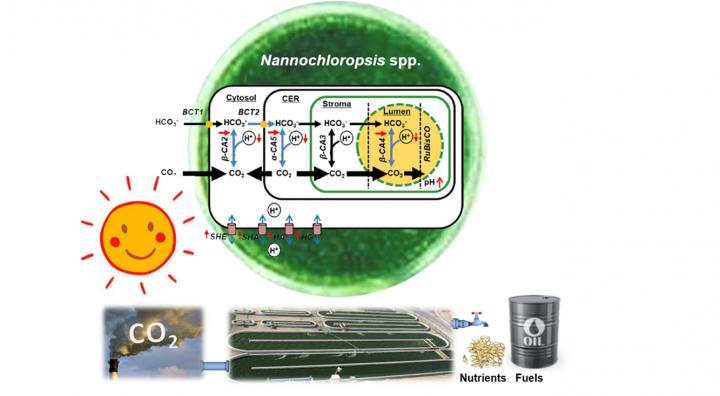
In a new study published in Metabolic Engineering, a team of scientists led by Prof. XU Jian from the Qingdao Institute of Bioenergy and Bioprocess Technology (QIBEBT), Chinese Academy of Sciences (CAS), and Prof. Ansgar Poetsch from Ruhr University, developed a way to improve tolerance to high levels of CO2 in the industrial oil-producing microalgae Nannochloropsis.

The research team started by discovering that CA2, a key enzyme of the carbon-concentrating mechanism (CCM), is a key sensor of the level of extracellular CO2. Then instead of enhancing the function of the sensor, they reduced its activity through RNAi-based gene knockdown. Surprisingly, the mutants were able to grow 30% faster than wild-type cells at a 5% CO2 level in flue gas, over 100 times higher than the 0.04% CO2 level found in air. Moreover, this advantage was persistent under various types of photobioreactors and a wide range of cultivation scales.

In ancient times, Earth’s atmospheric CO2 level was many times higher than today. Over millions of years of evolution, the CCMs of microalgae, whose role was to concentrate CO2 molecules around the prevalent carbon-fixing machinery called RuBisCO, have had to gradually adapt to lower and lower levels of atmospheric CO2.

Therefore, by down-regulating CCM activity, the research team essentially turned back the clock of this evolutionary process and returned modern-day CCM to its ancient high-CO2-accustomed form. This “anti-evolution” endeavor by scientists improves the microalga’s tolerance to high CO2 environments, such as that found in flue gases.

This novel strategy has general implications for the development of industrial oil-producing microalgae as well as food crops, under circumstances where high carbon levels are beneficial or even necessary.

These circumstances can arise not only in the industrial conversion of flue gas to reduce carbon emissions and mitigate global warming, but also as mankind explores space in search of its next home. For example, on Mars, the most promising planet to serve as mankind’s second home due to its short distance from Earth, the level of CO2 is as high as 95%. Thus, changing this hostile atmosphere to a human-friendly one is a must before Mars can be called home.

###

Media Contact
CHENG Jing
[email protected]

Related Journal Article

http://dx.doi.org/10.1016/j.ymben.2019.03.004

Tags: BiologyClimate ChangeEcology/EnvironmentEvolutionPollution/Remediation
Share12Tweet8Share2ShareShareShare2

Related Posts

61 Newly Discovered Beetle Species Highlight How Much We Still Have to Learn About Biodiversity — Biology

61 Newly Discovered Beetle Species Highlight How Much We Still Have to Learn About Biodiversity

May 15, 2026
Supercomputer Simulations Uncover How Bacterial Enzyme Pumps Sodium Ions, Opening Doors to Novel Antibiotics — Biology

Supercomputer Simulations Uncover How Bacterial Enzyme Pumps Sodium Ions, Opening Doors to Novel Antibiotics

May 15, 2026

New Astrobiology Special Collection Highlights Emerging Evidence Supporting Land-Based Origins of Life

May 14, 2026

Revolutionizing Textiles: Engineered Protein Fibers Pave the Way for Sustainable, Recyclable Fabrics

May 14, 2026
Please login to join discussion

POPULAR NEWS

  • Research Indicates Potential Connection Between Prenatal Medication Exposure and Elevated Autism Risk

    843 shares
    Share 337 Tweet 211
  • New Study Reveals Plants Can Detect the Sound of Rain

    729 shares
    Share 291 Tweet 182
  • Salmonella Haem Blocks Macrophages, Boosts Infection

    62 shares
    Share 25 Tweet 16
  • Breastmilk Balances E. coli and Beneficial Bacteria in Infant Gut Microbiomes

    58 shares
    Share 23 Tweet 15

About

We bring you the latest biotechnology news from best research centers and universities around the world. Check our website.

Follow us

Recent News

DNA Off-Targeting Disrupts RNA Chromatin Studies

Malnutrition Lowers Antioxidant Capacity in Older Adults

Revolutionary DNA-Guided CRISPR Paves the Way for Next-Generation RNA Editing

Subscribe to Blog via Email

Enter your email address to subscribe to this blog and receive notifications of new posts by email.

Join 82 other subscribers
  • Contact Us

Bioengineer.org © Copyright 2023 All Rights Reserved.

Welcome Back!

Login to your account below

Forgotten Password?

Retrieve your password

Please enter your username or email address to reset your password.

Log In
No Result
View All Result
  • Homepages
    • Home Page 1
    • Home Page 2
  • News
  • National
  • Business
  • Health
  • Lifestyle
  • Science

Bioengineer.org © Copyright 2023 All Rights Reserved.