• HOME
  • NEWS
  • EXPLORE
    • CAREER
      • Companies
      • Jobs
    • EVENTS
    • iGEM
      • News
      • Team
    • PHOTOS
    • VIDEO
    • WIKI
  • BLOG
  • COMMUNITY
    • FACEBOOK
    • INSTAGRAM
    • TWITTER
Thursday, June 25, 2026
BIOENGINEER.ORG
No Result
View All Result
  • Login
  • HOME
  • NEWS
  • EXPLORE
    • CAREER
      • Companies
      • Jobs
        • Lecturer
        • PhD Studentship
        • Postdoc
        • Research Assistant
    • EVENTS
    • iGEM
      • News
      • Team
    • PHOTOS
    • VIDEO
    • WIKI
  • BLOG
  • COMMUNITY
    • FACEBOOK
    • INSTAGRAM
    • TWITTER
  • HOME
  • NEWS
  • EXPLORE
    • CAREER
      • Companies
      • Jobs
        • Lecturer
        • PhD Studentship
        • Postdoc
        • Research Assistant
    • EVENTS
    • iGEM
      • News
      • Team
    • PHOTOS
    • VIDEO
    • WIKI
  • BLOG
  • COMMUNITY
    • FACEBOOK
    • INSTAGRAM
    • TWITTER
No Result
View All Result
Bioengineer.org
No Result
View All Result
Home NEWS Science News Chemistry

Scientists take the first step towards extending the Standard Model in physics

Bioengineer by Bioengineer
January 22, 2020
in Chemistry
Reading Time: 3 mins read
0
IMAGE
Share on FacebookShare on TwitterShare on LinkedinShare on RedditShare on Telegram

Researchers calculated previously unexplored effects in atoms
IMAGE

Credit: Peter the Great St.Petersburg Polytechnic University


Researchers of Peter the Great St.Petersburg Polytechnic University (SPbPU) in collaboration with colleagues from the Physikalisch Technische Bundesanstalt (PTB) and a number of German scientific organizations, calculated previously unexplored effects in atoms. The results were published in the PHYSICAL REVIEW A, highlighted as an Editor’s Choice article.

For many years, researchers all over the world have been looking for new particles beyond the currently accepted Standard Model of fundamental interactions in physics. Such research is most famously carried out at the Large Hadron Collider. A group of scientists from Russia and Germany is engaged in another approach to this problem based on methods of atomic spectroscopy. Such studies are less resource-intensive, but very promising due to the fact that the accuracy of experiments is higher in atomic physics than in high-energy physics.

SPbPU scientists calculated frequencies of electronic transitions in different isotopes of one element, in this case, argon.

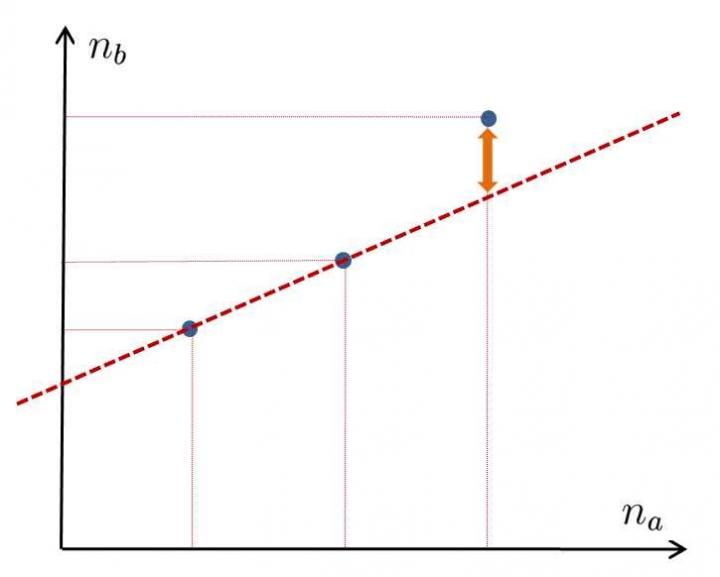
Researchers examined several states of argon ions with four, five, and six electrons. These are optimal electronic configurations.On one hand, they can be reliably calculated, and on the other hand, they are accessible for experiments. Scientists analyzed their results using the King plot, a widely used method for systematic studies of the isotope shifts of two atomic transitions in a chain of isotopes.

Modern theory claims that the King plot should be linear to a very high accuracy. Until recently, possible nonlinear effects were considered much to small to be of any practical interest. Butthe international scientific group calculated thenew effectsand found that the nonlinearities in the King plot are by four orders stronger than was previously expected (at the 10 kHz level). Previously, due to the limitations of the instruments, such effects couldn’t be detected, but a new generation of spectroscopic experiments increases the achievable accuracy by several orders of magnitude, thus making these effects observable. This is an important contribution to science, confirming that generally accepted ideas should to be adjusted.

“If the King plot turns out to be slightly curved, this may be a manifestation of new particles beyond the Standard Model of physics. It is necessary to continue studying these effects in other atoms with a larger number of electrons in order to reduce the influence of calculation errors,”said Vladimir Yerokhin, chief researcher at the Center for Advanced Studies of SPbPU.

In the near future, the theoretical predictions obtained by scientists of St. Petersburg Polytechnic University will be verified experimentally at the Physikalisch Technische Bundesanstalt using the facilities which trap ions in the magnetic and electric fields and investigate them using the quantum logic methods.

“If the experiment is successful, we can obtain restrictions on parameters of the proposed new particle beyond the Standard Model. In addition, such experiments will help to determine whether the fundamental constants change over time, which is of great importance for our understanding of the development of the Universe, “commented Vladimir Yerokhin.

###

Media Contact
Raisa Bestugina
[email protected]
7-812-591-6675

Related Journal Article

http://dx.doi.org/10.1103/PhysRevA.101.012502

Tags: Algorithms/ModelsAtomic PhysicsAtomic/Molecular/Particle PhysicsCalculations/Problem-SolvingChemistry/Physics/Materials SciencesMaterialsParticle Physics
Share13Tweet8Share2ShareShareShare2

Related Posts

International Team Including Dresden Scientists Develops Novel Designer Proteins for Advanced Study of Living Tissue

June 25, 2026

New Study Uncovers Key Factors Driving Water Chemistry in Nanoscale Environments

June 25, 2026

Plasma Technology Extends Catalyst Lifespan in Hydrogen Production

June 24, 2026

Electric Field and Oxygen Spillover Collaborate to Control Electrode Migration in SOECs

June 24, 2026
Please login to join discussion

POPULAR NEWS

  • Saying Goodbye to PGY-6: Pediatric Fellowship Realities

    103 shares
    Share 41 Tweet 26
  • Multi-Hospital Study Reveals Long Covid Burden Is Twice as High as Current Estimates

    92 shares
    Share 36 Tweet 23
  • Detection of EDCs in Breast Milk and Infant Urine Up to Six Months Highlights Early Exposure Risks

    77 shares
    Share 31 Tweet 19
  • New Drug Candidate Developed at McMaster Shows Potential for Treating Brain Cancer

    58 shares
    Share 23 Tweet 15

About

We bring you the latest biotechnology news from best research centers and universities around the world. Check our website.

Follow us

Recent News

Energy-Saving Membrane Technology Developed by KAIST and Georgia Tech Enables Crude Oil Separation Without Boiling

Cracking the Code: How Cancer Evades Antibody-Drug Conjugates and New Strategies to Overcome Resistance

Chiral Laser Gyroscopes Surpass Lock-In Limit

Subscribe to Blog via Email

Enter your email address to subscribe to this blog and receive notifications of new posts by email.

Join 82 other subscribers
  • Contact Us

Bioengineer.org © Copyright 2023 All Rights Reserved.

Welcome Back!

Login to your account below

Forgotten Password?

Retrieve your password

Please enter your username or email address to reset your password.

Log In
No Result
View All Result
  • Homepages
    • Home Page 1
    • Home Page 2
  • News
  • National
  • Business
  • Health
  • Lifestyle
  • Science

Bioengineer.org © Copyright 2023 All Rights Reserved.