• HOME
  • NEWS
  • EXPLORE
    • CAREER
      • Companies
      • Jobs
    • EVENTS
    • iGEM
      • News
      • Team
    • PHOTOS
    • VIDEO
    • WIKI
  • BLOG
  • COMMUNITY
    • FACEBOOK
    • INSTAGRAM
    • TWITTER
Monday, May 25, 2026
BIOENGINEER.ORG
No Result
View All Result
  • Login
  • HOME
  • NEWS
  • EXPLORE
    • CAREER
      • Companies
      • Jobs
        • Lecturer
        • PhD Studentship
        • Postdoc
        • Research Assistant
    • EVENTS
    • iGEM
      • News
      • Team
    • PHOTOS
    • VIDEO
    • WIKI
  • BLOG
  • COMMUNITY
    • FACEBOOK
    • INSTAGRAM
    • TWITTER
  • HOME
  • NEWS
  • EXPLORE
    • CAREER
      • Companies
      • Jobs
        • Lecturer
        • PhD Studentship
        • Postdoc
        • Research Assistant
    • EVENTS
    • iGEM
      • News
      • Team
    • PHOTOS
    • VIDEO
    • WIKI
  • BLOG
  • COMMUNITY
    • FACEBOOK
    • INSTAGRAM
    • TWITTER
No Result
View All Result
Bioengineer.org
No Result
View All Result
Home NEWS Science News Biology

Scientists take first snapshots of a molecular propeller that runs at 100 degrees Celsius

Bioengineer by Bioengineer
August 24, 2017
in Biology
Reading Time: 2 mins read
0
Share on FacebookShare on TwitterShare on LinkedinShare on RedditShare on Telegram
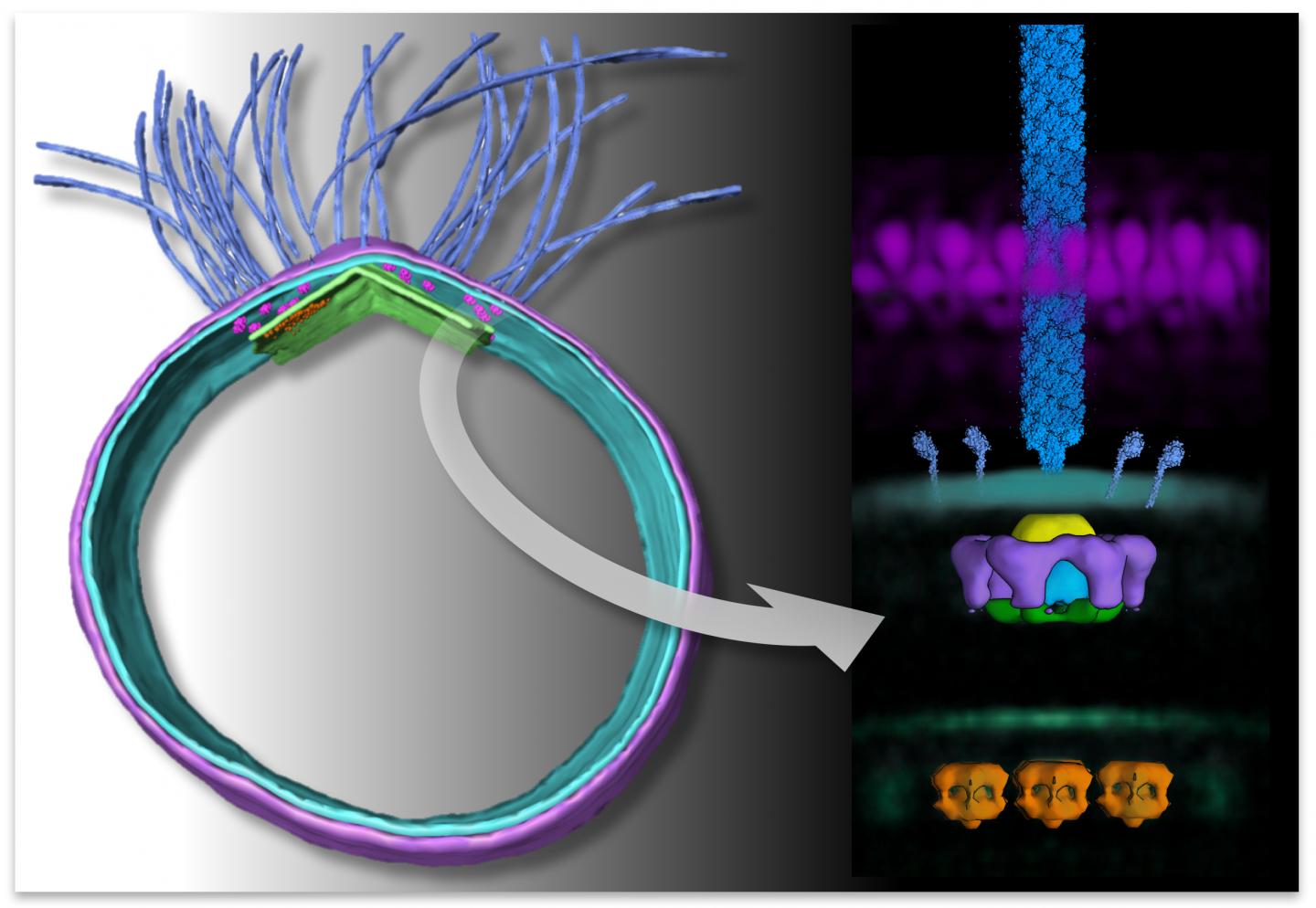
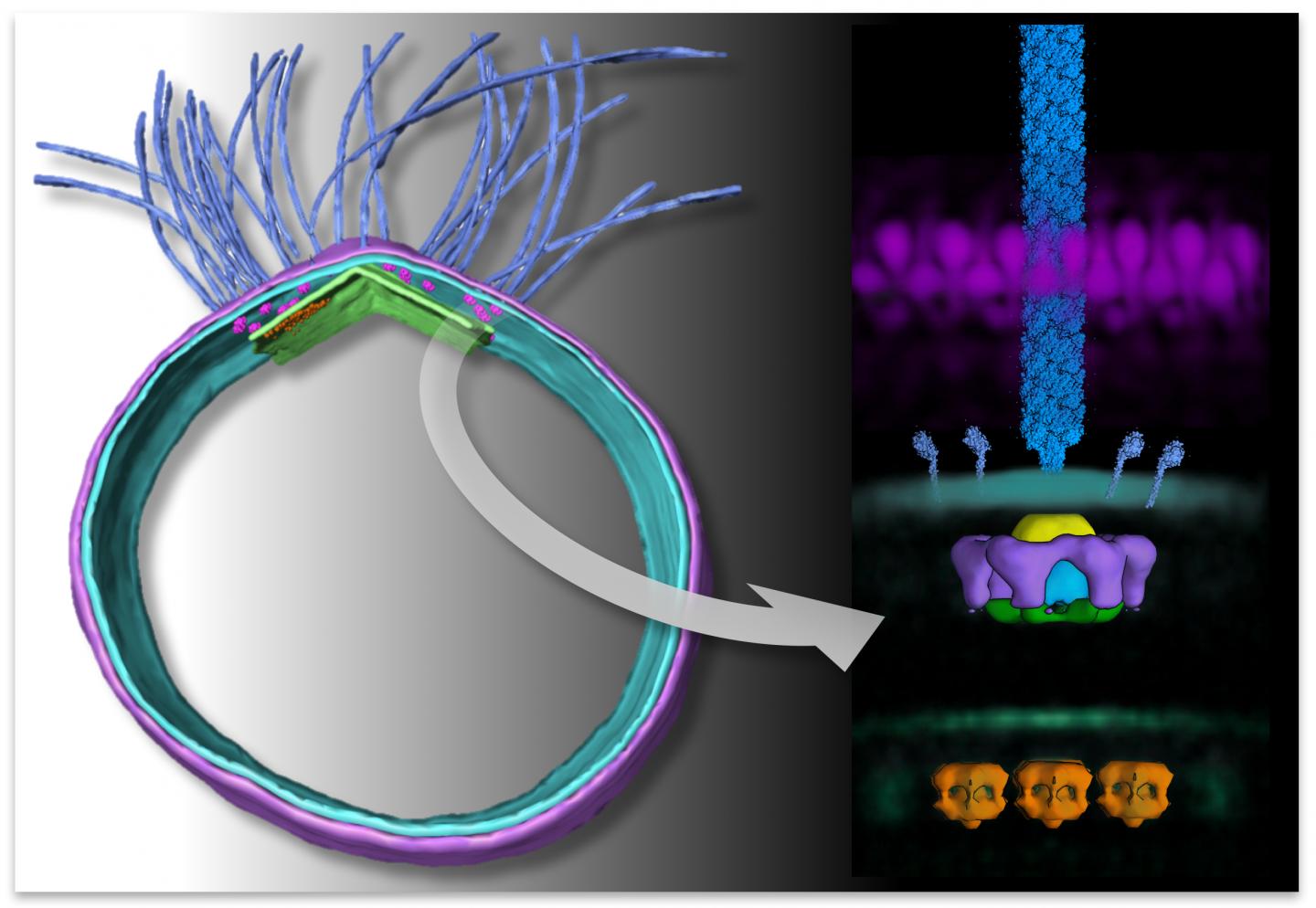
IMAGE

Credit: Bertram Daum / University of Exeter

Scientists have made a crucial new discovery into how a group of ancient microbes that can survive in some of the world's harshest environments, propel themselves forward.

An international team of experts, led by Dr Bertram Daum of the University of Exeter's Living System Institute, have revealed the structure of the unique whip-like appendage found on archaea, which rotates like a propeller to enable these cells to swim.

The structure, called the archaellum, is used for movement and also to allow the microbes to adhere themselves to surfaces, helping them flourish in their current environments and also to colonise new ones.

The researchers studied a particular type of archaea called Pyrococcus furious, which thrive without needing oxygen and at a temperature of 100° C – the boiling point of water.

Using state-of-the-art electron cryo-microscopy at the Max Planck Institute of Biophysics in Frankfurt (Germany), the research team have visualised this vital, yet previously poorly understood propelling motor in 3D and at so-far unachieved resolution. They say that the new research will pave the way for a deeper, molecular understanding of the swimming motion of the archaea.

The study is published in scientific journal eLife.

Dr Daum, a Research Fellow from the University of Exeter's College of Engineering, Mathematics and Physical Sciences said: "the machinery that drives these microorganisms can appear strikingly simple but it is extremely difficult to study in depth. This new research has allowed us to create, for the first time, a detailed model of the structure that propels the archaea, and as such helps them to thrive and survive in places that so much of life would perish.

"More than that, this could have an incredible impact on synthetic biology and by understanding how archaea move, we are able to provide a new idea for future medical practices. Understanding the molecular propeller in detail could help scientists create motors for minute artificial capsules, small enough to explore inside the human body and help combat infectious diseases or cancer."

As well as thriving in diverse and often harsh habitats across the world, such as boiling hot springs, salt lakes or deep sea vents, archaea are also found in the human digestive system and have been implicated as playing a role in obesity.

Dr Daum added: "We are really excited about our structure of the archaellum machinery because it has many downstream implications. Not only does it teach us about how life can exist at extreme conditions here on earth and potentially elsewhere in the universe, but it also provides us with a powerful and versatile tool to create revolutionary technology that works at the level of molecules."

Structure and in situ organisation of the Pyrococcus furiosus archaellum machinery is published in eLife.

###

Media Contact

Duncan Sandes
[email protected]
44-013-927-22391
@uniofexeter

http://www.exeter.ac.uk

Related Journal Article

http://dx.doi.org/10.7554/eLife.27470.001

Share14Tweet8Share2ShareShareShare2

Related Posts

Tiny Blue Octopus from the Galápagos Islands: Small Enough to Fit in the Palm of Your Hand — Biology

Tiny Blue Octopus from the Galápagos Islands: Small Enough to Fit in the Palm of Your Hand

May 25, 2026
Rising Sightings of Blue and Fin Whales in the South East Atlantic — Biology

Rising Sightings of Blue and Fin Whales in the South East Atlantic

May 23, 2026

New Maps Reveal How European Landscapes Can Simultaneously Promote Climate Action and Biodiversity Conservation

May 22, 2026

University of Cincinnati Structural Biologists Achieve World First in Visualizing Crucial Cell Protein

May 22, 2026
Please login to join discussion

POPULAR NEWS

  • ESMO 2025: mRNA COVID Vaccines Enhance Efficacy of Cancer Immunotherapy

    315 shares
    Share 126 Tweet 79
  • New Study Reveals Plants Can Detect the Sound of Rain

    734 shares
    Share 293 Tweet 183
  • Research Indicates Potential Connection Between Prenatal Medication Exposure and Elevated Autism Risk

    847 shares
    Share 339 Tweet 212
  • Common Food Preservatives Associated with Elevated Blood Pressure and Increased Heart Disease Risk

    56 shares
    Share 22 Tweet 14

About

BIOENGINEER.ORG

We bring you the latest biotechnology news from best research centers and universities around the world. Check our website.

Follow us

Recent News

Tiny Blue Octopus from the Galápagos Islands: Small Enough to Fit in the Palm of Your Hand

Stabilizing Fractional Dynamics Suppress Epileptic Seizures

AI Insights Uncover Causes of Injury Deaths

Subscribe to Blog via Email

Enter your email address to subscribe to this blog and receive notifications of new posts by email.

Join 83 other subscribers
  • Contact Us

Bioengineer.org © Copyright 2023 All Rights Reserved.

Welcome Back!

Login to your account below

Forgotten Password?

Retrieve your password

Please enter your username or email address to reset your password.

Log In
No Result
View All Result
  • Homepages
    • Home Page 1
    • Home Page 2
  • News
  • National
  • Business
  • Health
  • Lifestyle
  • Science

Bioengineer.org © Copyright 2023 All Rights Reserved.