• HOME
  • NEWS
  • EXPLORE
    • CAREER
      • Companies
      • Jobs
    • EVENTS
    • iGEM
      • News
      • Team
    • PHOTOS
    • VIDEO
    • WIKI
  • BLOG
  • COMMUNITY
    • FACEBOOK
    • INSTAGRAM
    • TWITTER
Thursday, May 14, 2026
BIOENGINEER.ORG
No Result
View All Result
  • Login
  • HOME
  • NEWS
  • EXPLORE
    • CAREER
      • Companies
      • Jobs
        • Lecturer
        • PhD Studentship
        • Postdoc
        • Research Assistant
    • EVENTS
    • iGEM
      • News
      • Team
    • PHOTOS
    • VIDEO
    • WIKI
  • BLOG
  • COMMUNITY
    • FACEBOOK
    • INSTAGRAM
    • TWITTER
  • HOME
  • NEWS
  • EXPLORE
    • CAREER
      • Companies
      • Jobs
        • Lecturer
        • PhD Studentship
        • Postdoc
        • Research Assistant
    • EVENTS
    • iGEM
      • News
      • Team
    • PHOTOS
    • VIDEO
    • WIKI
  • BLOG
  • COMMUNITY
    • FACEBOOK
    • INSTAGRAM
    • TWITTER
No Result
View All Result
Bioengineer.org
No Result
View All Result
Home NEWS Science News Chemistry

Scientists take a bite out of solar efficiency challenge with sandwich model

Bioengineer by Bioengineer
May 19, 2021
in Chemistry
Reading Time: 2 mins read
0
IMAGE
Share on FacebookShare on TwitterShare on LinkedinShare on RedditShare on Telegram

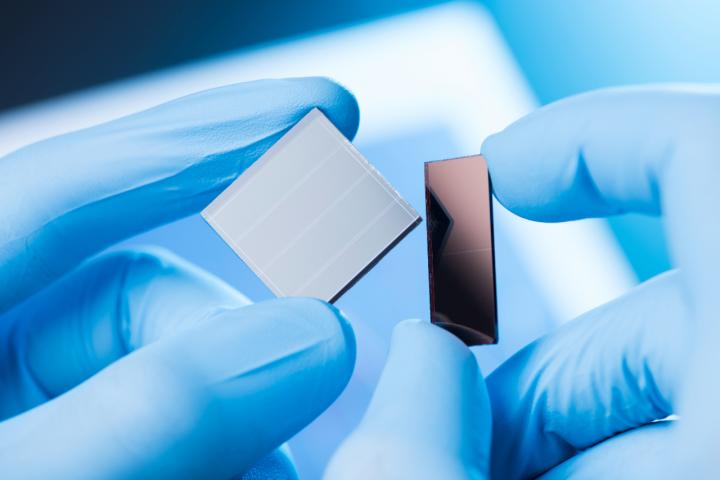
The design of next-generation solar panels can now be improved thanks to a greater fundamental understanding of the structure within a key component
IMAGE

Credit: Shutterstock

In a world hungry for cheaper, more efficient renewable energy, Australian researchers have served up a treat.

Work led by the ARC Centre of Excellence in Exciton Science has shown that the two-dimensional (2D) thin films used in some perovskite solar cells closely resemble a sandwich. Perovskite is an exciting material at the forefront of solar energy research and design.

Previously, scientists thought these 2D perovskite films had a ‘gradient’ structure, in which certain components were found deep in the material, with other complementary elements only located nearer to the surface, like topping on a cracker.

However, in a paper published in Journal of Materials Chemistry C, members of Exciton Science based at the University of Melbourne, together with collaborators at Australia’s national science agency CSIRO and Shandong University, have provided evidence for a sandwich-like structure, in which two layers of the same type (the bread) surround one central, contrasting layer (the filling).

This layout encourages excitons – quasiparticles important for converting sunlight to electricity – to move from the central layer to both surfaces of the film, while free carriers transport charge for collection by electrodes, helping to result in more efficient solar energy generation when incorporated into devices.

“A real problem has been understanding what the structure of these 2D perovskite solar cells really is,” corresponding author Professor Ken Ghiggino said.

“There’s been quite a lot of controversy in the literature. The advance that we’ve achieved is to find out what the real structure of these films is and how they work in a solar cell.”

2D perovskite devices are of particular interest due to their superior stability and durability relative to ‘3D’ perovskite cells. Prototype 2D devices, developed by the researchers using infrastructure and expertise at CSIRO, have demonstrated 13% efficiency.

With greater fundamental understanding of the structure, the researchers will now attempt to increase device efficiency by changing the thickness of the layers within the perovskite ‘sandwich’.

In addition to solar cells, improved 2D perovskite films have important applications in light-emitting diodes (LEDs) and photodetectors, such as video imaging, optical communications, biomedical imaging, security, night-vision, gas sensing, and motion detection.

Lead author Dr Fei Zheng said: “This is the first time a sandwich structure has been proposed versus the conventional gradient distribution model. We think this discovery will help design and device optimisation for higher performance of the 2D cells and LEDs.”

###

Media Contact
Iain Strachan
[email protected]

Original Source

https://excitonscience.com/news/scientists-take-bite-out-solar-efficiency-challenge-sandwich-model

Related Journal Article

http://dx.doi.org/10.1039/D1TC00606A

Tags: Chemistry/Physics/Materials SciencesEnergy/Fuel (non-petroleum)MaterialsSuperconductors/Semiconductors
Share12Tweet8Share2ShareShareShare2

Related Posts

New Method Finds More Efficient Route Between Earth and Moon Than Ever Before — Chemistry

New Method Finds More Efficient Route Between Earth and Moon Than Ever Before

May 14, 2026
Unveiling the Unseen: Exploring the Boundaries of Two-Photon Vision — Chemistry

Unveiling the Unseen: Exploring the Boundaries of Two-Photon Vision

May 14, 2026

On-Chip Ferroelectric Spherulites Enable Broadband Colored Skyrmion Generation

May 14, 2026

Innovating an Affordable and Sustainable Marimba #ASA190

May 14, 2026
Please login to join discussion

POPULAR NEWS

  • Research Indicates Potential Connection Between Prenatal Medication Exposure and Elevated Autism Risk

    842 shares
    Share 337 Tweet 211
  • New Study Reveals Plants Can Detect the Sound of Rain

    729 shares
    Share 291 Tweet 182
  • Salmonella Haem Blocks Macrophages, Boosts Infection

    62 shares
    Share 25 Tweet 16
  • Breastmilk Balances E. coli and Beneficial Bacteria in Infant Gut Microbiomes

    57 shares
    Share 23 Tweet 14

About

We bring you the latest biotechnology news from best research centers and universities around the world. Check our website.

Follow us

Recent News

First Study to Detect and Track Multiple Cancer-Causing Viruses in Wastewater

New Method Finds More Efficient Route Between Earth and Moon Than Ever Before

URI Master’s Student Emilio Pedroza Lopez Awarded Prestigious NSF Graduate Research Fellowship

Subscribe to Blog via Email

Enter your email address to subscribe to this blog and receive notifications of new posts by email.

Join 82 other subscribers
  • Contact Us

Bioengineer.org © Copyright 2023 All Rights Reserved.

Welcome Back!

Login to your account below

Forgotten Password?

Retrieve your password

Please enter your username or email address to reset your password.

Log In
No Result
View All Result
  • Homepages
    • Home Page 1
    • Home Page 2
  • News
  • National
  • Business
  • Health
  • Lifestyle
  • Science

Bioengineer.org © Copyright 2023 All Rights Reserved.