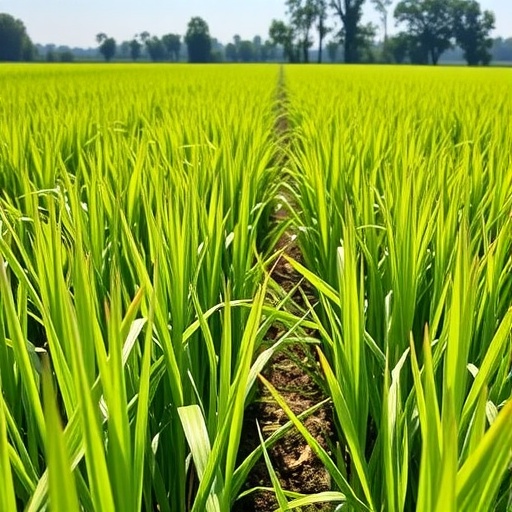
Water-saving irrigation methods like intermittent watering are critical for sustainable rice farming amid increasing freshwater scarcity. Yet, these practices inadvertently raise cadmium (Cd) levels in rice grains, posing serious food safety concerns. Now, a breakthrough from the Chinese Academy of Sciences unravels the molecular pathway driving this phenomenon, providing new hope for developing rice varieties that maintain yield without escalating toxic metal accumulation.
The study, led by Profs. SHEN Renfang and ZHU Xiaofang and published in Current Biology, reveals that drought-induced abscisic acid (ABA) signaling is not just a passive response but actively enhances Cd uptake in rice roots. This discovery challenges the long-held view that elevated grain Cd under intermittent irrigation results solely from soil chemistry changes.
Using CRISPR-Cas9 gene editing and extensive field trials, the team pinpointed the transcription factor OsNAC4 as a pivotal regulator linking water stress to Cd transport. Rice plants engineered to lack OsNAC4 showed a remarkable 30 to 50 percent reduction in grain Cd content under drought-like irrigation conditions, without any yield penalty.
Delving deeper, researchers identified a critical signaling module: OsSAPK2 kinase activates OsNAC4 through phosphorylation at four conserved serine residues. This modification stabilizes OsNAC4, increasing its binding to DNA sequences that promote the expression of OsNRAMP1, a plasma membrane transporter responsible for Cd uptake from the soil. Under aerobic soil conditions created by periodic drainage, this ABA-driven pathway amplifies Cd absorption, explaining the surge in grain contamination.
Importantly, OsNAC4-deficient rice retained normal transport of essential micronutrients such as manganese and iron, avoiding the growth defects seen in plants with direct mutations in OsNRAMP transporters. This separation of Cd uptake regulation from nutrient homeostasis is crucial for practical breeding applications.
Prof. Zhu emphasized, “Our findings demonstrate that the plant’s internal drought signaling actively orchestrates heavy metal accumulation, not just soil redox changes.” This nuanced understanding enables targeted molecular breeding strategies to decouple water stress responses from Cd hyperaccumulation.
The identification of the OsSAPK2–OsNAC4–OsNRAMP1 axis constitutes a paradigm shift, offering a precise genetic target to develop climate-resilient rice varieties compatible with water-saving irrigation yet safe from toxic metal contamination. This advancement paves the way for balancing environmental sustainability with food security in a warming world.
This landmark discovery not only addresses a critical challenge in agronomy but also exemplifies how integrating molecular biology with field agronomics can tackle global issues in crop safety and productivity.
Article Title: The OsSAPK2–OsNAC4 Module Couples Water Stress Signaling with Cadmium Accumulation in Rice
News Publication Date: 8-Jul-2026
Web References: http://dx.doi.org/10.1016/j.cub.2026.06.029
Image Credits: SHEN Renfang’s team
Keywords
Water-saving irrigation, cadmium accumulation, rice, ABA signaling, OsNAC4, OsSAPK2, OsNRAMP1, drought stress, CRISPR-Cas9, molecular breeding
Tags: abscisic acid role in metal transportcadmium accumulation in riceCRISPR-Cas9 gene editing in ricedrought stress signaling in rice plantsintermittent watering and food safetymolecular pathways of cadmium uptake in riceOsNAC4 transcription factor in cadmium regulationreducing heavy metal contamination in rice grainsrice breeding for toxic metal mitigationrice plant stress response mechanismssoil chemistry changes under water-saving irrigationwater-saving irrigation