• HOME
  • NEWS
  • EXPLORE
    • CAREER
      • Companies
      • Jobs
    • EVENTS
    • iGEM
      • News
      • Team
    • PHOTOS
    • VIDEO
    • WIKI
  • BLOG
  • COMMUNITY
    • FACEBOOK
    • INSTAGRAM
    • TWITTER
Thursday, May 28, 2026
BIOENGINEER.ORG
No Result
View All Result
  • Login
  • HOME
  • NEWS
  • EXPLORE
    • CAREER
      • Companies
      • Jobs
        • Lecturer
        • PhD Studentship
        • Postdoc
        • Research Assistant
    • EVENTS
    • iGEM
      • News
      • Team
    • PHOTOS
    • VIDEO
    • WIKI
  • BLOG
  • COMMUNITY
    • FACEBOOK
    • INSTAGRAM
    • TWITTER
  • HOME
  • NEWS
  • EXPLORE
    • CAREER
      • Companies
      • Jobs
        • Lecturer
        • PhD Studentship
        • Postdoc
        • Research Assistant
    • EVENTS
    • iGEM
      • News
      • Team
    • PHOTOS
    • VIDEO
    • WIKI
  • BLOG
  • COMMUNITY
    • FACEBOOK
    • INSTAGRAM
    • TWITTER
No Result
View All Result
Bioengineer.org
No Result
View All Result
Home NEWS Science News Biology

Scientists reveal how chronic liver injury causes bone loss

Bioengineer by Bioengineer
March 1, 2022
in Biology
Reading Time: 2 mins read
0
The appropriate intracellular cholesterol levels could promote osteoblast function and inhibit osteoclast differentiation
Share on FacebookShare on TwitterShare on LinkedinShare on RedditShare on Telegram

A research team led by Prof. CHEN Di from the Shenzhen Institute of Advanced Technology (SIAT) of the Chinese Academy of Sciences along with other collaborators have revealed the molecular mechanisms behind bone loss caused by chronic liver injury.
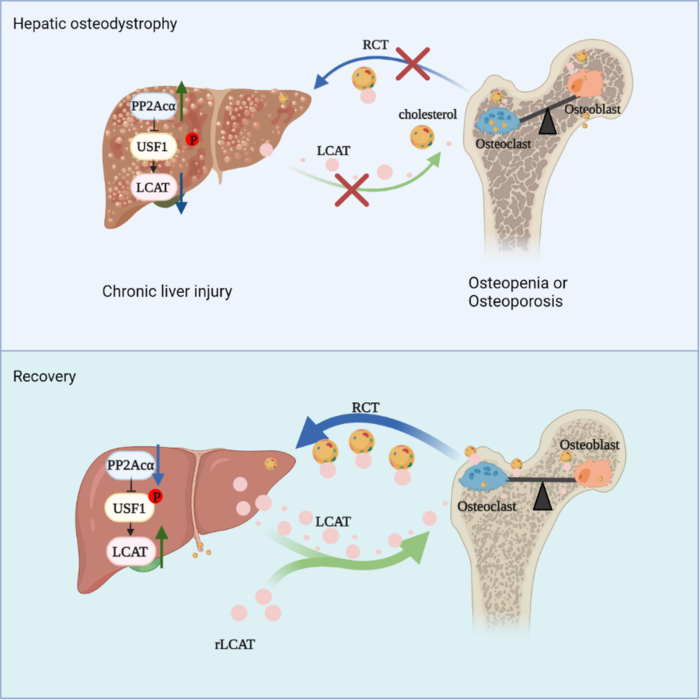
The appropriate intracellular cholesterol levels could promote osteoblast function and inhibit osteoclast differentiation

Credit: SIAT

A research team led by Prof. CHEN Di from the Shenzhen Institute of Advanced Technology (SIAT) of the Chinese Academy of Sciences along with other collaborators have revealed the molecular mechanisms behind bone loss caused by chronic liver injury.

Their study was published in Cell Metabolism on March 1.

Hepatic osteodystrophy disease (HOD) is a kind of metabolic bone disease that occurs in patients with chronic liver disorder. It mainly manifests as bone loss, bone density reduction, and destruction of bone structure.

As the body’s metabolic center, the liver plays an important role in the maintenance of tissue homeostasis and a large number of hepatic cytokines regulate peripheral organs, including bones, through the circulatory system.

This mutual regulation between liver and bone is called the liver-bone axis. External stimuli, such as viruses, alcohol, and drugs, may cause chronic liver damage, which subsequently affects bone metabolism through the liver-bone axis, resulting in an increased risk of osteoporosis and fragile fractures.

The fractures caused by HOD disease make bone reconstruction difficult, and severely affect disease prognosis and HOD patients’ quality of life. Thus, it is important to elucidate the mechanisms of HOD.

In patients with HOD and mouse models of HOD, the research team found high expression of PP2Acα. “Conditional knockout of PP2Acα in the liver of HOD mice helps the recovery of liver function and alleviates bone loss,” said Prof. CHEN.

Through proteomics analysis, the research team screened and identified the hepatic factor LCAT, the liver-bone axis regulator. As a cholesterol transferring enzyme, LCAT is able to transfer cholesterol from peripheral tissues to the liver, a process known as reverse cholesterol transport (RCT).

“LCAT mediates bone metabolism by maintaining appropriate intracellular cholesterol levels and improves liver function by reversing cholesterol transport from bone tissues to the liver,” said Dr. LU Ke, first author of the study.

RCT plays an important role in maintaining liver-bone homeostasis. Appropriate intracellular cholesterol levels can promote osteoblast function and inhibit osteoclast differentiation.

In patients with HOD and mouse models of HOD, the researchers found that PP2Acα down-regulated LCAT expression in HOD.

This study shows that imbalance of the liver-bone axis accelerates the progression of HOD caused by chronic liver injury. It also provides a potential target for the development of therapeutic drugs to treat hepatic bone disease.


Journal

Cell Metabolism

Article Title

Defects in a liver-bone axis contribute to hepatic osteodystrophy disease progression

Article Publication Date

1-Mar-2022

Share12Tweet8Share2ShareShareShare2

Related Posts

Plants Demonstrate Exceptional Resilience to Protein Translation Errors — Biology

Plants Demonstrate Exceptional Resilience to Protein Translation Errors

May 28, 2026
Long-Term Study Finds Plant-Forward, Low-Insulinemic Diets May Curb Weight Gain and Obesity Risk During Menopause — Biology

Long-Term Study Finds Plant-Forward, Low-Insulinemic Diets May Curb Weight Gain and Obesity Risk During Menopause

May 28, 2026

The Heart’s ‘Natural Bypass’: A Potential Alternative to Risky Procedures

May 28, 2026

Scientists Uncover New Cave Cricket Species in Kastellorizo, Greece—Nicknamed the “Balrog” of the Tunnels

May 28, 2026

POPULAR NEWS

  • ESMO 2025: mRNA COVID Vaccines Enhance Efficacy of Cancer Immunotherapy

    318 shares
    Share 127 Tweet 80
  • Multi-Hospital Study Reveals Long Covid Burden Is Twice as High as Current Estimates

    69 shares
    Share 28 Tweet 17
  • New Study Reveals Plants Can Detect the Sound of Rain

    735 shares
    Share 293 Tweet 183
  • Common Food Preservatives Associated with Elevated Blood Pressure and Increased Heart Disease Risk

    56 shares
    Share 22 Tweet 14

About

We bring you the latest biotechnology news from best research centers and universities around the world. Check our website.

Follow us

Recent News

Pain, Sleep, Depression Linked to Cognitive Decline

Miniaturized Passive Vacuum System Powers Cold Atom Sensors

AI Recommends Easy Food Swaps to Enhance Nutrition and Cut Meal Costs

Subscribe to Blog via Email

Enter your email address to subscribe to this blog and receive notifications of new posts by email.

Join 82 other subscribers
  • Contact Us

Bioengineer.org © Copyright 2023 All Rights Reserved.

Welcome Back!

Login to your account below

Forgotten Password?

Retrieve your password

Please enter your username or email address to reset your password.

Log In
No Result
View All Result
  • Homepages
    • Home Page 1
    • Home Page 2
  • News
  • National
  • Business
  • Health
  • Lifestyle
  • Science

Bioengineer.org © Copyright 2023 All Rights Reserved.