• HOME
  • NEWS
  • EXPLORE
    • CAREER
      • Companies
      • Jobs
    • EVENTS
    • iGEM
      • News
      • Team
    • PHOTOS
    • VIDEO
    • WIKI
  • BLOG
  • COMMUNITY
    • FACEBOOK
    • INSTAGRAM
    • TWITTER
Friday, June 26, 2026
BIOENGINEER.ORG
No Result
View All Result
  • Login
  • HOME
  • NEWS
  • EXPLORE
    • CAREER
      • Companies
      • Jobs
        • Lecturer
        • PhD Studentship
        • Postdoc
        • Research Assistant
    • EVENTS
    • iGEM
      • News
      • Team
    • PHOTOS
    • VIDEO
    • WIKI
  • BLOG
  • COMMUNITY
    • FACEBOOK
    • INSTAGRAM
    • TWITTER
  • HOME
  • NEWS
  • EXPLORE
    • CAREER
      • Companies
      • Jobs
        • Lecturer
        • PhD Studentship
        • Postdoc
        • Research Assistant
    • EVENTS
    • iGEM
      • News
      • Team
    • PHOTOS
    • VIDEO
    • WIKI
  • BLOG
  • COMMUNITY
    • FACEBOOK
    • INSTAGRAM
    • TWITTER
No Result
View All Result
Bioengineer.org
No Result
View All Result
Home NEWS Science News Chemistry

Scientists propose strategy for site-selective chiral drug synthesis in living systems

Bioengineer by Bioengineer
June 26, 2020
in Chemistry
Reading Time: 2 mins read
0
IMAGE
Share on FacebookShare on TwitterShare on LinkedinShare on RedditShare on Telegram

IMAGE

Credit: CIAC

Enantioselectivity plays an important role in the pharmacological and toxicological processes of chiral drugs.

In chiral drug synthesis that uses bioorthogonal chemistry within complex biological milieu, asymmetric transfer hydrogenation (ATH), which utilizes safe hydrogen donors instead of high pressure H2, has been gaining popularity and has been performed in living cells.

Prof. QU Xiaogang from the Changchun Institute of Applied Chemistry (CIAC) of the Chinese Academy of Sciences and his colleagues recently presented a novel strategy using a neutrophil-directed ATH reaction to achieve site-selective chiral drug synthesis in living systems.

The study was published in Chem on June 25.

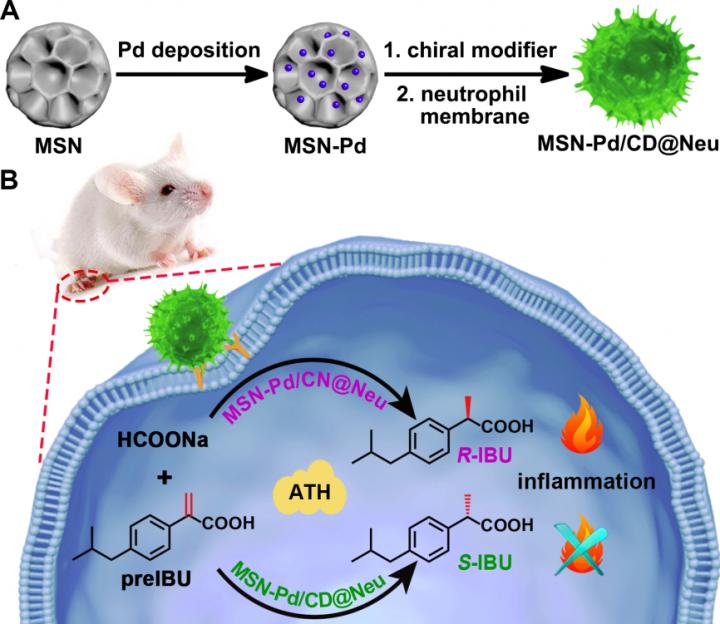
The researchers first constructed inflammation-targeted chiral catalysts by preparing Pd-immobilized mesoporous silica nanoparticles (MSN-Pd).

Cinchona alkaloid enantiomers were individually adsorbed on the MSN-Pd catalyst to introduce enantioselectivity.

A neutrophil membrane was subsequently coated onto the MSN-Pd chiral catalysts, creating the MSN-Pd/CD@Neu catalyst, which possessed inflammation-targeting ability inherited from the neutrophils.

The next stage of research involved using MSN-Pd/CD@Neu to catalyze an intracellular conversion involving the precursors of Ibuprofen (IBU).

IBU is a drug well-known for relieving inflammation, fever and pain. The pharmacological activity of IBU is mainly attributed to the S-enantiomer while the R-enantiomer is thought to be potentially harmful. For this reason, it is important to be able to control the catalysis of IBU into its enantiomers.

In this study, the conversion of the precursor molecule of IBU (pre-IBU) to S-IBU was realized by using a targeted ATH bioorthogonal reaction in a mouse paw model, with HCOONa as the hydrogen donor.

Compared with the controls, the MSN-Pd/CD@Neu catalyst simultaneously exhibited inflammation-targeted capability and enantioselectivity as part of its anti-inflammatory action.

In situ synthesized IBU can ameliorate lipopolysaccharide (LPS)-triggered acute inflammation, pyrexia and tissue edema.

This research opens a new avenue for chiral drug synthesis activated on the designed target in living systems. It also holds promise for wide application of targeted bioorthogonal chemistry, especially in enantioselective drug synthesis.

###

Media Contact
QU Xiaogang
[email protected]

Related Journal Article

http://dx.doi.org/10.1016/j.chempr.2020.06.002

Tags: Medicine/HealthPharmaceutical ChemistryPharmaceutical Science
Share12Tweet8Share2ShareShareShare2

Related Posts

AI and Physics Collaborate to Design Advanced Hydrogen Storage Materials

June 25, 2026

International Team Including Dresden Scientists Develops Novel Designer Proteins for Advanced Study of Living Tissue

June 25, 2026

New Study Uncovers Key Factors Driving Water Chemistry in Nanoscale Environments

June 25, 2026

Plasma Technology Extends Catalyst Lifespan in Hydrogen Production

June 24, 2026
Please login to join discussion

POPULAR NEWS

  • Saying Goodbye to PGY-6: Pediatric Fellowship Realities

    103 shares
    Share 41 Tweet 26
  • Multi-Hospital Study Reveals Long Covid Burden Is Twice as High as Current Estimates

    92 shares
    Share 36 Tweet 23
  • Detection of EDCs in Breast Milk and Infant Urine Up to Six Months Highlights Early Exposure Risks

    77 shares
    Share 31 Tweet 19
  • New Drug Candidate Developed at McMaster Shows Potential for Treating Brain Cancer

    58 shares
    Share 23 Tweet 15

About

We bring you the latest biotechnology news from best research centers and universities around the world. Check our website.

Follow us

Recent News

Tracking Lanthanide-Labeled Microplastics in Plants

POSTECH Researchers Slash Cost of Reconstituted Cell-Free Systems by 95%

AI and Physics Collaborate to Design Advanced Hydrogen Storage Materials

Subscribe to Blog via Email

Success! An email was just sent to confirm your subscription. Please find the email now and click 'Confirm' to start subscribing.

Join 82 other subscribers
  • Contact Us

Bioengineer.org © Copyright 2023 All Rights Reserved.

Welcome Back!

Login to your account below

Forgotten Password?

Retrieve your password

Please enter your username or email address to reset your password.

Log In
No Result
View All Result
  • Homepages
    • Home Page 1
    • Home Page 2
  • News
  • National
  • Business
  • Health
  • Lifestyle
  • Science

Bioengineer.org © Copyright 2023 All Rights Reserved.