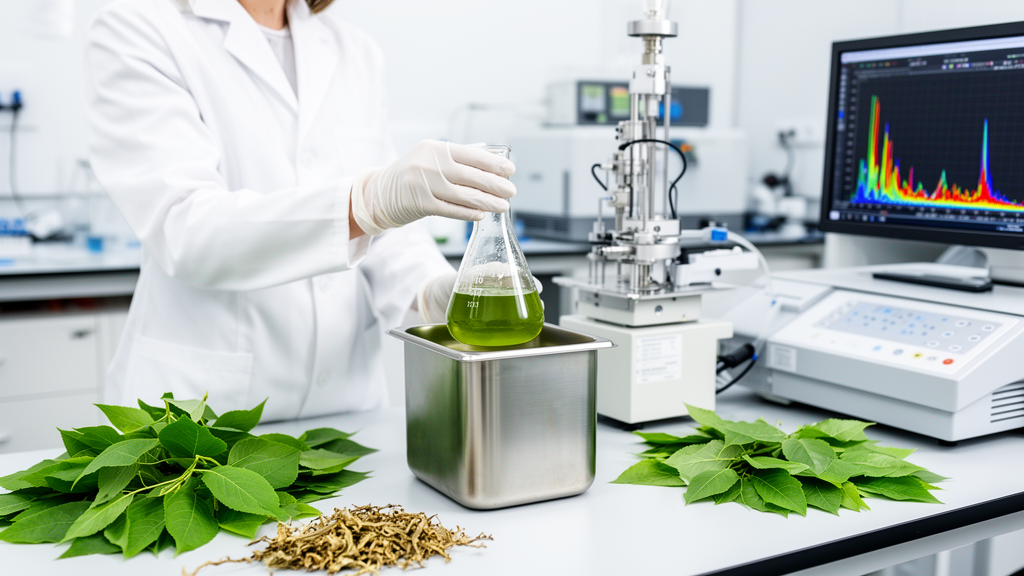
Researchers in China have reported an optimized ultrasound-assisted extraction process for luteoloside from leaves of Lonicera japonica, the plant better known as Japanese honeysuckle, using chlorogenic acid as a co-monitored marker compound. Alongside the extraction work, the team established a high-performance liquid chromatography fingerprint method intended for the quality assessment of leaf samples from different geographical origins and harvest periods. The study, published as open access research in BMC Chemistry on 8 October 2026, was led by Jingjian Liu and Huimin Liu with colleagues including Yu Chen, Xu Ling and Zhihao Li, and its authors describe the combined approach as a scientific basis for quality control and rational utilization of the leaves.
The optimization began with single-factor experiments, in which one parameter is varied at a time while the others are held constant, allowing the researchers to see how each condition influences the response variable, in this case the yield of luteoloside. Five key ultrasound-assisted extraction parameters were examined: the ethanol concentration of the extraction solvent, the liquid-to-solid ratio, the ultrasonic power, the extraction time and the number of extraction cycles.
Under the tested conditions, the optimal extraction recipe emerged as 60 percent ethanol by volume as the solvent, a liquid-to-solid ratio of 25:1 in milliliters per gram, an ultrasonic power of 300 watts, an extraction time of 2.5 hours and two extraction cycles. The authors report that the optimized process showed good repeatability within the conditions tested, an important practical consideration for any method intended to move from the laboratory toward routine analytical or preparative use.
With the extraction conditions settled, the team turned to the analytical side of the study. They established an HPLC fingerprint using chlorogenic acid and luteoloside as marker compounds. Chromatographic fingerprinting is a quality-control strategy widely applied to traditional Chinese medicines: rather than quantifying one or two constituents in isolation, it records the full pattern of peaks that a sample produces under standardized conditions, so that batches can be compared pattern-to-pattern. The fingerprint the researchers built contained 15 common peaks, meaning peaks present across the analyzed samples. Within this set, chlorogenic acid was unambiguously identified as common peak 6 with a retention time of 10.89 minutes, and luteoloside as common peak 15 with a retention time of 20.14 minutes, both confirmed by comparison with reference standards.
The fingerprint method was then applied to 18 batches of leaf samples. Similarity analysis was carried out with the Similarity Evaluation System for Chromatographic Fingerprints of Traditional Chinese Medicines, 2012 edition. The similarity values between each batch fingerprint and a generated reference fingerprint ranged from 0.827 to 1.000, with 14 of the 18 batches showing high similarity of at least 0.980. The authors interpret this as indicating good overall chemical consistency across the sampled material, even though the batches came from different places and harvest periods.
To probe the structure behind those similarities, the researchers deployed a battery of chemometric techniques. Hierarchical cluster analysis, based on the peak areas of all 15 common peaks, classified the 18 samples into three major clusters, a grouping driven primarily by the intrinsic content level of the marker compounds and by harvest period. Principal component analysis and orthogonal partial least squares-discriminant analysis further confirmed discrimination among samples with different chemical patterns. Again, the authors attribute this discrimination primarily to harvest period and intrinsic content level, with geographical origin playing a secondary role that showed dimension-specific effects: longitude for chlorogenic acid and latitude for luteoloside.
The statistical detail behind those conclusions is spelled out in the abstract. The first two principal components explained 38.3 percent and 24.0 percent of the total variance respectively, meaning that together they accounted for just over 62 percent of the variability in the fingerprint data. The primary OPLS-DA model showed an R²Y of 0.836 and a Q² of 0.738, figures the authors describe as indicating excellent fit and predictive ability. Spearman correlation analysis revealed significant spatial correlations for chlorogenic acid with longitude and for luteoloside with latitude. Notably, no individual common peak showed a significant monotonic correlation with collection time, even though the multivariate clustering aligned primarily with harvest period, a reminder that single-variable correlations and multivariate patterns can point in different directions in complex natural product data.
Among the 18 batches analyzed, one sample stood out: material from Jiulong Mountain in Shiyan, Hubei, designated S12, exhibited the highest luteoloside content at 0.162 percent. By combining an optimized extraction protocol with a fingerprint method and chemometric discrimination, the study offers what the authors describe as technical support for quality control and value-added utilization of the leaves. For now, the reported numbers, from the 60 percent ethanol solvent to the 15 common peaks and the three chemically distinct clusters, give researchers and producers of honeysuckle leaf material a concrete, quantified framework for evaluating consistency across harvests and origins, and a benchmark extraction protocol for the compound at the center of the analysis.
Subject of Research: Optimization of ultrasound-assisted extraction and HPLC fingerprinting of luteoloside and chlorogenic acid in Lonicera japonica leaves
Article Title: Optimization of ultrasound-assisted extraction and HPLC fingerprinting of luteoloside and chlorogenic acid in Lonicera japonica leaves
Article References: Liu, J., Liu, H., Chen, Y., Ling, X., & Li, Z. (2026). Optimization of ultrasound-assisted extraction and HPLC fingerprinting of luteoloside and chlorogenic acid in Lonicera japonica leaves. BMC Chemistry. https://doi.org/10.1186/s13065-026-01939-2
Image Credits: AI Generated
DOI: 10.1186/s13065-026-01939-2
Keywords: Lonicera japonica, luteoloside, chlorogenic acid, ultrasound-assisted extraction, HPLC fingerprinting, chemometrics, quality control, principal component analysis, OPLS-DA, hierarchical cluster analysis, traditional Chinese medicine, BMC Chemistry
News Source: Bethany Barker. (October 29, 2026). Scientists Optimize Ultrasound Extraction and HPLC Fingerprinting for Honeysuckle Leaf Compounds. Scienmag.