• HOME
  • NEWS
  • EXPLORE
    • CAREER
      • Companies
      • Jobs
    • EVENTS
    • iGEM
      • News
      • Team
    • PHOTOS
    • VIDEO
    • WIKI
  • BLOG
  • COMMUNITY
    • FACEBOOK
    • INSTAGRAM
    • TWITTER
Monday, May 11, 2026
BIOENGINEER.ORG
No Result
View All Result
  • Login
  • HOME
  • NEWS
  • EXPLORE
    • CAREER
      • Companies
      • Jobs
        • Lecturer
        • PhD Studentship
        • Postdoc
        • Research Assistant
    • EVENTS
    • iGEM
      • News
      • Team
    • PHOTOS
    • VIDEO
    • WIKI
  • BLOG
  • COMMUNITY
    • FACEBOOK
    • INSTAGRAM
    • TWITTER
  • HOME
  • NEWS
  • EXPLORE
    • CAREER
      • Companies
      • Jobs
        • Lecturer
        • PhD Studentship
        • Postdoc
        • Research Assistant
    • EVENTS
    • iGEM
      • News
      • Team
    • PHOTOS
    • VIDEO
    • WIKI
  • BLOG
  • COMMUNITY
    • FACEBOOK
    • INSTAGRAM
    • TWITTER
No Result
View All Result
Bioengineer.org
No Result
View All Result
Home NEWS Science News Chemistry

Scientists modelled natural rock arcades

Bioengineer by Bioengineer
June 23, 2020
in Chemistry
Reading Time: 2 mins read
0
IMAGE
Share on FacebookShare on TwitterShare on LinkedinShare on RedditShare on Telegram

IMAGE

Credit: Pavel Odinev / Skoltech

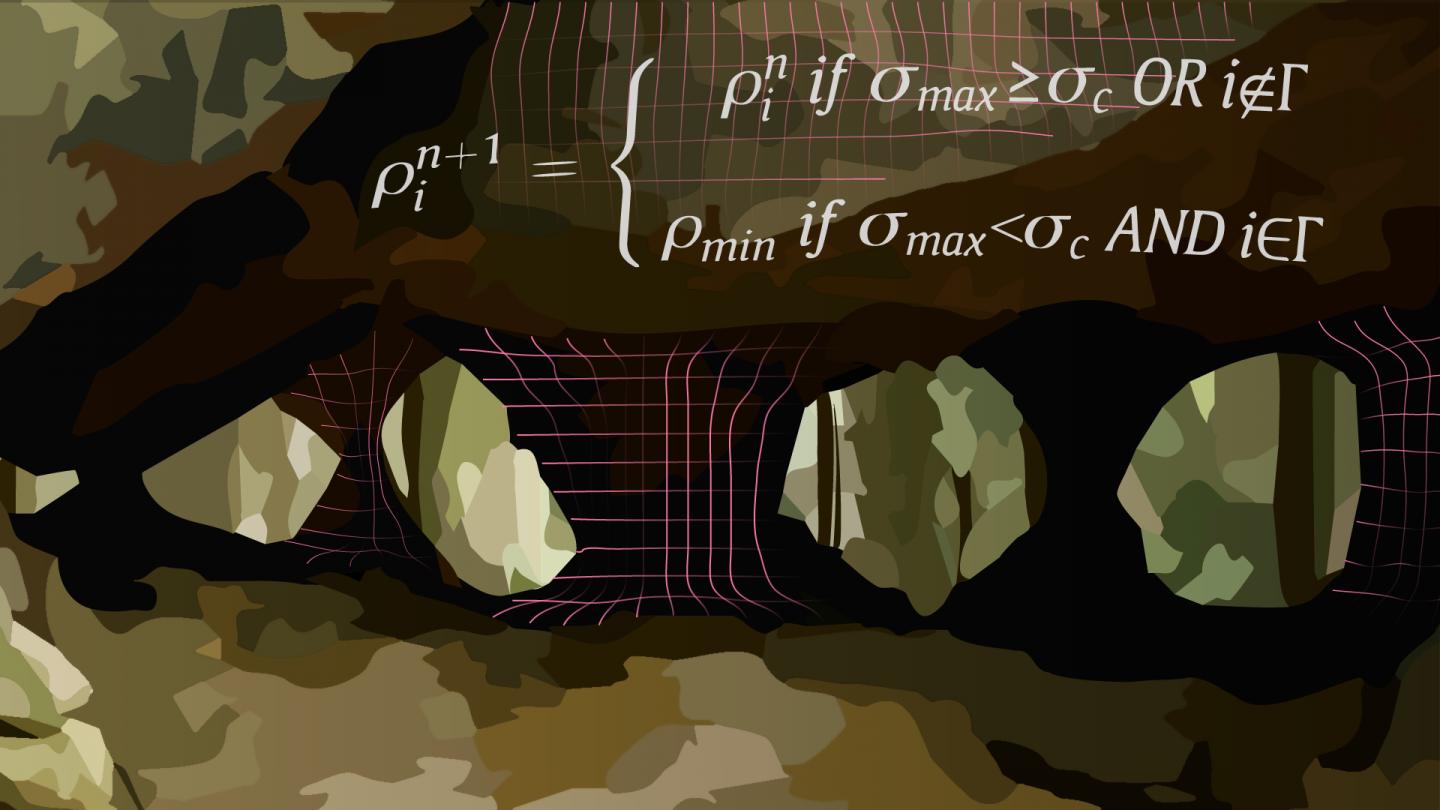
Researchers from Russia and the Czech Republic performed numerical modelling of natural rock arcades using a mathematical model that describes a succession of arches forming as a result of weathering and then turning into rock pillars without human involvement, despite their striking resemblance to architectural arcades. The results of the study were published in the journal Geomorphology.

An architectural arcade is a succession of arches of the same shape and size, each supported by pillars. The Romans widely used arcades in aqueducts, viaducts, circuses, and amphitheaters, while in the Middle Ages, English and Italian architects used them in cathedrals and open galleries. Arcades are an architectural landmark of Bologna in Italy. Interestingly, similar structures can be found in nature, as testimony to rock evolution through the ages, driven by weathering and erosion.

A group of scientists from the Skoltech Center for Design, Manufacturing and Materials (CDMM) and Charles University (Czech Republic) modelled the processes leading to the formation of rock arcades due to erosion. The study used the rock erosion mechanism described earlier by the Czech and Skoltech scientists who had found that erosion in rock (sandstone, granite, quartzite, tuff, etc.) occurs in low-stress areas. It was shown that arcades appear in areas with discontinuities, such as cracks or thin layers of softer rock.

“In non-uniform rock, erosion causes the stress to shift from one part of the rock to another, forming regular high-pressure areas. As erosion continues, arches appear along the rock surface and the adjacent neighboring high-pressure areas connect to form an arcade,” explains Alexander Safonov, an assistant professor at Skoltech.

The study showed that as the erosion front moves deeper into the rock, several rows of arcades are formed inside. A decrease in the rock’s total weight due to erosion reduces the loads on individual arches, which can lead to partial erosion of the arcades and their evolution into colonnades.

The model describes sandstone arcades and pillars in the Czech Republic (Bohemian Paradise) and the United States (Arches National Park)) as well as arches and columns in coastal areas.

###

Media Contact
Alina Chernova
[email protected]

Original Source

https://www.skoltech.ru/en/2020/06/scientists-modelled-natural-rock-arcades/

Related Journal Article

http://dx.doi.org/10.1016/j.geomorph.2020.107260

Tags: Chemistry/Physics/Materials SciencesGeophysics
Share12Tweet8Share2ShareShareShare2

Related Posts

Enhancing Surgical Safety with Laser-Induced Acoustic Imaging #ASA190 — Chemistry

Enhancing Surgical Safety with Laser-Induced Acoustic Imaging #ASA190

May 11, 2026
Miniature Sensor Uses Light to Detect Touch — Chemistry

Miniature Sensor Uses Light to Detect Touch

May 8, 2026

Iron Minerals Determine Whether Dissolved Organic Matter Fuels Microbes or Becomes Long-Term Carbon Storage

May 8, 2026

Kate Evans Appointed Associate Lab Director for Biological and Environmental Systems Science at ORNL

May 8, 2026
Please login to join discussion

POPULAR NEWS

  • Research Indicates Potential Connection Between Prenatal Medication Exposure and Elevated Autism Risk

    841 shares
    Share 336 Tweet 210
  • New Study Reveals Plants Can Detect the Sound of Rain

    728 shares
    Share 290 Tweet 182
  • Salmonella Haem Blocks Macrophages, Boosts Infection

    62 shares
    Share 25 Tweet 16
  • Breastmilk Balances E. coli and Beneficial Bacteria in Infant Gut Microbiomes

    57 shares
    Share 23 Tweet 14

About

We bring you the latest biotechnology news from best research centers and universities around the world. Check our website.

Follow us

Recent News

NYU Quantum Institute and IBM Launch Postdoctoral Research Program in Quantum Computing

Decarbonizing Desert Greenhouses with Direct Air Capture

Enhancing Surgical Safety with Laser-Induced Acoustic Imaging #ASA190

Subscribe to Blog via Email

Enter your email address to subscribe to this blog and receive notifications of new posts by email.

Join 82 other subscribers
  • Contact Us

Bioengineer.org © Copyright 2023 All Rights Reserved.

Welcome Back!

Login to your account below

Forgotten Password?

Retrieve your password

Please enter your username or email address to reset your password.

Log In
No Result
View All Result
  • Homepages
    • Home Page 1
    • Home Page 2
  • News
  • National
  • Business
  • Health
  • Lifestyle
  • Science

Bioengineer.org © Copyright 2023 All Rights Reserved.