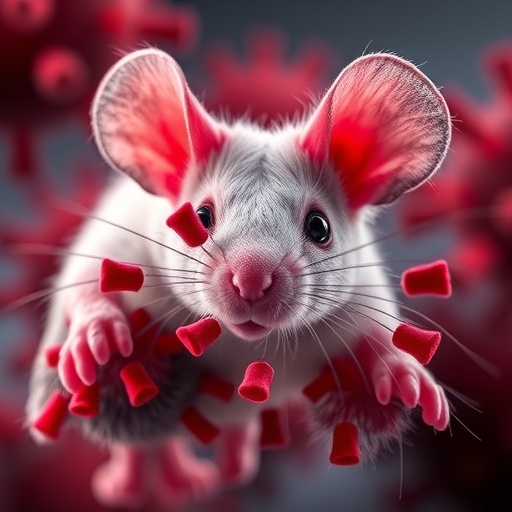
A Breakthrough in COVID-19 Therapeutics: Synergistic Targeting of SARS-CoV-2 PLpro and Host RIPK1 Yields Promising Results in Preclinical Models
The global battle against COVID-19 continues to demand innovative and efficacious treatments capable of addressing the challenges posed by rapidly evolving viral variants and escalating drug resistance. In this context, recent research published in Acta Pharmaceutica Sinica B unveils a pioneering approach that simultaneously targets the viral papain-like protease (PLpro) and the host receptor-interacting protein kinase 1 (RIPK1), demonstrating pronounced antiviral and anti-inflammatory synergy in a mouse model of SARS-CoV-2 infection. These findings could revolutionize therapeutic strategies against severe COVID-19.
SARS-CoV-2’s ability to propagate unabated hinges on intricate viral-host interactions and immune dysregulation, notably the cytokine storm, which often dictates disease severity and patient outcomes. Contemporary antiviral agents primarily focus on viral polymerase and spike protein targets, but emerging drug resistance and variant-associated escape mechanisms necessitate alternative approaches. The papain-like protease (PLpro) of SARS-CoV-2 represents a less conventional, yet highly druggable target essential for viral polyprotein processing and antagonism of host innate immunity.
Concurrently, RIPK1, a crucial signaling mediator in host cells, orchestrates inflammatory cascades and necroptosis pathways, which are implicated in the hyperinflammatory responses characterizing severe COVID-19 cases. Viral exploitation of RIPK1 not only facilitates viral replication but accelerates cytokine storms, aggravating pulmonary damage. Thus, RIPK1 stands as a promising host-directed therapeutic target that could mitigate inflammation and viral load concomitantly.
The research team employed robust high-throughput screening methodologies to discover potent and selective small-molecule inhibitors against both PLpro and RIPK1. Their efforts culminated in the identification of two lead compounds, SHY1643 targeting PLpro and QY1892 targeting RIPK1. These inhibitors exhibit high specificity and favorable pharmacokinetic profiles, critical parameters for advancing preclinical development.
In in vivo studies using a SARS-CoV-2-infected mouse model, administration of SHY1643 and QY1892 individually resulted in significant, yet moderate, reductions in viral titers and inflammatory cytokines. Remarkably, combined treatment with these inhibitors produced a synergistic therapeutic effect, dramatically diminishing viral loads and attenuating cytokine release syndrome, thereby preventing severe lung pathology. This synergistic efficacy underlines the therapeutic advantage of simultaneously modulating viral enzymatic activity and host inflammatory pathways.
Mechanistically, SHY1643 inhibits PLpro by competitively binding to its catalytic domain, thereby obstructing viral polyprotein cleavage and impairing viral replication. QY1892’s inhibitory action on RIPK1 curtails kinase-mediated signaling pathways responsible for propagating pro-inflammatory cytokine production and programmed necrosis, which are hallmarks of severe systemic inflammation in COVID-19. The dual blockade of viral replication and host inflammation presents a compelling case for combination therapy.
This study’s insights address an unmet clinical need for effective treatments that circumvent the limitations of existing antivirals and immunosuppressants. The robust preclinical data offer a proof-of-concept that dual targeting of viral and host factors can yield superior therapeutic benefits. Moreover, the selective nature of the inhibitors minimizes off-target effects, potentially translating into favorable safety profiles for future clinical trials.
The discovery pipeline integrating high-throughput screening, structural biology, and in vivo validation exemplifies a multidisciplinary approach in antiviral drug development. Such methodologies enable rapid identification and optimization of lead compounds with desirable pharmacodynamics and pharmacokinetics against emerging infectious diseases. The PLpro and RIPK1 inhibitors described represent promising candidates for further medicinal chemistry refinement and regulatory evaluation.
Importantly, the study emphasizes that viral proteases like PLpro constitute underexplored antiviral targets that complement established modalities focusing on polymerases or spike proteins. Meanwhile, targeting host molecules such as RIPK1 leverages the host-pathogen interface to temper deleterious immune responses without directly exerting selective pressure on the virus, thereby reducing the likelihood of resistance development.
While the findings are promising, challenges remain in translating these preclinical successes into clinical practice. Pharmacological characterization, dosage optimization, and comprehensive safety assessments in larger animal models and human subjects will be essential. Additionally, evaluating efficacy across diverse SARS-CoV-2 variants and in patients with varying disease severities will determine the clinical utility of this combination therapy.
Looking forward, the dual-inhibitor strategy delineated by this research holds potential not only for COVID-19 but also for other viral diseases where host inflammation exacerbates disease progression. It underscores the paradigm shift towards combination therapies that simultaneously target virus and host factors, heralding a new era in antiviral treatment design.
In summary, this groundbreaking study by Shan and colleagues marks a significant advance in COVID-19 therapeutics by demonstrating that concurrent inhibition of SARS-CoV-2 PLpro and host RIPK1 synergistically reduces viral replication and cytokine-mediated inflammation. This novel combination therapy approach offers a promising avenue to mitigate severe COVID-19 outcomes and enriches the antiviral arsenal against this relentless pandemic.
Subject of Research: Discovery and preclinical evaluation of synergistic inhibitors targeting SARS-CoV-2 PLpro and host RIPK1 for COVID-19 therapy.
Article Title: Discovery of SARS-CoV-2 PLpro inhibitors and RIPK1 inhibitors with synergistic antiviral efficacy in a mouse COVID-19 model
News Publication Date: Not specified
Web References:
Journal homepage: http://www.imm.ac.cn/
Chinese Pharmaceutical Association: http://www.cpa.org.cn/Index.html
Article DOI: http://dx.doi.org/10.1016/j.apsb.2025.09.026
Acta Pharmaceutica Sinica B on ScienceDirect: https://www.sciencedirect.com/journal/acta-pharmaceutica-sinica-b
References:
Hengyue Shan, Yuzheng Zhou, Ying Qin, Taijie Guo, Xiao Zhang, Huaijiang Xiang, Qinyang He, Chen Shi, Dekang Li, Jingli Liu, Chunting Qi, Shi Chen, Jiajia Dong, Gang Xu, Ying Li, Zheng Zhang, Li Tan, Acta Pharmaceutica Sinica B, Volume 16, Issue 1, 2026, Pages 387-405.
Keywords: SARS-CoV-2, COVID-19, PLpro, RIPK1, Infectious diseases, Cytokine storm, Small molecule inhibitors, Combination therapy.
Tags: antiviral and anti-inflammatory synergyantiviral drug resistanceCOVID-19 therapeutic strategiesCytokine Storm in COVID-19host-virus interactionsinnovative COVID-19 treatmentsmouse model of COVID-19preclinical research on COVID-19RIPK1 signaling pathwaySARS-CoV-2 PLpro inhibitorssevere COVID-19 disease managementsynergistic antiviral effects