• HOME
  • NEWS
  • EXPLORE
    • CAREER
      • Companies
      • Jobs
    • EVENTS
    • iGEM
      • News
      • Team
    • PHOTOS
    • VIDEO
    • WIKI
  • BLOG
  • COMMUNITY
    • FACEBOOK
    • INSTAGRAM
    • TWITTER
Monday, October 5, 2026
BIOENGINEER.ORG
No Result
View All Result
  • Login
  • HOME
  • NEWS
  • EXPLORE
    • CAREER
      • Companies
      • Jobs
        • Lecturer
        • PhD Studentship
        • Postdoc
        • Research Assistant
    • EVENTS
    • iGEM
      • News
      • Team
    • PHOTOS
    • VIDEO
    • WIKI
  • BLOG
  • COMMUNITY
    • FACEBOOK
    • INSTAGRAM
    • TWITTER
  • HOME
  • NEWS
  • EXPLORE
    • CAREER
      • Companies
      • Jobs
        • Lecturer
        • PhD Studentship
        • Postdoc
        • Research Assistant
    • EVENTS
    • iGEM
      • News
      • Team
    • PHOTOS
    • VIDEO
    • WIKI
  • BLOG
  • COMMUNITY
    • FACEBOOK
    • INSTAGRAM
    • TWITTER
No Result
View All Result
Bioengineer.org
No Result
View All Result
Home NEWS Science News Health

Scientists identify gene that puts brakes on tissue growth

Bioengineer by Bioengineer
January 22, 2020
in Health
Reading Time: 2 mins read
0
IMAGE
Share on FacebookShare on TwitterShare on LinkedinShare on RedditShare on Telegram

Findings in worm with regenerative prowess could aid human tissue engineering methods
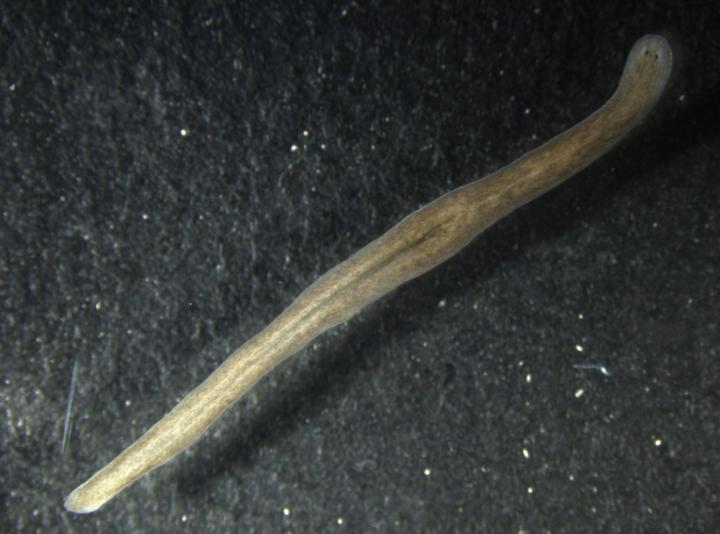
IMAGE

Credit: Northwestern University


The planarian flatworm is a simple animal with a mighty and highly unusual ability: it can regenerate itself from nearly every imaginable injury, including decapitation. These tiny worms can regrow any missing cell or tissue — muscle, neurons, epidermis, eyes, even a new brain.

Since the late 1800s, scientists have studied these worms to better understand fundamental principles of natural regeneration and repair, information that could provide insights into tissue healing and cancer. One mechanism that is yet unknown is how organisms like these control the proportional scaling of tissue during regeneration.

Now, two Northwestern University molecular biologists have identified the beginnings of a genetic signaling pathway that puts the brakes on the animal’s growth. This important process ensures the appropriate amount of tissue growth in these highly regenerative animals.

“These worms have essentially discovered a natural form of regenerative medicine through their evolution,” said Christian Petersen, who led the research. “Planarians can regenerate their whole lives, but how do they limit their growth? Our discovery will improve understanding of the molecular components and organizing principles that govern perfect tissue restoration.”

The findings ultimately may have important ramifications for novel tissue engineering methods or strategies to promote natural repair mechanisms in humans.

Petersen is an associate professor of molecular biosciences in Northwestern’s Weinberg College of Arts and Sciences. He and Erik G. Schad, a graduate student in Petersen’s lab, conducted the study.

The results were published in the Jan. 20 issue of the journal Current Biology. Petersen is the corresponding author, and Schad is the paper’s first author.

The researchers have identified a control system for limiting regeneration and also a new mechanism to explain how stem cells can influence growth. Specifically, Petersen and Schad discovered that a gene called mob4 suppresses tissue growth in the animals. When the researchers inhibited the gene in experiments, the animal grew to twice its normal size.

The gene, they found, works in a rather surprising way: by preventing the descendants of stem cells from producing a growth factor called Wnt, a protein released from cells to communicate across distances. The Wnt signaling pathway is known to play a role in cancer cell regeneration.

Planarians are 2 to 20 millimeters in size and have a complex anatomy with around a million cells. They live in freshwater ponds and streams around the world. The worm’s genome has been sequenced, and its basic biology is well-characterized, making planarians popular with scientists.

###

Petersen also is a member of the Robert H. Lurie Comprehensive Cancer Center of Northwestern University.

The title of the paper is “STRIPAK Limits Stem Cell Differentiation of a WNT Signaling Center to Control Planarian Axis Scaling.”

Media Contact
Megan Fellman
[email protected]
847-491-3115

Related Journal Article

http://dx.doi.org/10.1016/j.cub.2019.11.068

Tags: BiologycancerGenesGeneticsMedicine/HealthMolecular Biology
Share12Tweet8Share2ShareShareShare2

Related Posts

Exercise Leaves Distinct Protein Fingerprints in Blood That Track Memory Gains in Older Adults

Exercise Leaves Distinct Protein Fingerprints in Blood That Track Memory Gains in Older Adults

October 5, 2026
Low Health Literacy Linked to Higher Tobacco Use in Korean Adults, Study Finds

Low Health Literacy Linked to Higher Tobacco Use in Korean Adults, Study Finds

October 5, 2026

When the Skin Tells a Hidden Story: Rethinking Dermatitis Artefacta Care

October 5, 2026

New Scoring System Tracks How Nurse Anesthetists Grow, Month by Month

October 5, 2026
Please login to join discussion

POPULAR NEWS

  • Alloys That Shrink Their Own Grains: New PIX Mechanism Refines Metals With Heat Alone

    Alloys That Shrink Their Own Grains: New PIX Mechanism Refines Metals With Heat Alone

    29 shares
    Share 12 Tweet 7
  • Endurance Exercise Reshapes the Liver in Males and Females Through Distinct Molecular Routes

    29 shares
    Share 12 Tweet 7
  • Single Transcription Factor PU.1 Rapidly Converts Fibroblasts into Macrophage-Lineage Cells

    29 shares
    Share 12 Tweet 7
  • New Scale Measures How Ready Nurse Educators Really Are for the AI Era

    29 shares
    Share 12 Tweet 7

About

We bring you the latest biotechnology news from best research centers and universities around the world. Check our website.

Follow us

Recent News

Alloys That Shrink Their Own Grains: New PIX Mechanism Refines Metals With Heat Alone

Endurance Exercise Reshapes the Liver in Males and Females Through Distinct Molecular Routes

Single Transcription Factor PU.1 Rapidly Converts Fibroblasts into Macrophage-Lineage Cells

Subscribe to Blog via Email

Success! An email was just sent to confirm your subscription. Please find the email now and click 'Confirm' to start subscribing.

Join 85 other subscribers
  • Contact Us

Bioengineer.org © Copyright 2023 All Rights Reserved.

Welcome Back!

Login to your account below

Forgotten Password?

Retrieve your password

Please enter your username or email address to reset your password.

Log In
No Result
View All Result
  • Homepages
    • Home Page 1
    • Home Page 2
  • News
  • National
  • Business
  • Health
  • Lifestyle
  • Science

Bioengineer.org © Copyright 2023 All Rights Reserved.