• HOME
  • NEWS
  • EXPLORE
    • CAREER
      • Companies
      • Jobs
    • EVENTS
    • iGEM
      • News
      • Team
    • PHOTOS
    • VIDEO
    • WIKI
  • BLOG
  • COMMUNITY
    • FACEBOOK
    • INSTAGRAM
    • TWITTER
Thursday, August 13, 2026
BIOENGINEER.ORG
No Result
View All Result
  • Login
  • HOME
  • NEWS
  • EXPLORE
    • CAREER
      • Companies
      • Jobs
        • Lecturer
        • PhD Studentship
        • Postdoc
        • Research Assistant
    • EVENTS
    • iGEM
      • News
      • Team
    • PHOTOS
    • VIDEO
    • WIKI
  • BLOG
  • COMMUNITY
    • FACEBOOK
    • INSTAGRAM
    • TWITTER
  • HOME
  • NEWS
  • EXPLORE
    • CAREER
      • Companies
      • Jobs
        • Lecturer
        • PhD Studentship
        • Postdoc
        • Research Assistant
    • EVENTS
    • iGEM
      • News
      • Team
    • PHOTOS
    • VIDEO
    • WIKI
  • BLOG
  • COMMUNITY
    • FACEBOOK
    • INSTAGRAM
    • TWITTER
No Result
View All Result
Bioengineer.org
No Result
View All Result
Home NEWS Science News Health

Scientists grow precursors for human pigment cells

Bioengineer by Bioengineer
May 9, 2019
in Health
Reading Time: 2 mins read
0
IMAGE
Share on FacebookShare on TwitterShare on LinkedinShare on RedditShare on Telegram

Applications for research on skin cancer and pigmentation disorders
IMAGE

Credit: Kobe University

Our hair, skin and eyes are colored by a pigment called melanin, which is produced by pigment cells called melanocytes. Scientists have used stem cell technology to successfully create melanocyte precursor cells. These cells can be used in research on melanoma and other pigment cell-related illnesses. The findings were published on March 6 in the online edition of Pigment Cell & Melanoma Research.

Abnormalities in pigment cells can affect us in many ways, from genetic disorders such as albinism to freckles caused by aging. When melanocytes become malignant melanoma they cause a type of skin cancer called melanoma. To research and develop cures for these conditions, we need a stable supply of melanocytes. However, isolating melanocytes from human skin requires advanced techniques, and it is difficult to maintain stable primary cultures of adult melanocytes.

Induced pluripotent stem cells (iPS cells) are created from adult skin and blood cells, and they can be differentiated to become many types of human cells. Also known as “regenerative medicine”, stem cell technology enables us to grow cells that can be used in medical treatment and research.

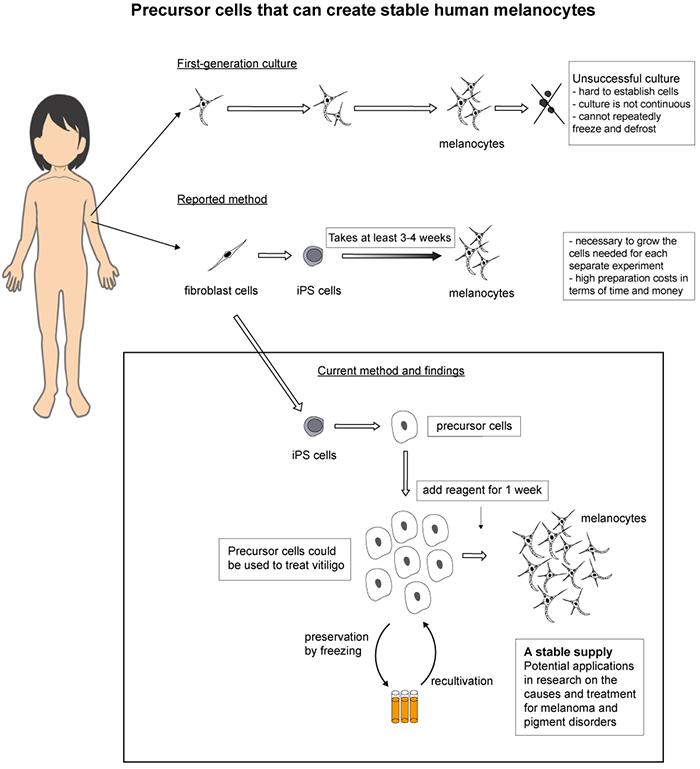
There are already several known methods of creating melanocytes from stem cells. In these protocols, various signal activators (reagents) are added to the cell culture in sequential order during the differentiation process from iPS cells to melanocytes. However, it is very difficult and costly to create melanocytes within the short timespan demanded by medical research.

In this new study, by temporarily pausing the signal activators, the team succeeded in creating precursor cells for melanocytes (Figure 1). These precursor cells are self-renewing in primary cultures and they can also be temporarily frozen. After defrosting them and administering differentiation activators, in just one week they develop into melanocytes. Using these precursor cells, researchers can now create the necessary amount of melanocytes on demand. During this study the team also revealed how these precursor cells can self-replicate without differentiation, and how they differentiate to become mature melanocytes.

This discovery was made by a research group led by members of the Division of Dermatology, Graduate School of Medicine, Kobe University (Professor Chikako Nishigori, Associate Professor Makoto Kunisada, and Researcher Chieko Hosaka), in collaboration with members of the Kobe University Graduate School of Science, Technology and Innovation and Fujita Health University.

With this new method, researchers can flexibly obtain melanocyte samples from both patients suffering pigment disorders and healthy donors. These precursor cells also have potential applications in research on melanoma, melanocyte disorders and aging-related skin hue changes.

###

Media Contact
Eleanor Wyllie
[email protected]

Original Source

http://www.kobe-u.ac.jp/research_at_kobe_en/NEWS/news/2019_05_09_01.html

Related Journal Article

http://dx.doi.org/10.1111/pcmr.12779

Tags: DermatologyMedicine/Health
Share13Tweet8Share2ShareShareShare2

Related Posts

PRAME-Specific T-Cell Therapy Used in Adolescent With Metastatic Kidney Tumor

August 13, 2026

Cathepsin D Hijacking of IL2RG–JAK2 Signaling Disrupts Liver Insulin Action, Study Finds

August 12, 2026

After Sandy, Household Fungal Exposure Linked to Asthma in New York Children

August 12, 2026

Physiological markers linked to levodopa emerge during deep brain stimulation for Parkinson’s

August 12, 2026
Please login to join discussion

POPULAR NEWS

  • PRAME-Specific T-Cell Therapy Used in Adolescent With Metastatic Kidney Tumor

    29 shares
    Share 12 Tweet 7
  • Sustainability-labeled US meats cost more, with premiums ranging from 7% to 33%

    29 shares
    Share 12 Tweet 7
  • Study finds extreme weather increasingly predicts North American bird species distributions

    29 shares
    Share 12 Tweet 7
  • Variation within species drives tropical forests’ resistance to drought

    29 shares
    Share 12 Tweet 7

About

We bring you the latest biotechnology news from best research centers and universities around the world. Check our website.

Follow us

Recent News

PRAME-Specific T-Cell Therapy Used in Adolescent With Metastatic Kidney Tumor

Sustainability-labeled US meats cost more, with premiums ranging from 7% to 33%

Study finds extreme weather increasingly predicts North American bird species distributions

Subscribe to Blog via Email

Enter your email address to subscribe to this blog and receive notifications of new posts by email.

Join 86 other subscribers
  • Contact Us

Bioengineer.org © Copyright 2023 All Rights Reserved.

Welcome Back!

Login to your account below

Forgotten Password?

Retrieve your password

Please enter your username or email address to reset your password.

Log In
No Result
View All Result
  • Homepages
    • Home Page 1
    • Home Page 2
  • News
  • National
  • Business
  • Health
  • Lifestyle
  • Science

Bioengineer.org © Copyright 2023 All Rights Reserved.