The team of Professor Michal Hocek at IOCB Prague explores the limits of the structure and function of DNA and successfully pushes forward known boundaries. An article presenting the results of their latest research has just been published in the major scientific journal Nucleic Acids Research. They prove that even heavily modified double helices of DNA are stable enough to be used for special applications. This discovery might expand the possibilities of utilizing modified DNA, for example, in medicine.
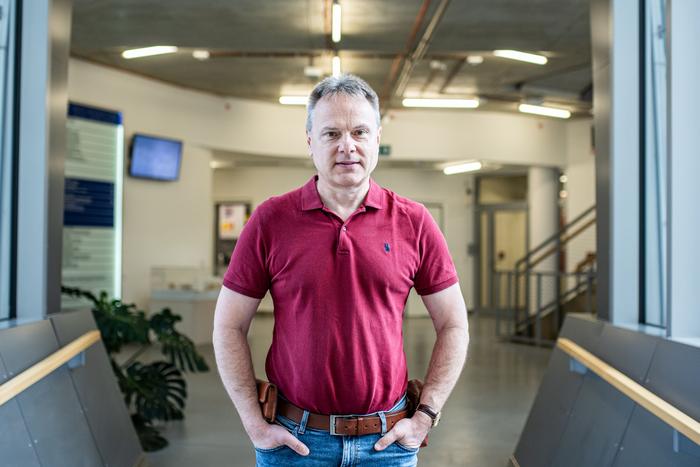
Credit: Photo: Tomáš Belloň / IOCB Prague
The team of Professor Michal Hocek at IOCB Prague explores the limits of the structure and function of DNA and successfully pushes forward known boundaries. An article presenting the results of their latest research has just been published in the major scientific journal Nucleic Acids Research. They prove that even heavily modified double helices of DNA are stable enough to be used for special applications. This discovery might expand the possibilities of utilizing modified DNA, for example, in medicine.
DNA consists of two long negatively charged chains that hold together even though they repel each other. This is made possible by what is known as stacking interactions and base pairing. Michal Hocek and his colleagues advanced the known limits when they modified DNA by adding an extra negative charge to each letter of the genetic code. This doubled the repulsive forces, yet the DNA double helix remained stable. They also found that such modified DNA not only holds together but that it can also be synthesized or replicated and sequenced using the enzyme DNA polymerase.
‘Think of DNA as a scaffold on which you can attach various chemical compounds with different functions. These are small molecules, such as side chains of amino acids, which occur naturally only in peptides and proteins. In current medicine, we are able to use these molecules only to a relatively limited extent. The reason is that they are markedly unstable and get decomposed rapidly when inside an organism. One solution to this would be a stable skeleton to which they could be firmly attached. And DNA could be just such a base structure in the future,’ says Prof. Michal Hocek.
The aim of this research carried out at IOCB Prague is to create DNA molecules that will mimic other chemical compounds. This would enable us to leverage the medicinal potential of certain biomolecules that are difficult to retain in the body. Examples of such biomolecules are the already mentioned peptides or proteins.
The Hocek group has already made significant progress, although research in this direction is at its beginning worldwide. The team has, for example, succeeded at developing a novel modified aptamer, which is a short DNA sequence that can bind to a specific target molecule, most frequently a protein. Aptamers have similar properties to antibodies, but they are much more stable. For this reason, aptamers can potentially replace antibodies employed in medicine. However, the number of approved therapeutic aptamers globally can still be counted on the fingers of one hand.
The current research exploring the limits of DNA is part of a larger project led by Michal Hocek, for which he has secured a prestigious EXPRO grant from the Czech Science Foundation. This is the second time its results have drawn interest from the journal Nucleic Acids Research. Previously, scientists from IOCB Prague published a method for the enzymatic synthesis of fully artificial DNA. During this synthesis, all nucleotides forming natural DNA are replaced by their modified versions with attached hydrophobic (i.e. water-repelling) molecules.
Original article: Kuprikova, N.; Ondruš, M.; Bednárová, L.; Riopedre-Fernandez, M.; Slavětínská, Lenka P.; Sýkorová, V.; Hocek, M. Superanionic DNA: enzymatic synthesis of hypermodified DNA bearing four different anionic substituents at all four nucleobases. Nucleic Acids Res. 2023, gkad893. https://doi.org/10.1093/nar/gkad893
The Institute of Organic Chemistry and Biochemistry of the Czech Academy of Sciences / IOCB Prague (www.uochb.cz) is a leading internationally recognized scientific institution whose primary mission is the pursuit of basic research in chemical biology and medicinal chemistry, organic and materials chemistry, chemistry of natural substances, biochemistry and molecular biology, physical chemistry, theoretical chemistry, and analytical chemistry. An integral part of the IOCB Prague’s mission is the implementation of the results of basic research in practice. Emphasis on interdisciplinary research gives rise to a wide range of applications in medicine, pharmacy, and other fields.
Journal
Nucleic Acids Research
DOI
10.1093/nar/gkad893
Method of Research
Experimental study
Article Title
Superanionic DNA: enzymatic synthesis of hypermodified DNA bearing four different anionic substituents at all four nucleobases
Article Publication Date
23-Oct-2023