• HOME
  • NEWS
  • EXPLORE
    • CAREER
      • Companies
      • Jobs
    • EVENTS
    • iGEM
      • News
      • Team
    • PHOTOS
    • VIDEO
    • WIKI
  • BLOG
  • COMMUNITY
    • FACEBOOK
    • INSTAGRAM
    • TWITTER
Wednesday, May 13, 2026
BIOENGINEER.ORG
No Result
View All Result
  • Login
  • HOME
  • NEWS
  • EXPLORE
    • CAREER
      • Companies
      • Jobs
        • Lecturer
        • PhD Studentship
        • Postdoc
        • Research Assistant
    • EVENTS
    • iGEM
      • News
      • Team
    • PHOTOS
    • VIDEO
    • WIKI
  • BLOG
  • COMMUNITY
    • FACEBOOK
    • INSTAGRAM
    • TWITTER
  • HOME
  • NEWS
  • EXPLORE
    • CAREER
      • Companies
      • Jobs
        • Lecturer
        • PhD Studentship
        • Postdoc
        • Research Assistant
    • EVENTS
    • iGEM
      • News
      • Team
    • PHOTOS
    • VIDEO
    • WIKI
  • BLOG
  • COMMUNITY
    • FACEBOOK
    • INSTAGRAM
    • TWITTER
No Result
View All Result
Bioengineer.org
No Result
View All Result
Home NEWS Science News Chemistry

Scientists find new way to sustainably make chemicals by copying nature’s tricks

Bioengineer by Bioengineer
January 6, 2020
in Chemistry
Reading Time: 3 mins read
0
IMAGE
Share on FacebookShare on TwitterShare on LinkedinShare on RedditShare on Telegram

IMAGE

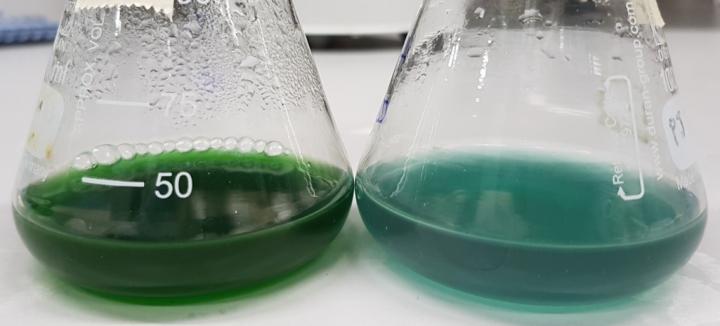
Credit: Patrik Jones/Imperial College London

Researchers have copied the way organisms produce toxic chemicals without harming themselves, paving the way for greener chemical and fuel production.

The new technique, pioneered by Imperial College London scientists, could reduce the need to use fossil fuels to create chemicals, plastics, fibres and fuels.

Currently, many useful chemicals are produced from fossil fuels, which require mining, are of limited supply, and disrupt the carbon cycle. An alternative is to engineer microorganisms like Escherichia coli (E. coli) and cyanobacteria to more sustainably produce the chemicals directly from atmospheric carbon dioxide.

However, many of the chemicals that can be produced this way are toxic to the microorganisms, reducing their ability to make large quantities in a cost-effective way.

Now, by copying the way natural organisms deal with their own toxic chemicals, researchers have shown that bacteria can be programmed to produce chemicals without also harming growth.

This concept could be used to produce useful chemicals, plastics and even fuels, which could further reduce the need for fossil fuels and help minimise climate change. The new technique and a first proof of concept are published today in Proceedings of the National Academy of Sciences.

Lead researcher Dr Patrik Jones, from the Department of Life Sciences at Imperial, said: “We looked at what nature does already, for its own benefit, and applied the idea to biotechnology, for our benefit.”

Organisms like plants and yeasts sometimes produce chemicals that are toxic to them, so to store them safely, they make small modifications to the chemicals to render them harmless. The resulting chemicals are known as ‘derivatives’, and can be returned to the original, toxic form through relatively simple chemistry.

The team took this idea and used genetic engineering to program E. coli and cyanobacteria to make 1-octanol, a chemical currently used in perfumes, which is toxic to the bacteria. They then added an extra set of instructions to E. coli so it would produce two different derivatives of 1-octanol that are both less harmful.

The researchers say if this were to be scaled up for industrial systems the engineered bacteria would produce the non-toxic derivative of 1-octanol, which would then be recovered and chemically transformed back into 1-octanol, ready for use.

The team found that their system produced 1-octanol without affecting the growth of the bacteria. They also found the system produced more 1-octanol than a system without the derivatization step, which they think is related to the fact that the derivative is not only less toxic but also more soluble in the surrounding water or solvent.

Dr Jones said: “A more soluble chemical may move away from the cells quicker, where it’s less likely to interfere with any of the bacteria’s processes.”

Now the team has shown the concept of creating derivatives using programmed microorganisms, they want to set up a complete system, from production of the derivative to recovery of the desired chemical.

This will help them refine the process, and potentially scale it up for use in industrial settings.

###

The research was funded by the European Union’s Horizon 2020 programme.

Media Contact
Hayley Dunning
[email protected]
020-759-42412

Original Source

https://www.imperial.ac.uk/news/194607/scientists-find-sustainably-make-chemicals-copying/

Related Journal Article

http://dx.doi.org/10.1073/pnas.1914069117

Tags: BacteriologyBiochemistryBiologyBiomedical/Environmental/Chemical EngineeringBiotechnology
Share12Tweet8Share2ShareShareShare2

Related Posts

How Olympic Weightlifting Harnesses the Barbell’s ‘Whip’ for Peak Performance #ASA190 — Chemistry

How Olympic Weightlifting Harnesses the Barbell’s ‘Whip’ for Peak Performance #ASA190

May 13, 2026
Just how effective are torpedo bats? #ASA190 — Chemistry

Just how effective are torpedo bats? #ASA190

May 13, 2026

Liquid-like Behavior Observed in Gold Nanoparticles

May 13, 2026

Vortex-Induced Triboelectric Nanogenerator Enables Efficient Multidirectional Wind Energy Harvesting in Low Wind and High Humidity Conditions

May 13, 2026
Please login to join discussion

POPULAR NEWS

  • Research Indicates Potential Connection Between Prenatal Medication Exposure and Elevated Autism Risk

    842 shares
    Share 337 Tweet 211
  • New Study Reveals Plants Can Detect the Sound of Rain

    728 shares
    Share 290 Tweet 182
  • Salmonella Haem Blocks Macrophages, Boosts Infection

    62 shares
    Share 25 Tweet 16
  • Breastmilk Balances E. coli and Beneficial Bacteria in Infant Gut Microbiomes

    57 shares
    Share 23 Tweet 14

About

We bring you the latest biotechnology news from best research centers and universities around the world. Check our website.

Follow us

Recent News

Engineered Water Channels Boost MRI Nanoprobe Sensitivity

Fearless Young Scientist Reveals Hidden Biodiversity in Snow and Glacier Ecosystems of Remote Antarctic Island

Boosting Microglia Repair Accelerates Stroke Recovery

Subscribe to Blog via Email

Success! An email was just sent to confirm your subscription. Please find the email now and click 'Confirm' to start subscribing.

Join 82 other subscribers
  • Contact Us

Bioengineer.org © Copyright 2023 All Rights Reserved.

Welcome Back!

Login to your account below

Forgotten Password?

Retrieve your password

Please enter your username or email address to reset your password.

Log In
No Result
View All Result
  • Homepages
    • Home Page 1
    • Home Page 2
  • News
  • National
  • Business
  • Health
  • Lifestyle
  • Science

Bioengineer.org © Copyright 2023 All Rights Reserved.