• HOME
  • NEWS
  • EXPLORE
    • CAREER
      • Companies
      • Jobs
    • EVENTS
    • iGEM
      • News
      • Team
    • PHOTOS
    • VIDEO
    • WIKI
  • BLOG
  • COMMUNITY
    • FACEBOOK
    • INSTAGRAM
    • TWITTER
Sunday, October 4, 2026
BIOENGINEER.ORG
No Result
View All Result
  • Login
  • HOME
  • NEWS
  • EXPLORE
    • CAREER
      • Companies
      • Jobs
        • Lecturer
        • PhD Studentship
        • Postdoc
        • Research Assistant
    • EVENTS
    • iGEM
      • News
      • Team
    • PHOTOS
    • VIDEO
    • WIKI
  • BLOG
  • COMMUNITY
    • FACEBOOK
    • INSTAGRAM
    • TWITTER
  • HOME
  • NEWS
  • EXPLORE
    • CAREER
      • Companies
      • Jobs
        • Lecturer
        • PhD Studentship
        • Postdoc
        • Research Assistant
    • EVENTS
    • iGEM
      • News
      • Team
    • PHOTOS
    • VIDEO
    • WIKI
  • BLOG
  • COMMUNITY
    • FACEBOOK
    • INSTAGRAM
    • TWITTER
No Result
View All Result
Bioengineer.org
No Result
View All Result
Home NEWS Science News Health

Scientists engineer mouse ‘smart house’ to study behavior

Bioengineer by Bioengineer
March 7, 2019
in Health
Reading Time: 2 mins read
0
IMAGE
Share on FacebookShare on TwitterShare on LinkedinShare on RedditShare on Telegram

IMAGE

Credit: Andrew Erskine

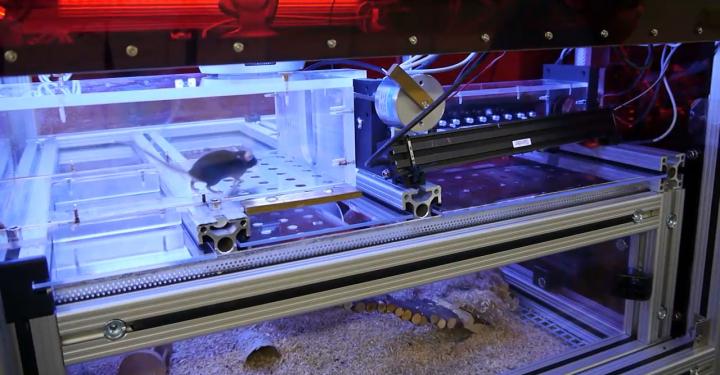
Researchers at the Francis Crick Institute have developed a ‘smart house’ for mice, that allows them to study the animals’ behaviour with minimal disturbance for periods of up to 18 months.

The ‘Autonomouse’ system improves animal welfare whilst simultaneously enhancing the efficiency and reliability of research findings. The team of scientists and engineers behind it have openly published the design and software of the system in PLOS ONE so that other labs can build their own.

“We want to understand how the brain works, and for that we need to measure behaviour,” explains Andreas Schaefer, Group Leader at the Crick who led the project. “In mice, this is normally done in a very manual and laborious way, which limits the amount of questions we can ask. So we thought of a more efficient way of doing this by getting animals to train themselves.”

In Autonomouse, groups of mice live together in an enriched environment with running wheels, ladders and unlimited access to food and water. Each mouse is tagged with a unique microchip – like those used for household pets – so that researchers can carefully monitor its activity levels, weight and water consumption.

The microchip also acts as an ID pass to access training: When a mouse enters the training room, a door closes behind it, temporarily preventing other mice from entering while it carries out a learning task for a reward. Data from the learning task is automatically recorded, and linked to the unique mouse ID.

“Working with an unstressed, group-housed cohort of mice that train themselves at the time of day that suits them, without the intervention of researchers over long periods of time, makes our experiments better and more efficient,” says Andreas.

People from the Crick’s Biological Research Facility, Mechanical Engineering, Electronics and the Making lab, who helped create this system were recently awarded a Crick prize for improving animal welfare.

###

Media Contact
Greta Keenan
[email protected]

Original Source

https://www.crick.ac.uk/news/2019-03-07_scientists-engineer-mouse-smart-house-to-study-behaviour

Related Journal Article

http://dx.doi.org/10.1371/journal.pone.0211571

Tags: BehaviorBiotechnologyneurobiologyTechnology/Engineering/Computer Science
Share12Tweet8Share2ShareShareShare2

Related Posts

Forskolin Extract Boosts Gut Hormone GLP-1 and Strengthens Intestinal Barrier in Cell Study

Forskolin Extract Boosts Gut Hormone GLP-1 and Strengthens Intestinal Barrier in Cell Study

October 4, 2026
Empathy, Not Mood, Drives Helping in Autistic Children, Study Finds

Empathy, Not Mood, Drives Helping in Autistic Children, Study Finds

October 4, 2026

Nose-to-Brain Protein Delivery Shows Promise for Protecting Dopamine Neurons in Parkinson’s Models

October 4, 2026

Doctors Reveal Why Opioid Care Fails Indigenous Patients in Canada

October 4, 2026
Please login to join discussion

POPULAR NEWS

  • Alloys That Shrink Their Own Grains: New PIX Mechanism Refines Metals With Heat Alone

    Alloys That Shrink Their Own Grains: New PIX Mechanism Refines Metals With Heat Alone

    29 shares
    Share 12 Tweet 7
  • Endurance Exercise Reshapes the Liver in Males and Females Through Distinct Molecular Routes

    29 shares
    Share 12 Tweet 7
  • Single Transcription Factor PU.1 Rapidly Converts Fibroblasts into Macrophage-Lineage Cells

    29 shares
    Share 12 Tweet 7
  • New Scale Measures How Ready Nurse Educators Really Are for the AI Era

    29 shares
    Share 12 Tweet 7

About

We bring you the latest biotechnology news from best research centers and universities around the world. Check our website.

Follow us

Recent News

Alloys That Shrink Their Own Grains: New PIX Mechanism Refines Metals With Heat Alone

Endurance Exercise Reshapes the Liver in Males and Females Through Distinct Molecular Routes

Single Transcription Factor PU.1 Rapidly Converts Fibroblasts into Macrophage-Lineage Cells

Subscribe to Blog via Email

Enter your email address to subscribe to this blog and receive notifications of new posts by email.

Join 85 other subscribers
  • Contact Us

Bioengineer.org © Copyright 2023 All Rights Reserved.

Welcome Back!

Login to your account below

Forgotten Password?

Retrieve your password

Please enter your username or email address to reset your password.

Log In
No Result
View All Result
  • Homepages
    • Home Page 1
    • Home Page 2
  • News
  • National
  • Business
  • Health
  • Lifestyle
  • Science

Bioengineer.org © Copyright 2023 All Rights Reserved.