San Juan, Puerto Rico – Scientists have discovered three new hydrothermal vent fields over a 434-mile-long stretch of the Mid-Atlantic Ridge during the first scientific expedition aboard Schmidt Ocean Institute’s recently launched research vessel Falkor (too).
Credit: Schmidt Ocean Institute
San Juan, Puerto Rico – Scientists have discovered three new hydrothermal vent fields over a 434-mile-long stretch of the Mid-Atlantic Ridge during the first scientific expedition aboard Schmidt Ocean Institute’s recently launched research vessel Falkor (too).
The multidisciplinary science team representing 11 institutions from the United States, Canada, and France used advanced ocean technologies to make the discovery. Scientists used autonomous and remotely operated underwater vehicles resulting in 65 square miles (170 square kilometers) of seafloor mapped at one-meter scale resolution, an area approximately the size of Manhattan Island.
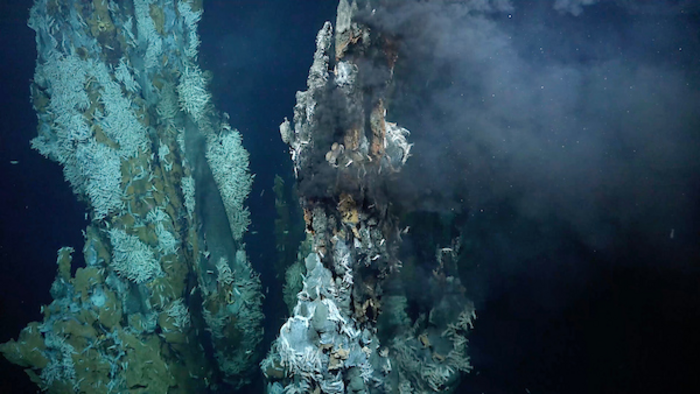
The discovery of the active hydrothermal vents is the first on this section of the world’s longest underwater mountain range, the mid-Atlantic Ridge, in more than 40 years. One of the discovered vent fields was located at the Puy des Folles volcano and has five active sites over 6.95 square miles (18 square kilometers). High-temperature ‘black smoker’ vents were also found at the Grappe Deux vent system and Kane Fracture Zone.
“This cruise exceeded expectations with the discovery of so many amazing hydrothermal vents vibrant with life,” said Dr. Jyotika Virmani, executive director of Schmidt Ocean Institute. “We are delighted with the new capability that Falkor (too) brings to the ocean science community, including the ability to put multiple different types of technology in the water simultaneously. The dedication of the scientists and crew, along with the capabilities of the ship, was evident in the success of this expedition and we look forward to more.”
The Mid-Atlantic ridge is a target area for deep-sea mining and exists in international waters, also known as “The High Seas”. All mineral-resources-related activities in the area are regulated by the International Seabed Authority, established by the United Nations. The ISA is currently considering whether to allow deep sea mining.
Active hydrothermal vents are rich in metal sulfide deposits– mineral ore often affiliated with copper and zinc. In exploring the vents for the first time, scientists found rich biological communities. The vents were teeming with marine life including massive swarms of vent shrimp and a rare sighting of big fin squid. Many species found on vents live off chemical energy (chemosynthesis) instead of energy from sunlight, which doesn’t reach those depths.
Scientists are still learning about how these ecosystems function and the role they play for cycling carbon on our planet. The impacts deep-sea mining would have on hydrothermal vent ecosystems is unknown, and the discovery of active marine life underscores the need for more research to understand the effects.
“Regional Environmental Management Plans for regulating ocean mining require accurate scientific data on the presence of animal communities and an understanding of how sites are colonized,” said Chief Scientist, Dr. David Butterfield, Principal Research Scientist with the Cooperative Institute for Climate, Ocean, and Ecosystem Studies at the University of Washington and Group Leader for the Earth Ocean Interactions Program at NOAA Pacific Marine Environmental Lab in Seattle. “There is some agreement that sites with active venting and chemosynthetic vent fauna communities should be excluded from mining because of the very limited extent of hydrothermal vent habitat, which is restricted to a narrow band of activity on the global mid-ocean ridge system.”
The inaugural 40-day expedition on R/V Falkor (too) began in March. The new vessel will be utilized for global ocean exploration, focused on a new region of the world each year. The next expedition will begin April 17 exploring deep sea coral.
“Falkor (too)’s inaugural expedition has demonstrated all that’s possible when you bring together scientists from around the world and give them access to the latest tools and technology, all aboard a collaborative floating laboratory,” said Wendy Schmidt, co-founder and president of Schmidt Ocean Institute. “The discoveries on this expedition underscore how much we have yet to learn about deep sea ecosystems—and why, before marching ahead with mining or other potentially damaging activities, we need to learn more about our unknown ocean.”