


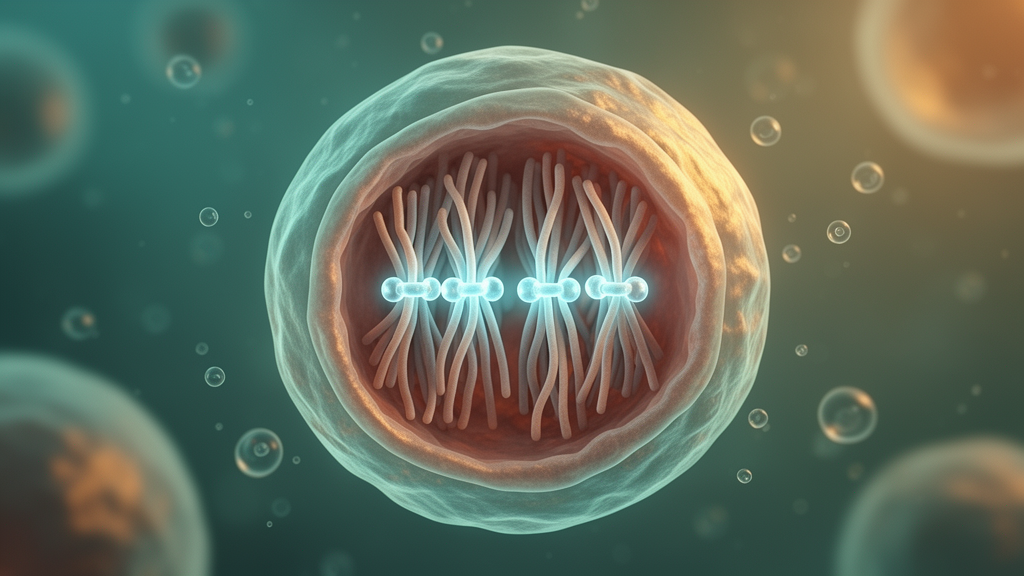
Human eggs are built to last. Every egg a woman will ever ovulate is formed before she is born, then held in a state of suspended development that can stretch across decades. During that long wait, the egg depends on a molecular structure called REC8 cohesin to keep its chromosomes correctly paired, and because this protein is never replenished, its slow deterioration is considered a major reason why eggs from older women more often carry the wrong number of chromosomes. A new study from researchers in Japan, published in the journal Nature Aging on October 29, 2026, reports the discovery of a previously unknown protein that appears to help maintain this fragile cohesion machinery in immature egg cells, keeping it in place from fetal life through adulthood.
The protein has been named OMC1, short for Oocyte-specific Meiotic Chromosome protein 1. The research team was led by Professor Kei-ichiro Ishiguro of the Graduate School of Medicine at Chiba University, with co-authors including Sakie Iisaka and Dr. Ryuki Shimada of Chiba University and Dr. Tomoya S. Kitajima and Dr. Shuhei Yoshida of the RIKEN Center for Biosystems Dynamics Research. Their work, conducted primarily in mice, suggests that egg cells are not simply left to watch their cohesin decay passively. Instead, at least one active maintenance factor appears to work continuously to hold the molecular glue on the chromosomes for as long as possible.
To understand why such a factor would matter, it helps to consider how differently eggs and sperm age. Sperm cells are produced continuously from puberty onward, so each sperm carries freshly assembled chromosomes. Eggs follow the opposite strategy. All of them are generated during the fetal stage, and each one then enters a dormant state known as the dictyate stage, in which the specialized cell division process called meiosis is paused partway through. This arrest ends only when the egg is ovulated, which in humans may occur thirty, forty, or even fifty years after the egg was formed. Throughout that interval, REC8 cohesin acts like a glue holding together the chromosome copies that were created before the division paused, keeping them properly organized so they can later be separated accurately.
The problem is that REC8 is irreplaceable. Once the egg enters its dormant period, no new REC8 is made, so whatever supply the egg starts with must last its entire reproductive lifetime. As the cohesin gradually weakens with age, chromosomes become more likely to mis-segregate when meiosis resumes. The resulting condition, aneuploidy, in which an egg ends up with the wrong number of chromosomes, is a leading cause of miscarriage, infertility, and chromosomal disorders such as Down syndrome. Before this study, it remained unclear whether egg cells possess any active mechanism to protect their cohesin, or whether the protein simply degrades over time while the egg waits.
The search for an answer began with a comparison of gene activity. Using single-cell RNA sequencing, the researchers compared fetal immature eggs, known as oocytes, with male germ cells, which do not undergo the same prolonged arrest. By combining this comparison with data from mice in which meiosis is delayed, the team identified a previously uncharacterized gene that is active specifically in oocytes shortly before they enter the dormant stage. They named the gene Omc1 and its protein product OMC1. Further experiments showed that the OMC1 protein sits on the chromosomes of the egg at the same locations as REC8 cohesin, and that it remains there from the fetal stage throughout adulthood, mirroring the long tenure of the glue it appears to protect.
Demonstrating what a protein actually does requires removing it, so the team engineered mice lacking a functional Omc1 gene. The consequences for their eggs were striking. Once the eggs entered their long dormant period, REC8 cohesin began disappearing from the chromosomes earlier than normal. Even eggs from young mice showed weakened chromosome cohesion and errors in chromosome separation resembling those frequently observed in aged eggs. In other words, losing OMC1 made young oocytes behave, in this specific chromosomal respect, like much older ones, pointing to OMC1 as a factor that normally delays the loss of cohesion rather than creating it.
The most consequential experiment came next. When the researchers restored OMC1 in adult oocytes, REC8 levels on the chromosomes partly recovered and chromosome errors decreased. This rescue experiment suggests that OMC1 does not merely sit passively beside the cohesin but actively works to keep REC8 in place on the chromosomes. Professor Ishiguro framed the finding carefully, noting that based on these results, OMC1 should be regarded not as a factor that stops aging itself, but as a maintenance factor that extends the chromosomal lifespan of eggs. The distinction matters: the protein slows the decline of one critical structure rather than reversing the aging process of the cell as a whole.
The study also connects to human genetics. Previous research has identified variants in CCDC201, the human counterpart of the mouse Omc1 gene, that are associated with early menopause and loss of ovarian function. To probe whether such variants could have a real functional effect, the team tested a truncated mouse OMC1 protein corresponding to one of the human CCDC201 variants. The truncated protein failed to localize to oocyte chromosomes and could not restore chromosome cohesion. These findings suggest that impaired OMC1 or CCDC201 function may contribute to variation in reproductive aging, offering a possible mechanistic explanation for a genetic association that had previously lacked one.
It is important to read these results with their scope in mind. The core experiments were performed in mice, an experimental study using animal models, and mouse and human oocytes, while sharing fundamental meiotic machinery, are not identical. The rescue of REC8 levels in adult oocytes was partial, not complete, and the researchers did not demonstrate improved fertility outcomes in living animals. The human genetic link rests on an association between CCDC201 variants and earlier menopause, together with a functional test of one corresponding truncated protein in the mouse system. What the study establishes is a plausible mechanism, a candidate maintenance factor whose loss accelerates cohesion decline and whose restoration partly repairs it, rather than a treatment or a diagnostic test ready for clinical use.
Even with those caveats, the implications reach into a broadly discussed area of reproductive health. In societies where the average age at childbirth is rising, the age-related decline in egg quality has become an increasingly pressing scientific and social question. Professor Ishiguro commented that revealing part of the mechanism protecting chromosome cohesion from age-related decline is highly significant in modern society, where people are increasingly having children later in life, and that in the longer term these findings may contribute to approaches for understanding, assessing, or potentially mitigating the decline in egg quality. Such statements describe long-term research directions, not near-term clinical options, and no intervention based on OMC1 currently exists for people.
The researchers themselves look further ahead. Within the next decade, they suggest, scientists may find safe ways to preserve or supplement OMC1 function before cohesin is irreversibly lost, establishing a foundation for strategies aimed at maintaining oocyte quality and extending fertility. That vision, articulated in the news release accompanying the paper, remains speculative and would require years of additional work in animal models and, eventually, careful evaluation in human cells before any application could be contemplated. For now, the study’s lasting contribution is conceptual: it shows that the egg’s decades-long vigil over its chromosomes is not a passive countdown but an actively defended state, and it names one of the defenders. Identifying OMC1 turns an open question about why eggs fail with age into a concrete molecular target, and gives researchers studying reproductive aging a specific, testable place to look next.
Subject of Research: A mouse study identifying the protein OMC1 as a maintenance factor that preserves chromosome cohesion in oocytes across reproductive life.
Article Title: Understanding how eggs keep their chromosomes intact over decades
Article References: Understanding how eggs keep their chromosomes intact over decades. Original publication (Bibliographic details unavailable.)
Image Credits: AI Generated
DOI: Not provided
Keywords: OMC1, REC8 cohesin, oocytes, chromosome cohesion, aneuploidy, reproductive aging, meiosis, CCDC201, Nature Aging, fertility, Chiba University, mouse study
News Source: Beatrice Stafford. (October 30, 2026). Scientists discover protein that keeps egg chromosomes glued together for decades. Scienmag.



