• HOME
  • NEWS
  • EXPLORE
    • CAREER
      • Companies
      • Jobs
    • EVENTS
    • iGEM
      • News
      • Team
    • PHOTOS
    • VIDEO
    • WIKI
  • BLOG
  • COMMUNITY
    • FACEBOOK
    • INSTAGRAM
    • TWITTER
Saturday, June 27, 2026
BIOENGINEER.ORG
No Result
View All Result
  • Login
  • HOME
  • NEWS
  • EXPLORE
    • CAREER
      • Companies
      • Jobs
        • Lecturer
        • PhD Studentship
        • Postdoc
        • Research Assistant
    • EVENTS
    • iGEM
      • News
      • Team
    • PHOTOS
    • VIDEO
    • WIKI
  • BLOG
  • COMMUNITY
    • FACEBOOK
    • INSTAGRAM
    • TWITTER
  • HOME
  • NEWS
  • EXPLORE
    • CAREER
      • Companies
      • Jobs
        • Lecturer
        • PhD Studentship
        • Postdoc
        • Research Assistant
    • EVENTS
    • iGEM
      • News
      • Team
    • PHOTOS
    • VIDEO
    • WIKI
  • BLOG
  • COMMUNITY
    • FACEBOOK
    • INSTAGRAM
    • TWITTER
No Result
View All Result
Bioengineer.org
No Result
View All Result
Home NEWS Science News Chemistry

Scientists discover how malaria parasites import sugar

Bioengineer by Bioengineer
January 29, 2020
in Chemistry
Reading Time: 2 mins read
0
IMAGE
Share on FacebookShare on TwitterShare on LinkedinShare on RedditShare on Telegram

IMAGE

Credit: David Drew


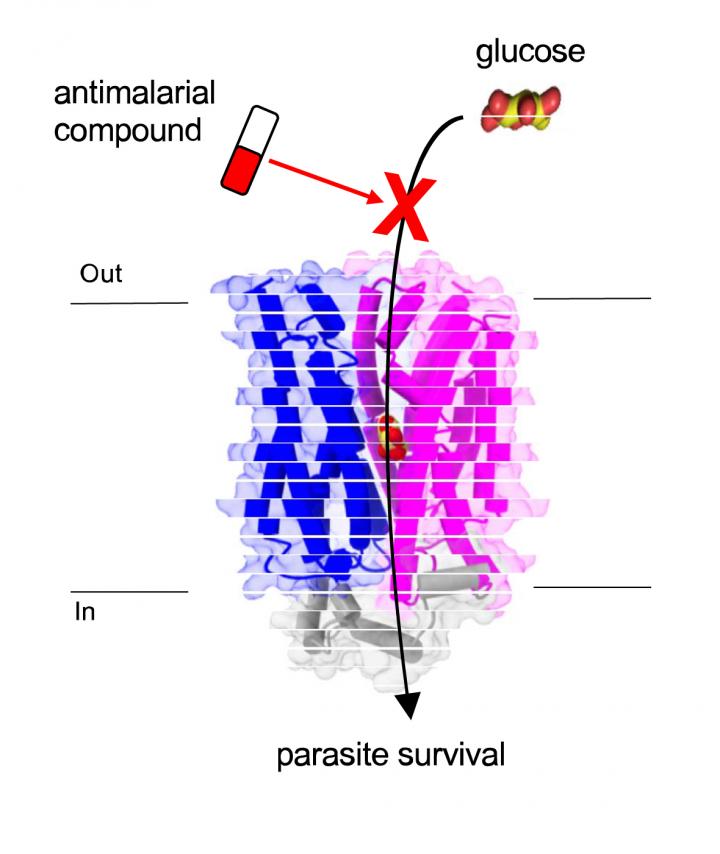
The consumption of sugar is a fundamental source of fuel in most living organisms. In the malaria parasite Plasmodium falciparum, the uptake of glucose is essential to its life cycle. Like in other cells, sugar is transported into the parasite by a transport protein – a door designed for sugar to pass through the cell membrane. The details in how this door works has now been revealed.

“By elucidating the atomic structure of the sugar-transporting-protein PfHT1, we can better understand how glucose is transported into the parasite”, says David Drew, Wallenberg Scholar at the Department of Biochemistry and Biophysics and leading the study at Stockholm University.

The main goal of the research is basic understanding of this important biological process, but with the potential for development of new antimalarial drugs. Malaria kills almost half a million persons each year, according to the WHO. By blocking the door for sugar, it has been shown that one can stop the growth of the malaria parasites.

“It’s a long process from a compound with antimalarial activity to a drug that can be taken in the clinic. However, with this knowledge one can improve known antimalarial compounds so that they are more specific to the malarial transporter, so they do not have the side-effect of stopping sugar transport into our own cells. As such, this knowledge increases the likelihood that more specific compounds can be developed into a successful drug”, says David Drew.

Despite million’s years of evolution between parasites and humans the research show that glucose is surprisingly captured by the sugar transporting protein in malaria parasites in a similar manner as by transporters in the human brain.

“This conservation reflects the fundamental importance of sugar uptake – basically, nature hit on a winning concept and stuck with it”, says David Drew.

However, the malaria parasite is more flexible. Other sugars, such as fructose, can also be imported. This flexibility could give a selective advantage to the malaria parasite so that it can survive under conditions when its preferred energy source glucose is unavailable.

“Every biochemistry student is taught about the process of sugar transport and it is exciting to add another important piece to this puzzle”, says Lucie Delemotte, Associate Professor of Biophysics at KTH Royal Institute of Technology and Science for Life Laboratory Fellow, who collaborated on this project.

###

The article “The molecular basis for sugar import in malaria parasites” is published in the scientific journal Nature.

The research was funded by The Knut and Alice Wallenberg foundation and Science for Life Laboratory.

Media Contact
David Drew
[email protected]
0046-816-2295

Related Journal Article

http://dx.doi.org/10.1038/s41586-020-1963-z

Tags: BiochemistryBiologyCell BiologyChemistry/Physics/Materials SciencesDisease in the Developing WorldMedicine/HealthPharmaceutical SciencePharmaceutical Sciences
Share12Tweet8Share2ShareShareShare2

Related Posts

AI and Physics Collaborate to Design Advanced Hydrogen Storage Materials

June 25, 2026

International Team Including Dresden Scientists Develops Novel Designer Proteins for Advanced Study of Living Tissue

June 25, 2026

New Study Uncovers Key Factors Driving Water Chemistry in Nanoscale Environments

June 25, 2026

Plasma Technology Extends Catalyst Lifespan in Hydrogen Production

June 24, 2026
Please login to join discussion

POPULAR NEWS

  • Saying Goodbye to PGY-6: Pediatric Fellowship Realities

    103 shares
    Share 41 Tweet 26
  • Multi-Hospital Study Reveals Long Covid Burden Is Twice as High as Current Estimates

    92 shares
    Share 36 Tweet 23
  • Detection of EDCs in Breast Milk and Infant Urine Up to Six Months Highlights Early Exposure Risks

    77 shares
    Share 31 Tweet 19
  • New Drug Candidate Developed at McMaster Shows Potential for Treating Brain Cancer

    58 shares
    Share 23 Tweet 15

About

We bring you the latest biotechnology news from best research centers and universities around the world. Check our website.

Follow us

Recent News

Tracking Lanthanide-Labeled Microplastics in Plants

POSTECH Researchers Slash Cost of Reconstituted Cell-Free Systems by 95%

AI and Physics Collaborate to Design Advanced Hydrogen Storage Materials

Subscribe to Blog via Email

Success! An email was just sent to confirm your subscription. Please find the email now and click 'Confirm' to start subscribing.

Join 82 other subscribers
  • Contact Us

Bioengineer.org © Copyright 2023 All Rights Reserved.

Welcome Back!

Login to your account below

Forgotten Password?

Retrieve your password

Please enter your username or email address to reset your password.

Log In
No Result
View All Result
  • Homepages
    • Home Page 1
    • Home Page 2
  • News
  • National
  • Business
  • Health
  • Lifestyle
  • Science

Bioengineer.org © Copyright 2023 All Rights Reserved.