• HOME
  • NEWS
  • EXPLORE
    • CAREER
      • Companies
      • Jobs
    • EVENTS
    • iGEM
      • News
      • Team
    • PHOTOS
    • VIDEO
    • WIKI
  • BLOG
  • COMMUNITY
    • FACEBOOK
    • INSTAGRAM
    • TWITTER
Saturday, August 22, 2026
BIOENGINEER.ORG
No Result
View All Result
  • Login
  • HOME
  • NEWS
  • EXPLORE
    • CAREER
      • Companies
      • Jobs
        • Lecturer
        • PhD Studentship
        • Postdoc
        • Research Assistant
    • EVENTS
    • iGEM
      • News
      • Team
    • PHOTOS
    • VIDEO
    • WIKI
  • BLOG
  • COMMUNITY
    • FACEBOOK
    • INSTAGRAM
    • TWITTER
  • HOME
  • NEWS
  • EXPLORE
    • CAREER
      • Companies
      • Jobs
        • Lecturer
        • PhD Studentship
        • Postdoc
        • Research Assistant
    • EVENTS
    • iGEM
      • News
      • Team
    • PHOTOS
    • VIDEO
    • WIKI
  • BLOG
  • COMMUNITY
    • FACEBOOK
    • INSTAGRAM
    • TWITTER
No Result
View All Result
Bioengineer.org
No Result
View All Result
Home NEWS Science News Chemistry

Scientists discover a new class of single-atom nanozymes

Bioengineer by Bioengineer
May 9, 2019
in Chemistry
Reading Time: 2 mins read
0
IMAGE
Share on FacebookShare on TwitterShare on LinkedinShare on RedditShare on Telegram

IMAGE

Credit: DONG Shaojun

Nanozymes – catalytic nanomaterials with enzyme-like characteristics – offer the advantage of low cost, high stability, tunable catalytic activity and ease of mass production. For these reasons, they have been widely applied in biosensing, therapeutics and environmental protection.

However, the low density of active sites in nanozymes is related to much lower catalytic activity than with natural enzymes. In addition, their inhomogeneous elemental composition and facet structure-derived intricate catalytic mechanisms seriously restrict the extensive application of conventional nanozymes.

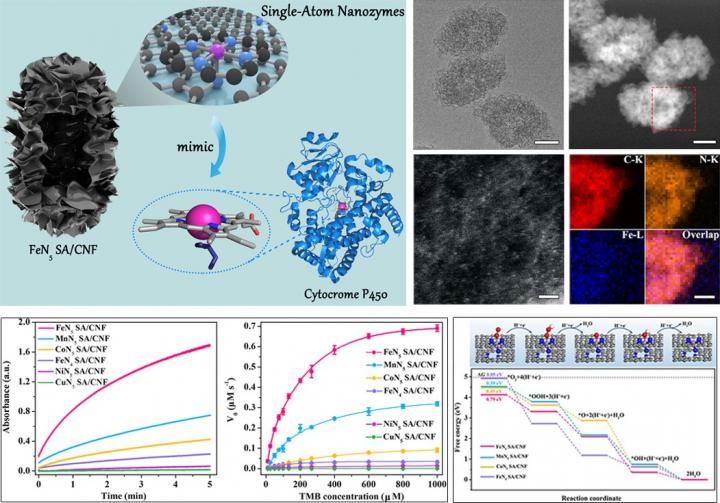
A research team led by Prof. DONG Shaojun from the Changchun Institute of Applied Chemistry (CIAC) of the Chinese Academy of Sciences discovered a new class of single-atom nanozymes, which integrates state-of-the-art single-atom technology with intrinsic enzyme-like active sites.

The researchers synthesized single-atom nanozymes with carbon nanoframe-confined axial N-coordinated FeN5 centers (FeN5 SA/CNF). Theoretical calculations and experimental studies indicated that the highest oxidase-like activity of FeN5 SA/CNF was derived from the enzyme-like active sites and catalytic mechanisms.

The atomically dispersed metal centers maximized the atomic utilization efficiency and density of the active sites. The well-defined coordination structure provided a clear experimental model for mechanism investigation.

The current results suggest that the single-atom nanozymes overcame the critical drawbacks of conventional nanozymes. In addition, mimicking the active sites of natural enzymes appears to be an efficient method for the synthesis of single-atom nanozymes with high activity and clear mechanism.

Furthermore, the catalytic property and the mechanism of single-atom nanozymes depend mainly upon the steric configuration of active centers, rather than the size, structure or facet of the supports. Thus, through altering the supported nanomaterials, certain types of active sites can be extended to general applications with definite enzyme-like mechanisms.

The study, published in Science Advances, shows that defined single-atom nanozymes provide a new perspective on the catalytic mechanism and rational design of nanozymes. They also show great potential for becoming the next generation of nanozymes.

###

Media Contact
DONG Shaojun
[email protected]

Related Journal Article

http://dx.doi.org/10.1126/sciadv.aav5490

Tags: Atomic/Molecular/Particle PhysicsChemistry/Physics/Materials SciencesMaterials
Share12Tweet8Share2ShareShareShare2

Related Posts

Scientists uncover design rules for high-performance thermoelectric materials

Scientists uncover design rules for high-performance thermoelectric materials

August 22, 2026
Bringing Optical Fibre Materials to Photonic Chips

Bringing Optical Fibre Materials to Photonic Chips

August 22, 2026

Nanoscience and Liquid Crystals Unite in Functional Hybrids With Transformative Applications

August 22, 2026

Designing Better Biomedical Hydrogels Through Molecular Building Blocks and Hierarchical Structures

August 22, 2026
Please login to join discussion

POPULAR NEWS

  • Real-world study examines psychotic complications of subcutaneous foslevodopa/foscarbidopa infusions in 198 patients

    29 shares
    Share 12 Tweet 7
  • Blood-flow signals from liver vessels direct region-specific liver function through Wnt pathways

    29 shares
    Share 12 Tweet 7
  • Ge/SiGe Quantum-Well Photodetectors Integrated with SiN Waveguides on 200-mm Silicon Wafers

    29 shares
    Share 12 Tweet 7
  • Consensus Roadmap Guides Clinical Trials for Rare Childhood CNS Tumors

    29 shares
    Share 12 Tweet 7

About

We bring you the latest biotechnology news from best research centers and universities around the world. Check our website.

Follow us

Recent News

Real-world study examines psychotic complications of subcutaneous foslevodopa/foscarbidopa infusions in 198 patients

Blood-flow signals from liver vessels direct region-specific liver function through Wnt pathways

Ge/SiGe Quantum-Well Photodetectors Integrated with SiN Waveguides on 200-mm Silicon Wafers

Subscribe to Blog via Email

Success! An email was just sent to confirm your subscription. Please find the email now and click 'Confirm' to start subscribing.

Join 85 other subscribers
  • Contact Us

Bioengineer.org © Copyright 2023 All Rights Reserved.

Welcome Back!

Login to your account below

Forgotten Password?

Retrieve your password

Please enter your username or email address to reset your password.

Log In
No Result
View All Result
  • Homepages
    • Home Page 1
    • Home Page 2
  • News
  • National
  • Business
  • Health
  • Lifestyle
  • Science

Bioengineer.org © Copyright 2023 All Rights Reserved.