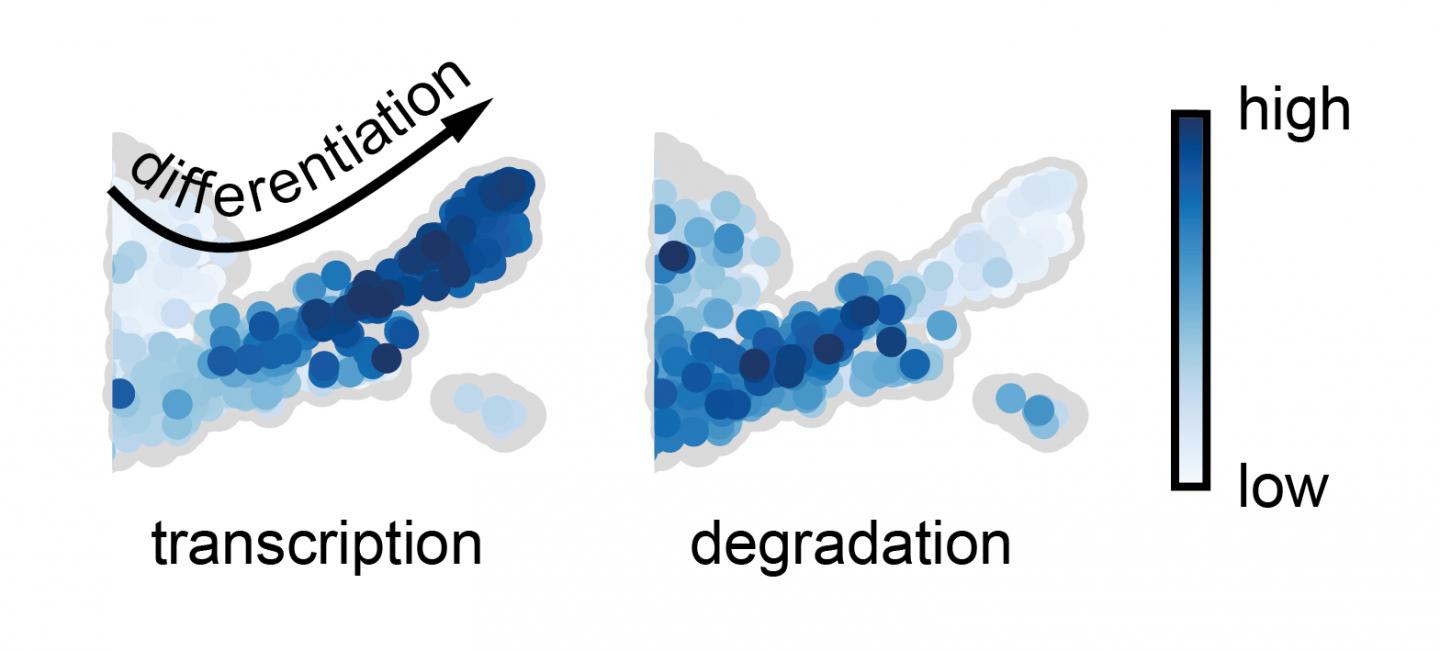
Credit: Nicolas Battich, ©Hubrecht Institute
Our bodies consist of trillions of cells that all contain the same DNA. Even though the DNA in each cell is the same, we consist of many different cell types, each with different functions. In different cell types, different sets of genes on the DNA are active – different recipes are being used to build the components of the cell. This in turn determines what kind of cell it is, for instance a skin cell or a muscle cell. To do this, the cell makes copies of the genes, so-called transcripts, that can be used to produce proteins.
Balancing creation and destruction
The number of transcripts of each gene in a cell is a measure of the activity of these genes. This number can be influenced by making new copies, a process called transcription, and by destroying already existing copies, a process called degradation. In individual cells, the number of transcript copies is typically measured by breaking up the cell and thus cannot be followed over time in the same cell. Until now it was therefore unclear how a combination of transcription and degradation in a single cell regulates the number of copies of a particular transcript.
Labeling new copies
Researchers from the group of Alexander van Oudenaarden set out to solve this problem by developing a new single-cell sequencing technique to distinguish freshly made transcripts from pre-existing transripts. Nicolas Battich, first author on this study: “We developed a method in which we label all the new copies that are made in a cell, so that we can identify those copies that were made since we started the experiment.” By varying the labeling time the researchers could investigate how many transcripts were created or destroyed.
Distinct strategies
By combining these data with computer models, the researchers could figure out that both transcription and degradation are heavily involved in regulating the number of copies of a transcript. Battich: “Cells seem to use distinct strategies to regulate the activity of their genes – or the number of copies of these transcripts. For some genes, the cell has to be able to very quickly change the number of copies. Those genes were both being transcribed and degraded at high levels. By involving both processes, cells were able to change the number of copies very quickly, for instance by decreasing transcription and increasing degradation simultaneously.”
The new method, called scEU-seq, can be used to study a plethora of processes, such as the specialization of cells during development, the regulation of cell division in healthy and cancer systems.
###
Publication
Sequencing metabolically labeled transcripts in single cells reveals mRNA turnover strategies. Nico Battich, Joep Beumer, Buys de Barbanson, Lenno Krenning, Chloé S. Baron, Marvin E. Tanenbaum, Hans Clevers, Alexander van Oudenaarden. Science 2020.
This study was a collaboration between the groups of Alexander van Oudenaarden, Hans Clevers and Marvin Tanenbaum at the Hubrecht Institute for Developmental Biology and Stem Cell Research.
Alexander van Oudenaarden is director of the Hubrecht Institute, group leader, professor of Quantitative Biology of Gene Regulation at the UMC Utrecht and Utrecht University and Oncode Investigator.
Hans Clevers is group leader at the Hubrecht Institute and the Princess Máxima Center for Pediatric Oncology, professor of Molecular Genetics at the UMC Utrecht and Utrecht University, and Oncode Investigator.
Marvin Tanenbaum is group leader at the Hubrecht Institute and Oncode Investigator.
About the Hubrecht Institute
The Hubrecht Institute is a research institute focused on developmental and stem cell biology. It encompasses 23 research groups that perform fundamental and multidisciplinary research, both in healthy systems and disease models. The Hubrecht Institute is a research institute of the Royal Netherlands Academy of Arts and Sciences (KNAW), situated on Utrecht Science Park. Since 2008, the institute is affiliated with the UMC Utrecht, advancing the translation of research to the clinic. The Hubrecht Institute has a partnership with the European Molecular Biology Laboratory (EMBL). For more information, visit http://www.
Media Contact
Melanie Fremery
[email protected]
31-683-596-548