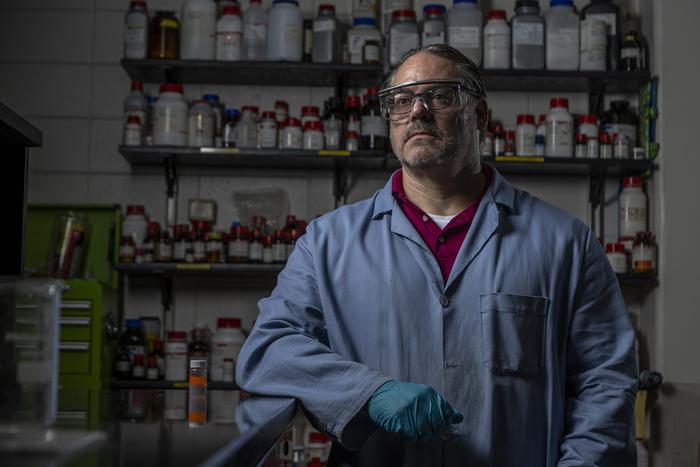

Imagine a world where microscopic building blocks come together autonomously like LEGO pieces snapping into place, forming intricately designed, sturdy sheets. Now, envision these sheets being chemically modified with specialized molecular “hooks,” allowing them to tether fluorescent molecules known as fluorophores. This is precisely what Associate Professor Gary Baker, along with Piyuni Ishtaweera, PhD ’24, and their research team at the University of Missouri, have achieved. They have engineered novel, clay-based nanomaterials termed fluorescent polyionic nanoclays, which can be customized with unparalleled precision for a diverse range of applications spanning from energy technology to environmental protection and medical diagnostics.
The foundation of this breakthrough rests on the unique properties of the nanoclays—tiny, layered silicate materials that exhibit a remarkable capacity for polyionic interactions. By functionalizing these nanoclays with fluorescent molecules, the researchers have created a highly adaptable and tunable sensory platform. This approach allows scientists to dictate both the quantity and type of fluorescent tags attached, essentially programming the nanomaterials to emit specific optical signals tailored to the desired application. Such precise control over the optical and physicochemical features opens avenues to revolutionize fields dependent on fluorescence-based detection.
Fluorophores, the glowing molecules integrated into these nanoclays, have long been instrumental in medical imaging and diagnostic sciences. Their ability to emit light upon excitation enables the visualization of cellular and molecular phenomena that are otherwise invisible to standard observation techniques. These fluorescent markers are routinely employed for disease detection, biomarker tagging, and forensic analysis, as well as in biosensing and chemical monitoring. However, existing fluorophore systems face challenges of stability, brightness, and adaptability, limiting their application scope. The innovation from Baker’s team addresses these constraints directly by harnessing the intrinsic versatility of polyionic nanoclays.
A particularly compelling aspect of this research is the nanoclays’ exceptional fluorescence intensity. According to Dr. Baker, when normalized for volume, these fluorescently tagged materials exhibit brightness levels reaching 7,000 units, which aligns with the highest emission intensities ever reported for fluorescent substances. This formidable brightness translates into enhanced sensitivity for optical detection techniques, making it possible to detect minute quantities of analytes and subtle biological changes with unprecedented accuracy. The implications for medical imaging are profound, offering the potential for earlier and more precise disease diagnosis.
Beyond brightness, the stability and programmability of these nanoclays set them apart. Their polyionic nature allows them to be conjugated not only with fluorophores but also with a wide variety of biologically relevant molecules such as amino acids, antibodies, DNA aptamers, and metal-binding ligands. This molecular customization endows the nanoclays with multifunctionality, enabling their use in targeted drug delivery systems, selective metal ion sequestration, and as biosensors capable of detecting specific genetic or protein markers with high fidelity. This multifunctionality is crucial for tailoring materials to niche scientific and medical challenges.
The team’s investigations further confirm the biocompatibility of these fluorescent nanoclays, suggesting their safe implementation in clinical settings. Early laboratory and preclinical tests reveal that the nanoclays do not induce significant cytotoxic effects, paving the way for their use as contrast agents in imaging modalities. This advancement promises to overcome limitations faced by current contrast agents, many of which have restrictions due to toxicity or limited signal intensity. The fluorescent polyionic nanoclays, therefore, could dramatically improve the resolution and reliability of imaging small-scale physiological processes.
From a technical standpoint, the chemical architecture of these nanoclays is compelling. Their polyionic framework facilitates strong electrostatic interactions between the clay surface and the functional fluorophores, ensuring robust attachment and stability of the fluorescent markers. This electrostatic assembly technique circumvents the shortcomings of covalent modification methods, which often involve complex and less reversible chemistry. Moreover, the layered structure of the clay provides a large surface area for extensive functionalization, amplifying the fluorescent signal and enabling the fine-tuning of nanoclays’ optical properties.
The application spectrum of fluorescent polyionic nanoclays is broad. In energy research, they represent innovative materials for solar energy capture, thanks to their capacity to integrate light-absorbing fluorophores strategically. Such materials could contribute to the development of next-generation photovoltaic devices with improved efficiency and durability. Environmental monitoring also stands to benefit, as the nanoclays’ fluorescence can report on the presence of pollutants or changes in water quality in real time with heightened sensitivity, surpassing current sensor technologies.
Furthermore, the adaptability of the fluorescent nanoclays extends to forensic science, where sensitive detection of trace chemicals or biological materials is paramount. The fluorescent sensors can be engineered to illuminate specific substances or cellular markers, bolstering the accuracy of forensic investigations. They can also tag and track biomolecules, helping scientists trace biochemical pathways or disease progression in living organisms with minimal invasiveness.
The research team’s work is meticulously detailed in their recent publication titled “Programmable Fluorescent Polyionic Nanoclays as Sensory Materials,” appearing in the journal Chemistry of Materials. The article delves deeply into the synthesis methods, functionalization protocols, and performance metrics of the nanoclays, highlighting their superior brightness, stability, and tunability compared to existing fluorescence-based materials. Collaborators on this groundbreaking project include Luis Polo-Parada, associate professor of medical pharmacology and physiology at Mizzou, and Nathaniel Larm from the United States Naval Academy.
Looking ahead, the researchers are eager to expand the functional repertoire of these nanoclays beyond fluorescence. By exploring their conjugation with biomolecules such as antibodies and nucleic acids, the team hopes to develop highly selective targeting capabilities suitable for precision medicine. These advancements may yield platforms that can identify and neutralize cancerous cells, deliver drugs precisely where needed, or dynamically monitor disease biomarkers, thereby refining treatment strategies and improving patient outcomes.
In conclusion, the programmable fluorescent polyionic nanoclays introduced by this team represent a landmark in nanomaterials science. Their unique combination of brightness, versatility, and biocompatibility positions them at the forefront of emerging technologies in medical imaging, environmental sensing, energy harvesting, and beyond. The potential to tailor these materials with modular chemical hooks equips researchers and clinicians with powerful tools to innovate across multiple disciplines. As this technology matures, it promises significant impacts on how we diagnose diseases, monitor environmental health, and harness renewable energy sources.
Subject of Research: Programmable fluorescent polyionic nanoclays for advanced sensory materials with applications in medical imaging, environmental monitoring, and energy technology.
Article Title: Programmable Fluorescent Polyionic Nanoclays as Sensory Materials
News Publication Date: 22-Jan-2025
Web References: https://doi.org/10.1021/acs.chemmater.4c01864
Image Credits: Sam O’Keefe/University of Missouri
Keywords: Nanomaterials, Fluorescence, Sensors, Medical imaging, Chemical analysis, Solar energy, Polyionic nanoclays, Optical properties, Biocompatibility, Drug delivery, Forensic analysis, Energy harvesting
Tags: autonomous assembly of nanostructurescustomizable nanomaterialsenergy technology innovationsenvironmental protection technologiesfluorescent polyionic nanoclaysfluorophores in researchlayered silicate materialsmedical diagnostics applicationsmolecular hooks for fluorescencenanoscale chemical toolsprogrammable optical signalstunable sensory platforms