• HOME
  • NEWS
  • EXPLORE
    • CAREER
      • Companies
      • Jobs
    • EVENTS
    • iGEM
      • News
      • Team
    • PHOTOS
    • VIDEO
    • WIKI
  • BLOG
  • COMMUNITY
    • FACEBOOK
    • INSTAGRAM
    • TWITTER
Tuesday, July 14, 2026
BIOENGINEER.ORG
No Result
View All Result
  • Login
  • HOME
  • NEWS
  • EXPLORE
    • CAREER
      • Companies
      • Jobs
        • Lecturer
        • PhD Studentship
        • Postdoc
        • Research Assistant
    • EVENTS
    • iGEM
      • News
      • Team
    • PHOTOS
    • VIDEO
    • WIKI
  • BLOG
  • COMMUNITY
    • FACEBOOK
    • INSTAGRAM
    • TWITTER
  • HOME
  • NEWS
  • EXPLORE
    • CAREER
      • Companies
      • Jobs
        • Lecturer
        • PhD Studentship
        • Postdoc
        • Research Assistant
    • EVENTS
    • iGEM
      • News
      • Team
    • PHOTOS
    • VIDEO
    • WIKI
  • BLOG
  • COMMUNITY
    • FACEBOOK
    • INSTAGRAM
    • TWITTER
No Result
View All Result
Bioengineer.org
No Result
View All Result
Home NEWS Science News Chemistry

Scientists develop a technique to dynamically curve a photon jet

Bioengineer by Bioengineer
September 15, 2020
in Chemistry
Reading Time: 3 mins read
0
IMAGE
Share on FacebookShare on TwitterShare on LinkedinShare on RedditShare on Telegram

Scientists of Tomsk Polytechnic University jointly with international colleagues have found a simple technique to dynamically curve a photonic jet, turning it into a photonic hook.
IMAGE

Credit: Tomsk Polytechnic University

The photon jet effect was discovered in the early 2000s. The jet is an electromagnetic wave focused at the surface of a quartz glass microsphere, which is at lens focus. This jet has a unique transverse dimension, which is less than the diffraction limit. This feature of the photon jet drew the attention of scientists. As a result, in 2011, a nanoscope based on the effect of a photonic jet was developed. It pushed the envelope of traditional optical microscopes limitation with a maximum resolution of 200 nanometers and made possible to observe up to 50 nanometers.

In 2015, TPU scientists proposed a photonic hook, a new type of curved light beam based on a photonic jet. It is much easier to obtain it than existing analogs. Only a microparticle of a certain shape is needed to obtain a photonic hook. Light passes through it and curve. For instance, the photonic hook moves nanoparticles using light pressure, curves around a barrier and transfers them through it.

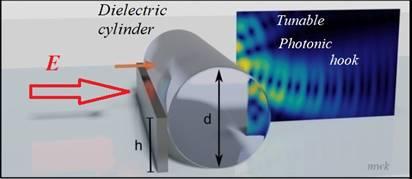
“Researchers use microparticles from a dielectric material, such as glass to obtain a photonic jet and a photonic hook. Traditionally, it was believed that this requires particles of different shapes, such as symmetrical for the photon jet and asymmetrical for the hook. However, it is not so. We carried out simulations and conducted experiments. These experiments demonstrated that symmetric particles can be used in both cases. In order to do this, we partially covered the particle with a metal micro-size screen, which can be made of any metal, but in the experiments we used aluminum,” Igor Minin, project manager and Professor of Division for Electronic Engineering, says.

To form a photon jet, the particle is irradiated completely, and in the case of a curved photonic hook, the particle is partially overlapped by the screen.

“Then we use an asymmetric wavefront with a symmetric particle. This expands the application potential of the photon jet and the hook. For instance, they can be used in one device depending on the tasks. You can grab nanoparticles by a photon jet and if you use the screen, the beam will curve and the particles can be moved, ” the scientist explains.

Another possible application field is the lithography process in the manufacture of microcircuits. Lithography is a technology of using a laser to draw a pattern of a future microcircuit.

“Drawing can be made with either a straight beam or with a curved one, you only need to change the focusing particle. To do so, you can use a micro-sized metal screen, which is an extremely simple solution. Moreover, it will not significantly complicate the structure of devices, using a photonic jet or hook effect,” Igor Minin says.

###

The research is being conducted jointly with scientists from the National Yang-Ming University (Taiwan), Ben-Gurion University of the Negev (Israel). It was supported by grants from the Russian Foundation for Basic Research and the TPU Competitiveness Enhancement Program.

Media Contact
Vitalii Sdelnikov
[email protected]

Original Source

https://news.tpu.ru/en/news/2020/09/10/36689/

Related Journal Article

http://dx.doi.org/10.1364/OL.402248

Tags: Chemistry/Physics/Materials Sciences
Share12Tweet8Share2ShareShareShare2

Related Posts

Dual-Frequency Photoacoustic CT Reveals Clear Whole Brain, Centimeters Deep

Dual-Frequency Photoacoustic CT Reveals Clear Whole Brain, Centimeters Deep

July 14, 2026
World-First Neutron Lens Sharply Enhances Atomic-Scale Observations

World-First Neutron Lens Sharply Enhances Atomic-Scale Observations

July 14, 2026

Unveiling the Metallic Secrets of an Ancient Bio-Metal Maw

July 14, 2026

Programmable Arene Ring Opening Enables Diverse Phenol Synthesis

July 14, 2026
Please login to join discussion

POPULAR NEWS

  • New Drug Candidate Developed at McMaster Shows Potential for Treating Brain Cancer

    58 shares
    Share 23 Tweet 15
  • Detection of EDCs in Breast Milk and Infant Urine Up to Six Months Highlights Early Exposure Risks

    77 shares
    Share 31 Tweet 19
  • Experimental Therapy Simultaneously Destroys Prostate Tumor Cells and Reactivates Antitumor Immunity

    46 shares
    Share 18 Tweet 12
  • 高齢者の骨粗鬆症治療の持続性比較

    51 shares
    Share 20 Tweet 13

About

We bring you the latest biotechnology news from best research centers and universities around the world. Check our website.

Follow us

Recent News

Dual-Frequency Photoacoustic CT Reveals Clear Whole Brain, Centimeters Deep

Researchers Identify Therapeutic Vulnerability in Aggressive Childhood Leukemia

Aging Cells Revert to Stem Cells as Self-Repair Mimics

Subscribe to Blog via Email

Enter your email address to subscribe to this blog and receive notifications of new posts by email.

Join 85 other subscribers
  • Contact Us

Bioengineer.org © Copyright 2023 All Rights Reserved.

Welcome Back!

Login to your account below

Forgotten Password?

Retrieve your password

Please enter your username or email address to reset your password.

Log In
No Result
View All Result
  • Homepages
    • Home Page 1
    • Home Page 2
  • News
  • National
  • Business
  • Health
  • Lifestyle
  • Science

Bioengineer.org © Copyright 2023 All Rights Reserved.