• HOME
  • NEWS
  • EXPLORE
    • CAREER
      • Companies
      • Jobs
    • EVENTS
    • iGEM
      • News
      • Team
    • PHOTOS
    • VIDEO
    • WIKI
  • BLOG
  • COMMUNITY
    • FACEBOOK
    • INSTAGRAM
    • TWITTER
Sunday, May 10, 2026
BIOENGINEER.ORG
No Result
View All Result
  • Login
  • HOME
  • NEWS
  • EXPLORE
    • CAREER
      • Companies
      • Jobs
        • Lecturer
        • PhD Studentship
        • Postdoc
        • Research Assistant
    • EVENTS
    • iGEM
      • News
      • Team
    • PHOTOS
    • VIDEO
    • WIKI
  • BLOG
  • COMMUNITY
    • FACEBOOK
    • INSTAGRAM
    • TWITTER
  • HOME
  • NEWS
  • EXPLORE
    • CAREER
      • Companies
      • Jobs
        • Lecturer
        • PhD Studentship
        • Postdoc
        • Research Assistant
    • EVENTS
    • iGEM
      • News
      • Team
    • PHOTOS
    • VIDEO
    • WIKI
  • BLOG
  • COMMUNITY
    • FACEBOOK
    • INSTAGRAM
    • TWITTER
No Result
View All Result
Bioengineer.org
No Result
View All Result
Home NEWS Science News Chemistry

Scientists created building materials effectively protecting from radiation

Bioengineer by Bioengineer
May 21, 2021
in Chemistry
Reading Time: 3 mins read
0
IMAGE
Share on FacebookShare on TwitterShare on LinkedinShare on RedditShare on Telegram

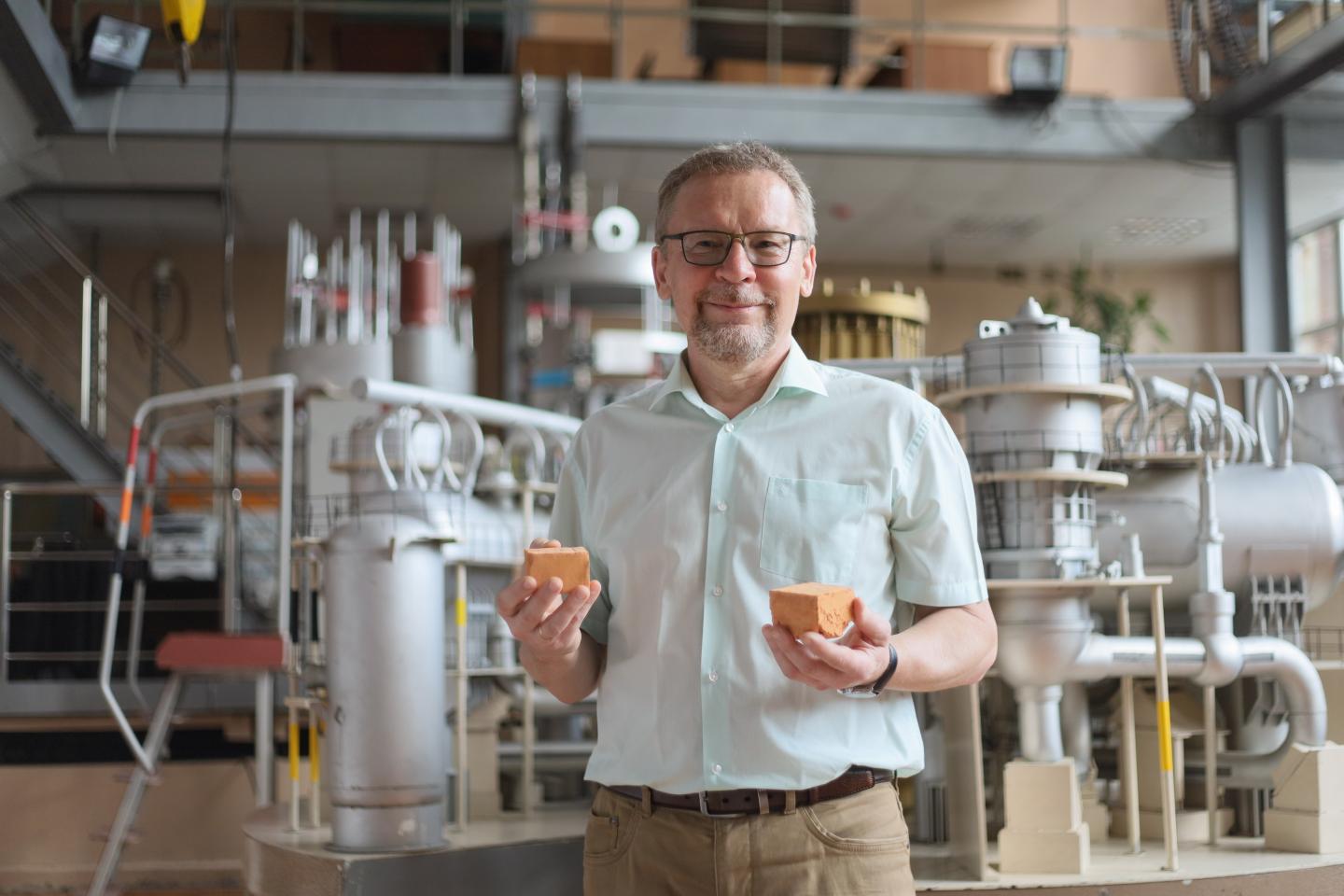
Bricks made of new materials are cheaper and more environmentally friendly than analogues made of lead and other materials
IMAGE

Credit: UrFU / Anastasia Farafontova

Scientists at the Ural Federal University (UrFU, Russia) have created clay bricks that are able to attenuate ionizing radiation to a level that is safe for the human body. To the composition of bricks scientists add waste from the industry, which protects against radiation. The article describing the technology was published in the journal Applied Radiation and Isotopes.

“Bricks are a relatively cheap and convenient material with which we can quickly erect protective rooms, structures, walls around objects with radiation,” says scientific head of the project, associate professor of the Department of Nuclear Power Plants and Renewable Energy Sources at UrFU Oleg Tashlykov. “The bricks are alloyed with heavy metals – wastes from the metallurgical enterprises. These substances have pronounced radiation-protective properties. Thus, we solve two problems at once. First, by adding crushed absorbers of ionizing radiation to the matrix, in this case from clay, we obtain building materials with the desired protective properties. Secondly, in this way we find a way to utilize industrial waste.”

The ultimate goal of scientists is to develop a wide range of materials based not only on clay, but also cement mortars or concrete, artificial polymers with different chemical composition and concentration of absorbing substances. In other words, with specified protective properties that meet specific conditions (isotopic composition of radioactive contamination, types of radiation, etc.) at nuclear power plants, in radioactive waste storage facilities, as well as in medical institutions where diagnostics and treatment are carried out using X-ray equipment and irradiating devices.

“Tungsten is widely known to be the most reliable protection against gamma or X-ray radiation, but it is very expensive,” says research coauthor, research engineer of the Department of Nuclear Power Plants and Renewable Energy Sources at UrFU Karem Makhmud. “Lead is cheaper but toxic. And, besides, it is plastic and in an upright position can slide under its own weight, forming holes in the radiation protection system and reducing its stability. Our materials are optimal in terms of radiation protection efficiency and ease of manufacture, strength, durability, cost. The latter factor is important, since today the contribution of biological protection to the cost of nuclear power facilities reaches 20-30%.”

Scientists use high-precision computational codes to create bricks. Also they use for their experimental research the reactor plant of the Institute of Reactor Materials of the State Corporation “Rosatom” (Russia), as well as the production technologies of the Sealing Materials Plant (Russia). The products of joint activities are of great interest to domestic and foreign enterprises of the nuclear industry. There are plans to further study the mechanical and radiation-protective parameters of various natural substances, including those common in the partner countries of Rosatom (Turkey, Egypt, Bangladesh), where nuclear power plants are being built with the participation of Russian specialists.

###

Media Contact
Anna Marinovich
[email protected]

Original Source

http://urfu.ru/en/news/36550/

Related Journal Article

http://dx.doi.org/10.1016/j.apradiso.2021.109720

Tags: Atomic PhysicsChemistry/Physics/Materials SciencesMaterialsNuclear Physics
Share13Tweet8Share2ShareShareShare2

Related Posts

Miniature Sensor Uses Light to Detect Touch — Chemistry

Miniature Sensor Uses Light to Detect Touch

May 8, 2026
Iron Minerals Determine Whether Dissolved Organic Matter Fuels Microbes or Becomes Long-Term Carbon Storage — Chemistry

Iron Minerals Determine Whether Dissolved Organic Matter Fuels Microbes or Becomes Long-Term Carbon Storage

May 8, 2026

Kate Evans Appointed Associate Lab Director for Biological and Environmental Systems Science at ORNL

May 8, 2026

Advancing Multiscale Modeling and Overcoming Operational Challenges in Autothermal COâ‚‚-to-Methanol Reactors

May 8, 2026
Please login to join discussion

POPULAR NEWS

  • Research Indicates Potential Connection Between Prenatal Medication Exposure and Elevated Autism Risk

    840 shares
    Share 336 Tweet 210
  • New Study Reveals Plants Can Detect the Sound of Rain

    727 shares
    Share 290 Tweet 181
  • Scientists Investigate Possible Connection Between COVID-19 and Increased Lung Cancer Risk

    68 shares
    Share 27 Tweet 17
  • Salmonella Haem Blocks Macrophages, Boosts Infection

    61 shares
    Share 24 Tweet 15

About

We bring you the latest biotechnology news from best research centers and universities around the world. Check our website.

Follow us

Recent News

Urdu Fall Risk Questionnaire Adapted for Elderly

Key Pharmacological Markers for HIV Prevention in MSM

Taking 8,500 Steps Daily May Aid Long-Term Weight Management, Study Finds

Subscribe to Blog via Email

Success! An email was just sent to confirm your subscription. Please find the email now and click 'Confirm' to start subscribing.

Join 82 other subscribers
  • Contact Us

Bioengineer.org © Copyright 2023 All Rights Reserved.

Welcome Back!

Login to your account below

Forgotten Password?

Retrieve your password

Please enter your username or email address to reset your password.

Log In
No Result
View All Result
  • Homepages
    • Home Page 1
    • Home Page 2
  • News
  • National
  • Business
  • Health
  • Lifestyle
  • Science

Bioengineer.org © Copyright 2023 All Rights Reserved.