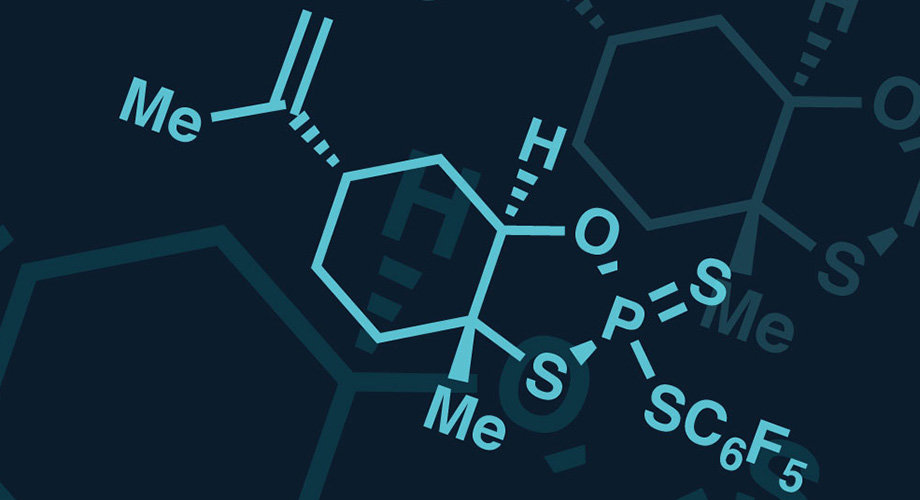
When it comes to certain molecules, shape makes all the difference. The shape of limonene, for instance, a compound produced by citrus fruits, determines whether it tastes like orange juice or turpentine. In the case of therapeutics, the 3D shape of a molecule can be critical to activity.
Now, scientists at Scripps Research and Bristol-Myers Squibb have created a powerful new tool for precisely controlling the 3D architecture–also called stereochemistry–of linkages known as thiophosphates, found in some promising new drugs that target genetic molecules and other disease targets, according to a paper published today in Science.
Dubbed phosphorus-sulfur incorporation (PSI, for short), the first-of-its-kind technology acts like an atomic glue gun, binding nucleosides into oligomers with specific, preprogrammed spatial configurations at the thiophosphate linkage. The thiophosphate linkages are analogues of nature’s method of connecting nucleosides and offer multiple advantages to drug development, but add the complexity of stereochemistry at the phosphorous atom. PSI provides an unprecedented, inexpensive and simple method to enable the development of single isomers of these compounds, which can have hundreds of thousands of stereoisomers.
“Thiophosphate based nucleotide compounds represent remarkable therapeutic potential, but our understanding of these systems has been hindered an inability to easily control the stereochemistry of the thiophosphate during drug synthesis,” says Phil Baran, PhD, a Scripps Research professor and senior scientist on the study. “PSI provides a robust and stereo-controlled method of synthesizing oligonucleotide drugs, allowing us to create, analyze and manufacture stereoisomers of a drug candidate in ways that were previously only possible with expensive and inefficient methods.”
Martin Eastgate, PhD, co-senior author on the Science paper and lead scientist on the Bristol-Myers Squibb team, says that by providing a simple and generalized method for controlling the stereochemistry of the phosphorus-centered bonds, called thiophosphate linkages, PSI overcomes a significant hurdle to discovering the next generation of innovative medicines.
“The invention of these stereoselective, simple, scalable and stable reagents provides a solution to this complex problem,” says Eastgate, group director and head of chemical research in Bristol-Myers Squibb’s Chemical and Synthetic Development organization. “We hope the invention of the PSI reagent class will prove to be an enabling technology to the scientific community.”
To build the long chain of nucleotides present in oligonucleotides, the current manufacturing technique relies on the unnatural, but highly reactive, phosphorous(III) oxidation state. One of the major limitations of applying standard P(III) chemistry to thiophosphate synthesis is a lack of control over the 3D shape of the new phosphorous based stereocenter.
“Using P(III) chemistry to produce even a modest amount of the compound as a single stereoisomer is challenging, making it difficult to fully assess the impact of molecular shape on biological function,” says Justine deGruyter, a Scripps Research graduate student and one of the first authors on the Science paper. To overcome these limitations, the Bristol-Myers Squibb and Scripps researchers explored using a different form of phosphorus, P(V), that was long eschewed by synthetic chemists due to its low reactivity. While P(V) is generally less reactive than P(III), which can make it more challenging to use in building molecules in the laboratory, the scientists suspected its superior stability could translate into far better control over the three-dimensional molecular shape during synthesis.
Over the course of two years, the Scripps and Bristol-Myers Squibb teams collaborated to develop an effective method of using P(V) to produce desired stereoisomers of molecules. They focused on finding a way to bind together chains of nucleosides with a traceless reagent that wouldn’t leave behind unwanted atoms. The result of this was the reagent PSI.
The researchers have used PSI to generate pure stereoisomers of cyclic dinucleotides (CDNs), the basis of CDN drug candidates that have generated much excitement as a new type of cancer immunotherapy. CDN drugs target a protein called STING (STimulator of INterferon Genes) to activate the body’s immune system against cancers.
“CDNs show incredible promise for activating the immune system against cancers, but until now there was no simple way to control their stereochemistry,” says Kyle Knouse, a graduate student in Baran’s lab and first author on the Science paper. “The ability to efficiently and inexpensively create pure stereoisomers will provide a powerful tool to advance CDN research.”
In the case of CDNs, and ASO drugs, the ability to prepare a single stereoisomer will enable scientists to explore what shapes of the drugs are most therapeutically effective and generate those stereoisomers for clinical use. Another advantage of PSI is that it is traceless, thus avoiding the time and cost of having to remove it from the drug product during manufacturing.
The Bristol-Myers Squibb and Scripps researchers are excited to continue exploring other ways to use these reagents to build complex molecules.
###
The research was supported by the National Science Foundation, the National Institutes of Health (grant GM-118176) and Bristol-Myers Squibb.
About Scripps Research
Scripps Research is ranked the most influential scientific institution in the world for its impact on innovation. A nonprofit research organization, Scripps expands basic knowledge in the biosciences and uses these fundamental advancements to develop profound innovations that improve well-being. Scripps researchers lead breakthrough studies that address the world’s most pressing health concerns, accelerating the creation and delivery of medical breakthroughs to better human health across the globe. Our educational and training programs mold talented and committed students and postdocs into the next generation of leading scientists.
For more information about Scripps Research visit http://www.scripps.edu. Follow @ScrippsResearch on Twitter, Facebook or LinkedIn.
Media Contact
Chris Emery
[email protected]
301-873-6952
@scrippsresearch
http://www.scripps.edu
https://www.scripps.edu/news-and-events/press-room/2018/20180806-baran-chemistry-bms.html
Related Journal Article
http://dx.doi.org/10.1126/science.aau3369