A revolutionary technique gives scientists an unparalleled close-up view inside fleeting particles called excitons
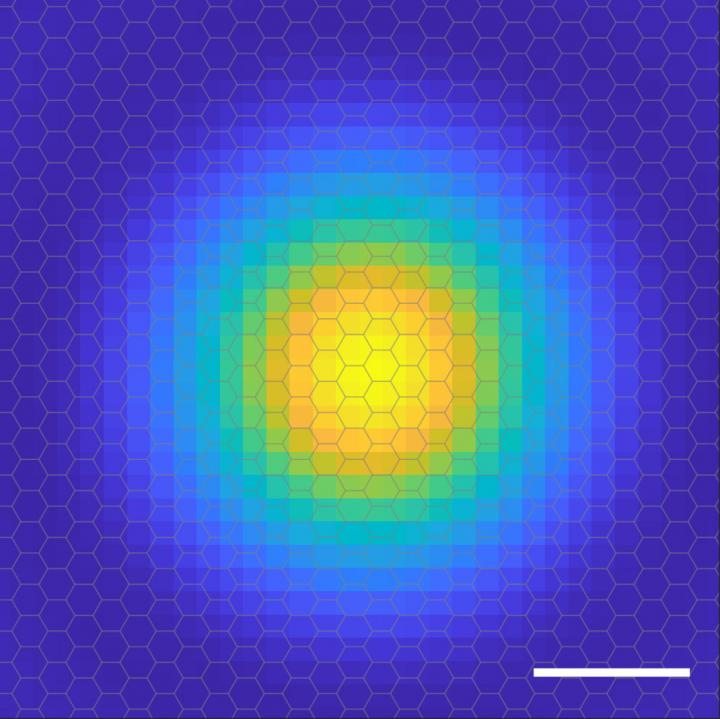
Credit: OIST
In a world-first, researchers from the Okinawa Institute of Science and Technology Graduate University (OIST) have captured an image showing the internal orbits, or spatial distribution, of particles in an exciton – a goal that had eluded scientists for almost a century.
Excitons are excited states of matter found within semiconductors – a class of materials that are key to many modern technological devices, such as solar cells, LEDs, lasers and smartphones.
“Excitons are really unique and interesting particles; they are electrically neutral which means they behave very differently within materials from other particles like electrons. Their presence can really change the way a material responds to light,” said Dr. Michael Man, co-first author and staff scientist in the OIST Femtosecond Spectroscopy Unit. “This work draws us closer to fully understanding the nature of excitons.”
Excitons are formed when semiconductors absorb photons of light, which causes negatively charged electrons to jump from a lower energy level to a higher energy level. This leaves behind positively charged empty spaces, called holes, in the lower energy level. The oppositely charged electrons and holes attract and they start to orbit each other, which creates the excitons.
Excitons are crucially important within semiconductors, but so far, scientists have only been able to detect and measure them in limited ways. One issue lies with their fragility – it takes relatively little energy to break the exciton apart into free electrons and holes. Furthermore, they are fleeting in nature – in some materials, excitons are extinguished in about a few thousandths of a billionth of a second after they form, when the excited electrons “fall” back into the holes.
“Scientists first discovered excitons around 90 years ago,” said Professor Keshav Dani, senior author and head of the Femtosecond Spectroscopy Unit at OIST. “But up until very recently, one could generally access only the optical signatures of excitons – for example, the light emitted by an exciton when extinguished. Other aspects of their nature, such as their momentum, and how the electron and the hole orbit each other, could only be described theoretically.”
However, in December 2020, scientists in the OIST Femtosecond Spectroscopy Unit published a paper in Science describing a revolutionary technique for measuring the momentum of the electrons within the excitons.
Now, reporting on 21st April in Science Advances, the team used the technique to capture the first ever image that shows the distribution of an electron around the hole inside an exciton.
The researchers first generated excitons by sending a laser pulse of light at a two-dimensional semiconductor – a recently discovered class of materials that are only a few atoms in thickness and harbor more robust excitons.
After the excitons were formed, the team used a laser beam with ultra-high energy photons to break apart the excitons and kick the electrons right out of the material, into the vacuum space within an electron microscope.
The electron microscope measured the angle and energy of the electrons as they flew out of the material. From this information, the scientists were able to determine the initial momentum of the electron when it was bound to a hole within the exciton.
“The technique has some similarities to the collider experiments of high-energy physics, where particles are smashed together with intense amounts of energy, breaking them open. By measuring the trajectories of the smaller internal particles produced in the collision, scientists can start to piece together the internal structure of the original intact particles,” said Professor Dani. “Here, we are doing something similar – we are using extreme ultraviolet light photons to break apart excitons and measuring the trajectories of the electrons to picture what’s inside.”
“This was no mean feat,” continued Professor Dani. “The measurements had to be done with extreme care – at low temperature and low intensity to avoid heating up the excitons. It took a few days to acquire a single image.”
Ultimately, the team succeeded in measuring the exciton’s wavefunction, which gives the probability of where the electron is likely to be located around the hole.
“This work is an important advancement in the field,” said Dr. Julien Madeo, co-first author and staff scientist in the OIST Femtosecond Spectroscopy Unit. “Being able to visualize the internal orbits of particles as they form larger composite particles could allow us to understand, measure and ultimately control the composite particles in unprecedented ways. This could allow us to create new quantum states of matter and technology based on these concepts.”
###
Media Contact
Tomomi Okubo
[email protected]
Original Source
https:/