• HOME
  • NEWS
  • EXPLORE
    • CAREER
      • Companies
      • Jobs
    • EVENTS
    • iGEM
      • News
      • Team
    • PHOTOS
    • VIDEO
    • WIKI
  • BLOG
  • COMMUNITY
    • FACEBOOK
    • INSTAGRAM
    • TWITTER
Sunday, May 10, 2026
BIOENGINEER.ORG
No Result
View All Result
  • Login
  • HOME
  • NEWS
  • EXPLORE
    • CAREER
      • Companies
      • Jobs
        • Lecturer
        • PhD Studentship
        • Postdoc
        • Research Assistant
    • EVENTS
    • iGEM
      • News
      • Team
    • PHOTOS
    • VIDEO
    • WIKI
  • BLOG
  • COMMUNITY
    • FACEBOOK
    • INSTAGRAM
    • TWITTER
  • HOME
  • NEWS
  • EXPLORE
    • CAREER
      • Companies
      • Jobs
        • Lecturer
        • PhD Studentship
        • Postdoc
        • Research Assistant
    • EVENTS
    • iGEM
      • News
      • Team
    • PHOTOS
    • VIDEO
    • WIKI
  • BLOG
  • COMMUNITY
    • FACEBOOK
    • INSTAGRAM
    • TWITTER
No Result
View All Result
Bioengineer.org
No Result
View All Result
Home NEWS Science News Chemistry

Scientists can replace metal collimators with plastic analogs

Bioengineer by Bioengineer
November 6, 2019
in Chemistry
Reading Time: 2 mins read
0
IMAGE
Share on FacebookShare on TwitterShare on LinkedinShare on RedditShare on Telegram

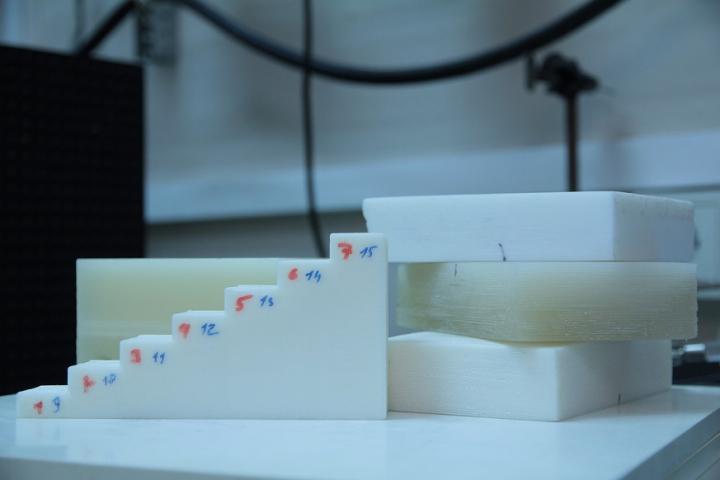
Scientists of Tomsk Polytechnic University conducted studies of plastic collimators, which can replace their metal analogs used in radiation therapy. At the first stage, the research team was involved in the exact characteristics of the desired product
IMAGE

Credit: Tomsk Polytechnic University


Nowadays, electron beam radiotherapy is conducted using metal collimators for the formation of radiation field around a tumor and protection of healthy organs and tissues. However, the development of such a metal collimator is a time- and energy-consuming process, requiring special facilities and equipment. In most cases, it is beyond capabilities of an average hospital. The research team seeks to replace metal collimators with plastic analogs made by 3D printer.

“In the modern world, 3D printing is widely used in various fields, including medicine. However, the development of a plastic collimator requires a detailed study, which results are important for medicine. For instance, we should determine its thickness and printing parameters, and optimal plastic for production,”

— Irina Miloichikova, an assistant at the TPU Division for Nuclear-Fuel Cycle, says.

The research team includes Associate Prof. Sergei Stuchebrov, the Research School of High-Energy Physics, assistant Irina Miloichikova, the Division for Nuclear-Fuel Cycle, engineer-researcher Angelina Bulavskaya, the Research School of High-Energy Physics, Associate Prof. Yury Cherepennikov, the Division for Nuclear-Fuel Cycle. The team collaborates with medical physicists in Moscow and Hamburg (Germany).

The researchers used a numerical model to study HIPS- and ABS-plastic capability to completely absorb an electron beam. Then, they used this plastic to manufacture the first products through the method of layer-by-layer deposition.

One of the important points of the study was to choose the required thickness of the printed collimator.

“Metal collimators should be 1.6 cm thick to absorb the beam but, unlike metal, plastic does not have the same density and a number of other characteristics. We conducted a number of calculations and experiments to determine the thickness of a plastic product. For instance, we used special dosimeters, placed inside the plastic, to measure the depth distribution of the electron beam,”

— Associate Prof. Sergei Stuchebrov, Research School of High-Energy Physics, says.

The first experimental models of plastic collimators were printed at Tomsk Polytechnic University, while their testing and experiments were conducted at the Moscow City Oncology Hospital No. 62 and the University Hospital Hamburg-Eppendorf (Germany).

The results showed the viability of the new methodology. So far, the team has completed documents for patenting the discovery.

###

The following study is supported by a grant of the Russian Science Foundation.

Media Contact
Vitalii Sdelnikov
[email protected]
7-382-260-6404

Original Source

https://news.tpu.ru/en/news/2019/11/06/35482/

Related Journal Article

http://dx.doi.org/10.1016/j.ejmp.2019.07.014

Tags: BiologyChemistry/Physics/Materials SciencesMedicine/Health
Share12Tweet8Share2ShareShareShare2

Related Posts

Miniature Sensor Uses Light to Detect Touch — Chemistry

Miniature Sensor Uses Light to Detect Touch

May 8, 2026
Iron Minerals Determine Whether Dissolved Organic Matter Fuels Microbes or Becomes Long-Term Carbon Storage — Chemistry

Iron Minerals Determine Whether Dissolved Organic Matter Fuels Microbes or Becomes Long-Term Carbon Storage

May 8, 2026

Kate Evans Appointed Associate Lab Director for Biological and Environmental Systems Science at ORNL

May 8, 2026

Advancing Multiscale Modeling and Overcoming Operational Challenges in Autothermal COâ‚‚-to-Methanol Reactors

May 8, 2026
Please login to join discussion

POPULAR NEWS

  • Research Indicates Potential Connection Between Prenatal Medication Exposure and Elevated Autism Risk

    840 shares
    Share 336 Tweet 210
  • New Study Reveals Plants Can Detect the Sound of Rain

    727 shares
    Share 290 Tweet 181
  • Scientists Investigate Possible Connection Between COVID-19 and Increased Lung Cancer Risk

    68 shares
    Share 27 Tweet 17
  • Salmonella Haem Blocks Macrophages, Boosts Infection

    61 shares
    Share 24 Tweet 15

About

We bring you the latest biotechnology news from best research centers and universities around the world. Check our website.

Follow us

Recent News

Urdu Fall Risk Questionnaire Adapted for Elderly

Key Pharmacological Markers for HIV Prevention in MSM

Taking 8,500 Steps Daily May Aid Long-Term Weight Management, Study Finds

Subscribe to Blog via Email

Success! An email was just sent to confirm your subscription. Please find the email now and click 'Confirm' to start subscribing.

Join 82 other subscribers
  • Contact Us

Bioengineer.org © Copyright 2023 All Rights Reserved.

Welcome Back!

Login to your account below

Forgotten Password?

Retrieve your password

Please enter your username or email address to reset your password.

Log In
No Result
View All Result
  • Homepages
    • Home Page 1
    • Home Page 2
  • News
  • National
  • Business
  • Health
  • Lifestyle
  • Science

Bioengineer.org © Copyright 2023 All Rights Reserved.