• HOME
  • NEWS
  • EXPLORE
    • CAREER
      • Companies
      • Jobs
    • EVENTS
    • iGEM
      • News
      • Team
    • PHOTOS
    • VIDEO
    • WIKI
  • BLOG
  • COMMUNITY
    • FACEBOOK
    • INSTAGRAM
    • TWITTER
Sunday, May 17, 2026
BIOENGINEER.ORG
No Result
View All Result
  • Login
  • HOME
  • NEWS
  • EXPLORE
    • CAREER
      • Companies
      • Jobs
        • Lecturer
        • PhD Studentship
        • Postdoc
        • Research Assistant
    • EVENTS
    • iGEM
      • News
      • Team
    • PHOTOS
    • VIDEO
    • WIKI
  • BLOG
  • COMMUNITY
    • FACEBOOK
    • INSTAGRAM
    • TWITTER
  • HOME
  • NEWS
  • EXPLORE
    • CAREER
      • Companies
      • Jobs
        • Lecturer
        • PhD Studentship
        • Postdoc
        • Research Assistant
    • EVENTS
    • iGEM
      • News
      • Team
    • PHOTOS
    • VIDEO
    • WIKI
  • BLOG
  • COMMUNITY
    • FACEBOOK
    • INSTAGRAM
    • TWITTER
No Result
View All Result
Bioengineer.org
No Result
View All Result
Home NEWS Science News Biology

Scientists accidentally discover a new water mold threatening Christmas trees

Bioengineer by Bioengineer
December 9, 2019
in Biology
Reading Time: 2 mins read
0
IMAGE
Share on FacebookShare on TwitterShare on LinkedinShare on RedditShare on Telegram

IMAGE

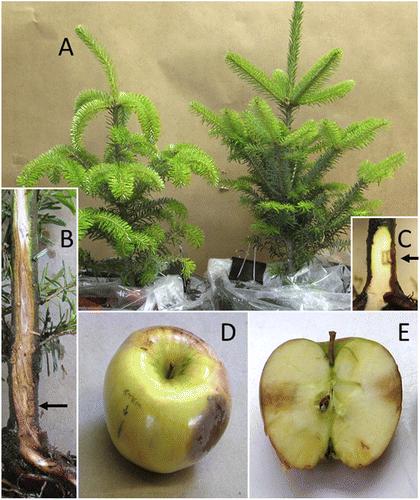
Credit: De-Wei Li, Neil P. Schultes, James A. LaMondia, and Richard S. Cowles


Grown as Christmas trees, Fraser firs are highly prized for their rich color and pleasant scent as well as their ability to hold their needles. Unfortunately, they are also highly susceptible to devastating root rot diseases caused by water molds in the genus Phytophthora.

Scientists in Connecticut were conducting experiments testing various methods to grow healthier Fraser trees when they accidentally discovered a new species of Phytophthora. They collected the diseased plants, isolated and grew the pathogen on artificial media, then inoculated it into healthy plants before re-isolating it to prove its pathogenicity.

“Once the organism was isolated, the presence of unusually thick spore walls alerted us that this may not be a commonly encountered species,” said Rich Cowles, a scientist at the Connecticut Agricultural Experiment Station involved with this study, “and so comparison of several genes’ sequences with known Phytophthora species was used to discover how our unknown was related to other, previously described species.” In fact, they had discovered a new species altogether.

The fact that these scientists so readily discovered a new species of Phytophthora infecting Christmas trees suggests that there could be many more species waiting to be discovered. Recognizing the greater biodiversity among this genus infecting Christmas trees is important. Transportation of infected nursery stock and chance encounters of different Phytophthora species in the field can lead to new hybrids arising, which can have different pathogenic characteristics than their parent species.

“Knowing how many and which species are present is important, not only for Christmas tree growers, but also for protecting our natural environment,” Cowles adds.

Also of note, this research was conducted using apples to do the initial isolation of Phytophthora, a method that dates back to 1931, demonstrating that old methods in plant pathology are still valid and useful. “Combining this robust old technique worked well with modern molecular biology methods to isolate, and then identify our unknown plant disease,” according to Cowles.

###

For more information about this study, read “Phytophthora abietivora, A New Species Isolated from Diseased Christmas Trees in Connecticut, U.S.A.” in the December issue of Plant Disease.

Media Contact
Ashley Bergman Carlin
[email protected]
651-994-3832

Related Journal Article

http://dx.doi.org/10.1094/PDIS-03-19-0583-RE

Tags: AgricultureBiodiversityForestryGenesMolecular BiologyPlant Sciences
Share12Tweet8Share2ShareShareShare2

Related Posts

Uncovering C. elegans Immunity via Genetic Screens — Biology

Uncovering C. elegans Immunity via Genetic Screens

May 16, 2026
Single mother must adapt swiftly — the survival of her colony depends on it — Biology

Single mother must adapt swiftly — the survival of her colony depends on it

May 15, 2026

Why Are Nearly Everyone Right-Handed? It Might Be Linked to How We Learned to Walk

May 15, 2026

Excessive Neuronal Activity Initiates Severe Autoimmune Brain Disorder

May 15, 2026
Please login to join discussion

POPULAR NEWS

  • Research Indicates Potential Connection Between Prenatal Medication Exposure and Elevated Autism Risk

    844 shares
    Share 338 Tweet 211
  • New Study Reveals Plants Can Detect the Sound of Rain

    730 shares
    Share 291 Tweet 182
  • Salmonella Haem Blocks Macrophages, Boosts Infection

    62 shares
    Share 25 Tweet 16
  • Breastmilk Balances E. coli and Beneficial Bacteria in Infant Gut Microbiomes

    58 shares
    Share 23 Tweet 15

About

We bring you the latest biotechnology news from best research centers and universities around the world. Check our website.

Follow us

Recent News

Cerebellar Growth Links Brain Maturation and Language

Flexible Framework Optimizes Data Center Site Planning

Short-Term Home Cognitive & Physical Training Tested in Seniors

Subscribe to Blog via Email

Enter your email address to subscribe to this blog and receive notifications of new posts by email.

Join 82 other subscribers
  • Contact Us

Bioengineer.org © Copyright 2023 All Rights Reserved.

Welcome Back!

Login to your account below

Forgotten Password?

Retrieve your password

Please enter your username or email address to reset your password.

Log In
No Result
View All Result
  • Homepages
    • Home Page 1
    • Home Page 2
  • News
  • National
  • Business
  • Health
  • Lifestyle
  • Science

Bioengineer.org © Copyright 2023 All Rights Reserved.