• HOME
  • NEWS
  • EXPLORE
    • CAREER
      • Companies
      • Jobs
    • EVENTS
    • iGEM
      • News
      • Team
    • PHOTOS
    • VIDEO
    • WIKI
  • BLOG
  • COMMUNITY
    • FACEBOOK
    • INSTAGRAM
    • TWITTER
Monday, June 29, 2026
BIOENGINEER.ORG
No Result
View All Result
  • Login
  • HOME
  • NEWS
  • EXPLORE
    • CAREER
      • Companies
      • Jobs
        • Lecturer
        • PhD Studentship
        • Postdoc
        • Research Assistant
    • EVENTS
    • iGEM
      • News
      • Team
    • PHOTOS
    • VIDEO
    • WIKI
  • BLOG
  • COMMUNITY
    • FACEBOOK
    • INSTAGRAM
    • TWITTER
  • HOME
  • NEWS
  • EXPLORE
    • CAREER
      • Companies
      • Jobs
        • Lecturer
        • PhD Studentship
        • Postdoc
        • Research Assistant
    • EVENTS
    • iGEM
      • News
      • Team
    • PHOTOS
    • VIDEO
    • WIKI
  • BLOG
  • COMMUNITY
    • FACEBOOK
    • INSTAGRAM
    • TWITTER
No Result
View All Result
Bioengineer.org
No Result
View All Result
Home NEWS Science News Chemistry

Say goodbye to power outages, says UBC Okanagan engineer

Bioengineer by Bioengineer
February 28, 2020
in Chemistry
Reading Time: 3 mins read
0
IMAGE
Share on FacebookShare on TwitterShare on LinkedinShare on RedditShare on Telegram

Researchers shine a light on ways to keep the energy flowing
IMAGE

Credit: UBCO


With the goal of eliminating brownouts and blackouts, new research from UBC’s Okanagan School of Engineering is redesigning how electricity is distributed within power grids.

The research describes a power system operation that will consist of multiple microgrids–separate grids operating like individual islands that can disconnect from the main power supply and run independently.

These islanded systems will provide electricity to smaller geographical areas, such as cities and large neighbourhoods. In the case of a failure in the main system, the local grid operation system will keep the lights on.

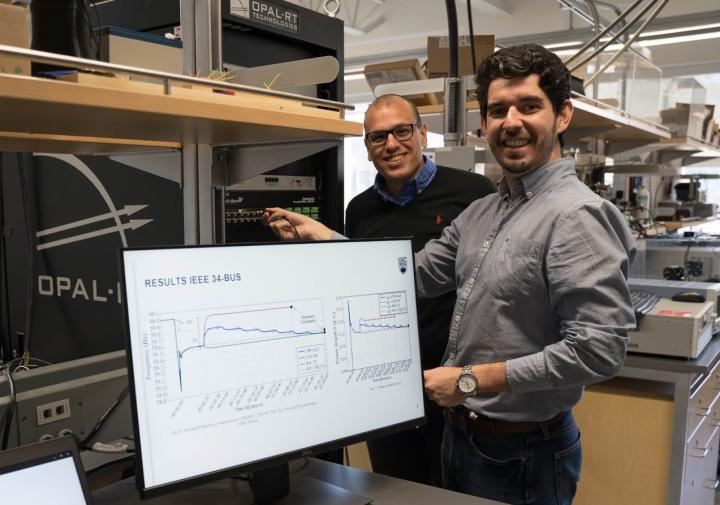
“The microgrid will recognize the problem in the main power system and will isolate itself, avoiding previously inevitable power outages,” explains Yuri Rodrigues, a UBCO electrical engineering doctoral student and study co-author.

He explains, however, that a continued supply of power in this mode will depend on locally available generating reserves. This means that conserving energy is vital to keeping the islanded grid operational for as long as possible.

Rodrigues describes their approach as the difference between using the sports mode on your car versus the eco mode. The microgrid can distribute power at a slightly diluted level that won’t negatively impact electronics while allowing power to flow for longer periods without running out.

“Our new proposed method takes a more sustainable approach, allowing the microgrids to conserve power so any shortfall can be better handled by the microgrid itself,” Rodrigues says.

The challenge with using this concept in a larger system is that those larger systems may experience too much instability–this could result in the entire system shutting down. Rodrigues points to a similar occurrence in 2003 when most of the eastern seaboard of North America collapsed leaving millions in the dark.

Many safeguards already exist within power distribution systems to enlarge the system operation, but they only help by prioritizing power based on urgency, meaning hospitals and infrastructure would take precedence over regular consumer needs, he says.

This new approach of conserving power that is distributed within microgrids and thereby reducing or eliminating brownouts and blackouts could soon be an option for power systems around the world. It would also allow for global energy conservation that would decrease the network’s demand and improve the self-sufficiency of the microgrid as a whole.

According to Rodrigues, their testing indicates this approach can significantly enhance microgrid autonomy and stability with no impact on the wider power system.

“There are many components that make up a power system from generation to distribution before electricity arrives in the outlets of consumers,” says Rodrigues. “Creating a system this is more self-sufficient, robust and sustainable is key to creating a reliable and blackout-free experience for future power consumers.”

###

The research, published in the Journal of Electrical Power and Energy Systems, was supported by several agencies in Brazil and the Natural Sciences and Engineering Research Council of Canada.

Media Contact
Patty Wellborn
[email protected]
250-317-0293

Original Source

https://news.ok.ubc.ca/2020/03/02/ubco-professor-simplifies-exercise-advice-for-spinal-cord-injury

Related Journal Article

http://dx.doi.org/10.1016/j.ijepes.2019.105499

Tags: Climate ChangeElectrical Engineering/ElectronicsEnergy SourcesEnergy/Fuel (non-petroleum)Hydrology/Water ResourcesSoftware EngineeringSuperconductors/SemiconductorsTechnology/Engineering/Computer Science
Share12Tweet8Share2ShareShareShare2

Related Posts

AI and Physics Collaborate to Design Advanced Hydrogen Storage Materials

June 25, 2026

International Team Including Dresden Scientists Develops Novel Designer Proteins for Advanced Study of Living Tissue

June 25, 2026

New Study Uncovers Key Factors Driving Water Chemistry in Nanoscale Environments

June 25, 2026

Plasma Technology Extends Catalyst Lifespan in Hydrogen Production

June 24, 2026
Please login to join discussion

POPULAR NEWS

  • Saying Goodbye to PGY-6: Pediatric Fellowship Realities

    103 shares
    Share 41 Tweet 26
  • Multi-Hospital Study Reveals Long Covid Burden Is Twice as High as Current Estimates

    92 shares
    Share 36 Tweet 23
  • Detection of EDCs in Breast Milk and Infant Urine Up to Six Months Highlights Early Exposure Risks

    77 shares
    Share 31 Tweet 19
  • New Drug Candidate Developed at McMaster Shows Potential for Treating Brain Cancer

    58 shares
    Share 23 Tweet 15

About

We bring you the latest biotechnology news from best research centers and universities around the world. Check our website.

Follow us

Recent News

Tracking Lanthanide-Labeled Microplastics in Plants

POSTECH Researchers Slash Cost of Reconstituted Cell-Free Systems by 95%

AI and Physics Collaborate to Design Advanced Hydrogen Storage Materials

Subscribe to Blog via Email

Success! An email was just sent to confirm your subscription. Please find the email now and click 'Confirm' to start subscribing.

Join 82 other subscribers
  • Contact Us

Bioengineer.org © Copyright 2023 All Rights Reserved.

Welcome Back!

Login to your account below

Forgotten Password?

Retrieve your password

Please enter your username or email address to reset your password.

Log In
No Result
View All Result
  • Homepages
    • Home Page 1
    • Home Page 2
  • News
  • National
  • Business
  • Health
  • Lifestyle
  • Science

Bioengineer.org © Copyright 2023 All Rights Reserved.