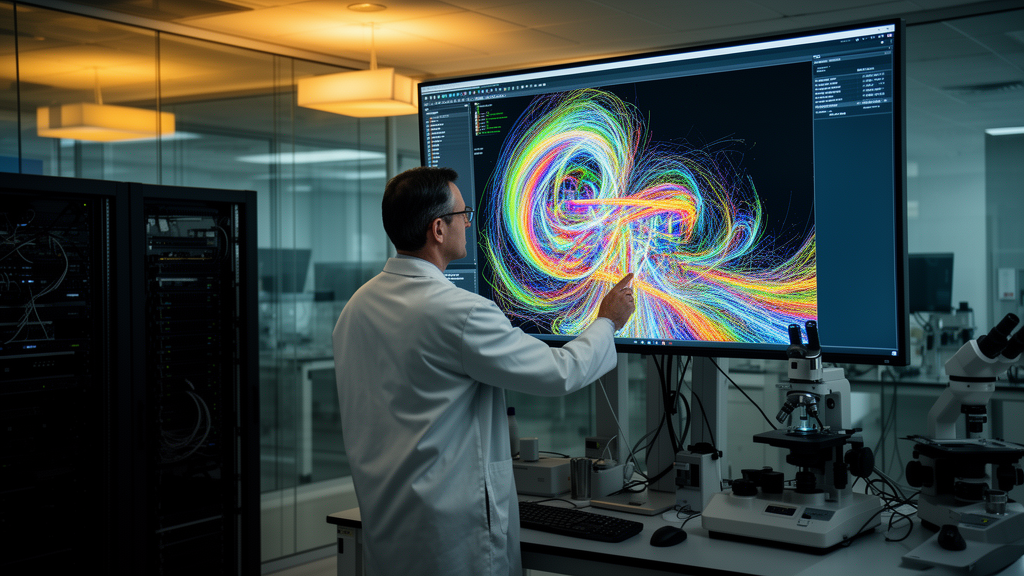
Researchers led by Sandia National Laboratories are developing a physics-constrained artificial intelligence foundation model for complex turbulent flows, with a central goal of quantifying uncertainty in predictions involving wind, aerosols and combustion. The project brings together Sandia and researchers from Harvard John A. Paulson School of Engineering and Applied Sciences as part of the Department of Energy-funded Genesis Mission, a national initiative integrating AI with supercomputing and scientific infrastructure. The announcement describes a research program in development; it does not report performance results, validated uncertainty estimates or evidence that the planned model outperforms existing simulation approaches.
The model is intended for flow problems that are difficult and expensive to simulate in fine detail. Potential applications include research into combustion processes for emerging fuels such as hydrogen, atmospheric reconstruction for wind-energy operations, improved understanding of how turbulence affects wind turbines and aerosol modeling that includes the movement and interactions of microscopic particles in Earth’s atmosphere. Rather than being designed for one narrowly defined task, the proposed foundation model would be trained on large datasets and adapted to different problems. The Sandia-led effort also draws on MATEY, a foundation model for turbulence previously developed by researchers at Oak Ridge National Laboratory, and will combine it with a physics-informed training approach called Bayesian Optimization of a Discrete Loss, or B-ODIL.
Harvard’s team is led by Petros Koumoutsakos, the Herbert S. Winokur, Jr. Professor of Computing in Science and Engineering. He said quantifying uncertainty in a foundation model remains a major open problem, particularly how equations and data can be brought together within a predictive system. The planned approach is designed to incorporate both large-scale data-driven modeling and known physical laws. Koumoutsakos said the project’s Bayesian methodology is intended to address that combination and measure uncertainty in foundation-model forecasts, while the announcement provides no numerical forecasts or benchmark comparisons for the system.
The work is part of a broader effort to use AI for scientific and engineering research. Koumoutsakos has previously pioneered approaches including multi-agent reinforcement learning for turbulence modeling and generative AI for forecasting turbulent flows. Within the wider Genesis Mission, the project seeks to connect AI, supercomputing and scientific infrastructure to improve research and engineering outputs. Its immediate focus is the development of a transferable model for complex flows and the measurement of uncertainty in its predictions, with possible uses spanning wind-related studies, aerosols and combustion. Whether the resulting model can deliver reliable uncertainty estimates for those applications remains to be established through the planned development and testing.
Subject of Research: Physics-constrained AI foundation models for uncertainty quantification in turbulent flows
Article Title: Using AI to model wind, aerosols and combustion
Article References: Using AI to model wind, aerosols and combustion. Original publication (Bibliographic details unavailable.)
Image Credits: AI Generated
DOI: Not provided
Keywords: artificial intelligence, turbulence modeling, uncertainty quantification, foundation models, Bayesian methods, Sandia National Laboratories, Genesis Mission, aerosol modeling, combustion, wind energy, model, wind
News Source: Audrey Campbell. (October 26, 2026). Sandia-Led AI Project Targets Uncertainty in Turbulent Flow Models. Scienmag.