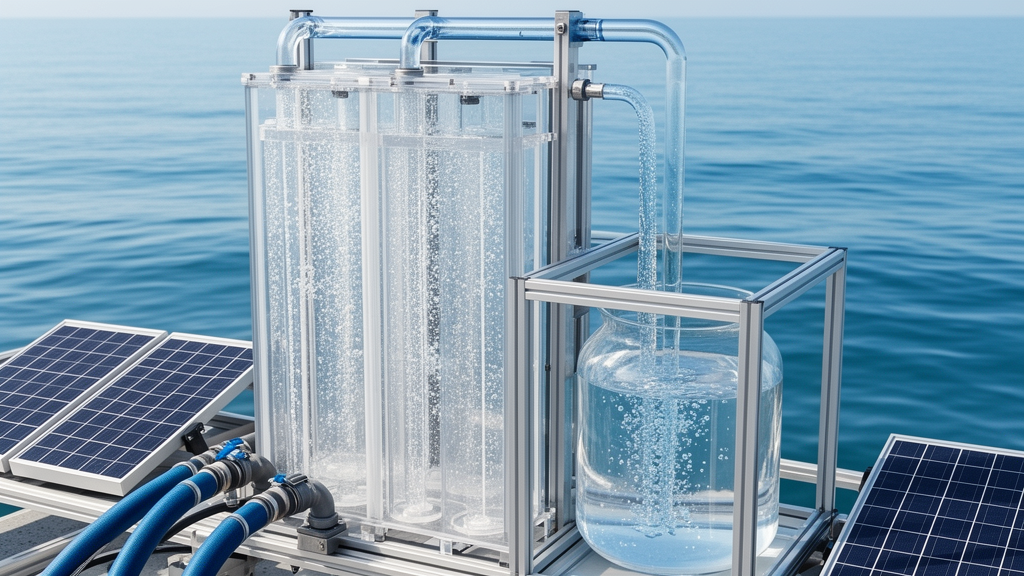
A 250-kilowatt experimental system co-produced hydrogen and fresh water from seawater by using low-grade waste heat from alkaline water electrolysis to drive low-temperature vacuum distillation. The system produced hydrogen at 48 normal cubic metres per hour and fresh water at 31.6 kilograms per hour, while improving electrical efficiency by 14.4% compared with conventional alkaline electrolysis using fresh water alone.
The demonstration was developed by a team led by Prof. Deng Dehui and Associate Prof. Liu Yanting from the Dalian Institute of Chemical Physics at the Chinese Academy of Sciences. Published in Nature Energy on September 15, the experimental study introduced a “seawater to hydrogen and fresh water” route, abbreviated STHW. In this configuration, alkaline water electrolysis generates hydrogen and releases heat that would otherwise be lost as low-grade waste. The recovered heat supplies energy for seawater desalination, and part of the resulting fresh water is returned to the electrolysis process while the remainder is available for external use.
Researchers first evaluated the route in a 20-kilowatt industrial pilot system. That system achieved a hydrogen productivity of 3.8 normal cubic metres per hour and co-produced 1.2 kilograms of fresh water per hour. It operated stably for 100 days. The duration applies to the 20-kilowatt pilot, not the later 250-kilowatt system. Together, the two experimental scales demonstrated the basic process at different sizes, but the supplied research report does not provide a comparable duration of continuous operation for the 250-kilowatt installation.
At the larger scale, the 250-kilowatt system produced both high-purity hydrogen and fresh water at the rates reported above. Its 14.4% electrical-efficiency improvement was measured against conventional alkaline electrolysis using fresh water alone. This comparison concerns the operating conditions tested in the study and does not by itself establish performance at utility scale, long-term durability under other conditions, or commercial viability. The work was an engineering demonstration of coupled electrolysis and desalination rather than an assessment of the technology across multiple industrial sites.
The process also generates concentrated brine after desalination. The researchers identified salt, uranium and bromine as resources that could potentially be recovered from this stream, but the supplied report does not specify recovery yields or document the performance of separate downstream extraction processes. The central experimental result is therefore the simultaneous production of hydrogen and usable fresh water through heat integration: the 20-kilowatt pilot sustained operation for 100 days, and the 250-kilowatt system reached reported output rates of 48 normal cubic metres of hydrogen and 31.6 kilograms of fresh water per hour. The study presents a pathway for making electrolysis waste heat perform useful desalination work while adding a fresh-water output, while further evidence would be needed to establish deployment readiness.
Subject of Research: Experimental seawater electrolysis and vacuum distillation for hydrogen and fresh-water co-production
Article Title: New strategy enables co-production of hydrogen and fresh water from seawater
Article References: New strategy enables co-production of hydrogen and fresh water from seawater. Original publication (Bibliographic details unavailable.)
Image Credits: AI Generated
DOI: Not provided
Keywords: seawater electrolysis, green hydrogen, freshwater production, waste heat recovery, vacuum distillation, alkaline electrolysis, desalination, pilot scale, electrical efficiency, concentrated brine, strategy, enables
News Source: Bethany Barker. (October 26, 2026). Pilot system co-produces hydrogen and fresh water from seawater. Scienmag.