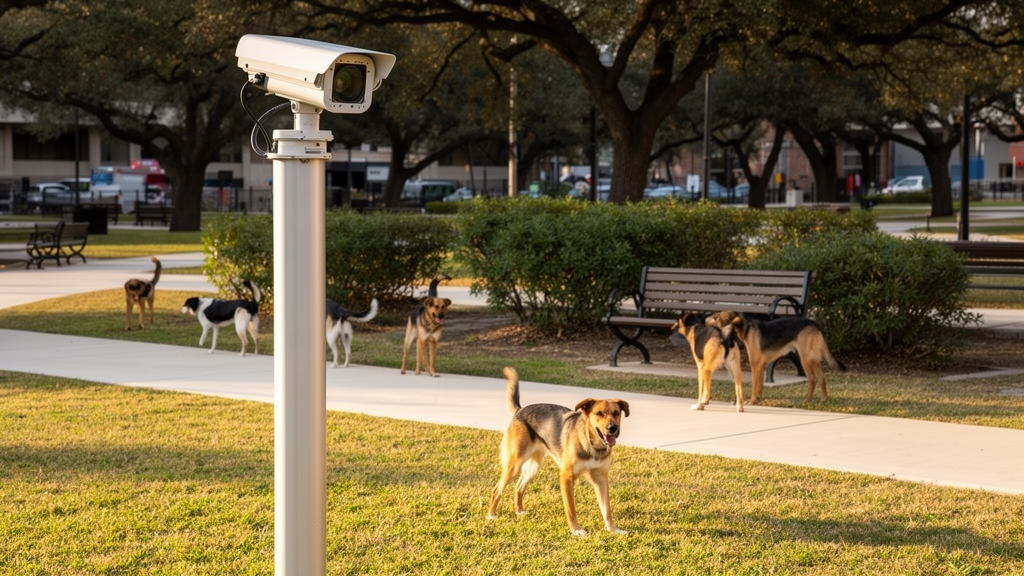
Southwest Research Institute and the City of San Antonio are beginning an automated survey of unrestrained dogs across 32 areas of the city. The city-funded project pairs cellular phones mounted on vehicle windows with SwRI-developed object-detection and data-analysis software. Engineers plan to collect video during fieldwork from October through December 2026, then compile summary data and videos of observed dogs in a final report.
The study is a sampled survey rather than a census of every unrestrained dog in San Antonio, and the announced project is a test of the surveying technology rather than a report of completed findings. The automated effort will revisit the 32 study locations used in a manual survey conducted in 2019. In that earlier survey, volunteers helped San Antonio Animal Care Services identify unrestrained dogs and classify them as “stray” or “roaming.” Under the survey’s stated criteria, strays appear malnourished and skittish, whereas dogs that seem healthier and more approachable are likely to be owned by local families and are classified as roaming.
The new study uses the same general sampling areas to determine whether a camera-and-software workflow can help characterize this population while retaining human review. For each deployment, SwRI engineers will use a cellular phone mounted to a vehicle window to gather video of unrestrained dogs. Object-detection software will identify candidate animals in the footage, after which automated and human review will examine the clips.
Reviewers are expected to verify that detected animals were unrestrained, determine whether a human was present, count the dogs and assess whether each animal was owned or a stray. The survey has an explicitly limited geographic scope. The 32 locations represent areas in which unrestrained dogs are common, but the sample does not cover the entire city.
The project will therefore produce information about dogs observed in the selected areas rather than a precise total for San Antonio as a whole. Its workflow will also connect machine vision with human evaluation: the phone-mounted camera gathers roadside video, the software detects animals, and reviewers determine whether each detection meets the survey’s criteria. No totals, detection rates, classification accuracy or comparisons with the 2019 manual survey are available at the start of the announced October-to-December 2026 research period.
Those outcomes have not yet been reported, and the release does not provide performance measurements for the system. San Antonio Animal Care Services Director Jon Gary said the study would give the department another tool for understanding where unrestrained dogs are seen while supporting its broader work to protect the health and safety of people and pets. Mike Koets, a staff engineer in SwRI’s Intelligent Systems Division, said the organization was excited to test the technology and help San Antonio apply real-world solutions to an issue affecting many residents.
The planned final report is expected to include summary data and videos of dogs observed during the deployment. Until that report is completed, the release supports a description of the survey method and its intended municipal application, but not conclusions about how many unrestrained dogs are present or how well the automated system performs compared with the earlier volunteer-led survey.
Subject of Research: A machine vision and human-review survey of unrestrained dogs in 32 sampled areas of San Antonio
Article Title: SwRI applies automation to count unrestrained dogs in San Antonio
Article References: SwRI applies automation to count unrestrained dogs in San Antonio. Original publication (Bibliographic details unavailable.)
Image Credits: AI Generated
DOI: Not provided
Keywords: unrestrained dogs, machine vision, San Antonio, Southwest Research Institute, object detection, stray dogs, roaming dogs, municipal surveys, animal care services, SwRI, applies, automation
News Source: Elena Sutton. (October 22, 2026). San Antonio tests machine vision to survey unrestrained dogs. Scienmag.