3D-printed burning-out models are used in the production of ceramic molds
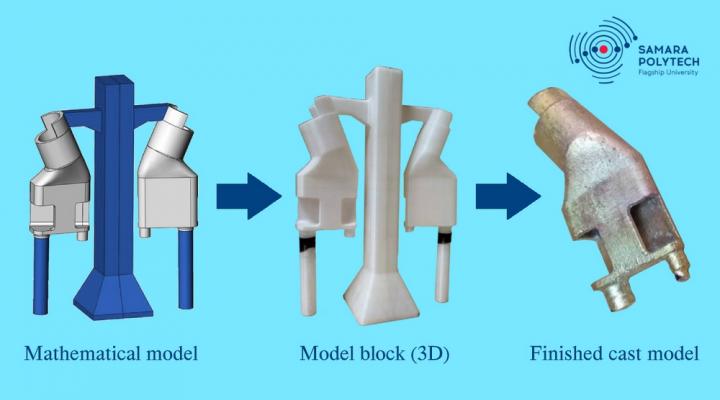
Credit: @SamaraPolytech
Specialists of the Department of Foundry and Highly Efficient Technologies of the Faculty of Mechanical Engineering, Metallurgy and Transport of Samara Polytech have been experimenting with metal alloys and developing new methods of cast products manufacturing for over 30 years. Recently, the foundry scientists have found another innovative way – to use additive technologies. The results of the latest experiments are published in the summer issues of the journal Foundry.
Polytech casters suggested to simplify the traditional casting technology by using additive technologies – the burning-out model printed on a 3D printer is covered with the refractory ceramic agent by method of layer-by-layer fusing, and that’s how the refractory ceramic mold is formed.
Thus, the casting process using burning-out models includes the following stages: creating three-dimensional computer models for the further 3D printing of a polymer burning-out model, making refractory ceramic molds, burning out a model block from them, calcinating them, pouring a metal melt, and knocking the hardened product out of the mold.
“In additive technologies, the strategy of making a product directly affects the complex of its physical properties: mass, strength, elasticity, shrinkage, and so on,” Bagdat Tukabayov, an engineer of the Foundry Technology Center of Samara Polytech explains. “Therefore, in the manufacture of the burning-out models, it is necessary to ensure the required surface quality and the required strength of the model, to minimize its weight, and also to achieve the optimal printing time.
In addition, the Samara Polytech scientists optimize the material structure when printing a 3D model.
“Any model material expands and puts pressure on the mold walls in the process of heating and burning”, Bagdat notes. “And the optimal material structure allows the model to “fold” inward when expanding, without creating external pressure. This way we can eliminate the risk of breaking the ceramic mold”.
Thus, the casting technology with the use of 3D printing allows to reduce the product cost, while increasing the production rate regardless of the complexity of their configuration, and also significantly reduces the share of manual labor in the production of castings.
###
For reference:
Samara State Technical University (SSTU, Samara Polytech) as a flagship university offers a wide range of education and research programs and aims at development and transfer of high-quality and practically-oriented knowledge. The university has an established reputation in technical developments and focuses on quality education, scientific and pragmatic research, combining theory and practice in the leading regional businesses and enterprises. Education is conducted in 30 integrated groups of specialties and areas of training (about 200 degree programs including bachelor, master programs and 55 PhD programs) such as oil and gas, chemistry and petrochemistry, mechanics and energy, transportation, food production, defense, IT, mechanical and automotive engineering, engineering systems administration and automation, material science and metallurgy, biotechnology, industrial ecology, architecture, civil engineering and design, etc.
Media Contact
Roman Naumov
[email protected]