A novel noninvasive technique may detect human papilloma virus-16, the strain associated with oropharyngeal cancer, in saliva samples, reports The Journal of Molecular Diagnostics
Credit: The Journal of Molecular Diagnostics
Philadelphia, December 13, 2019 – Unfortunately, cancers that occur in the back of the mouth and upper throat are often not diagnosed until they become advanced, partly because their location makes them difficult to see during routine clinical exams. A report in the Journal of Molecular Diagnostics, published by Elsevier, describes the use of acoustofluidics, a new non-invasive method that analyzes saliva for the presence of human papilloma virus (HPV)-16, the pathogenic strain associated with oropharyngeal cancers (OPCs). This novel technique detected OPC in whole saliva in 40 percent of patients tested and 80 percent of confirmed OPC patients.
“OPC has an approximate incidence of 115,000 cases per year worldwide and is one of the fastest-rising cancers in Western countries due to increasing HPV-related incidence, especially in younger patients. It is paramount that surveillance methods are developed to improve early detection and outcomes,” explained co-lead investigator Tony Jun Huang, PhD, Department of Mechanical Engineering and Materials Science, Duke University, Durham, NC, USA.
“Considering these factors, the successful detection of HPV from salivary exosomes isolated by our acoustofluidic platform offers distinct advantages, including early detection, risk assessment, and screening,” added Dr. Huang. This technique may also help physicians predict which patients will respond well to radiation therapy or achieve longer progression-free survival.
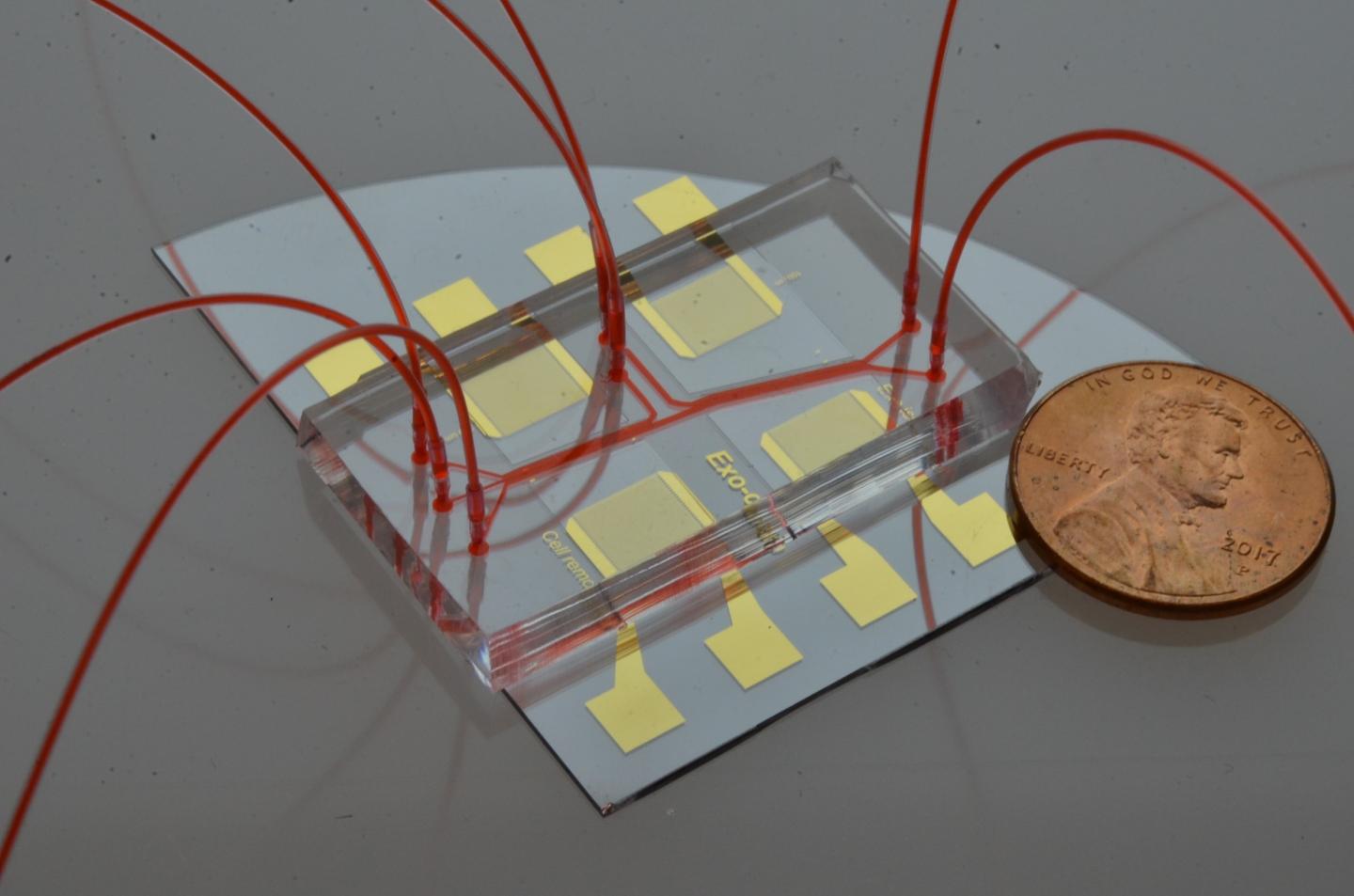
Exosomes are tiny microvesicles originating within cells that are secreted into body fluids. They are believed to play a role in intercellular communication and their numbers are elevated in association with several types of cancers. Acoustofluidics is an advanced technology that fuses acoustics and microfluidics. Fluid samples are analyzed using a tiny acoustofluidic chip developed to isolate salivary exosomes by removing unwanted particles based on size, leaving exosome-rich concentrated samples that make it easier to detect tumor-specific biomarkers.
In this study investigators analyzed saliva samples from 10 patients diagnosed with HPV-OPC using traditional methods. They found that the technique identified the tumor biomarker HPV-16 DNA in 80 percent of the cases when coupled with droplet digit PCR. Since this method is independent of sample variability that arises due to changes in saliva viscosity and collection methods used, it may prove ideal for use in clinical settings.
Dr. Huang highlighted some of the technique’s features, including automated and fast exosome isolation (less than five minutes of processing time compared to approximately eight hours of processing time using benchmark technologies). Analyses can be performed at relatively low cost and at points of care. Also, it is suitable for repeated and continuous monitoring of tumor progression and treatment, unlike traditional biopsy.
“With these features, the acoustofluidic technology has the potential to significantly exceed current industry standards, address unmet needs in the field, help expedite exosome-related biomedical research, and aid in the discovery of new exosomal biomarkers,” commented Dr. Huang.
“The saliva exosome liquid biopsy is an effective early detection and risk assessment approach for OPC,” said co-lead investigator David T.W. Wong, DMD, DMSc, of the Center for Oral/Head and Neck Oncology Research, School of Dentistry at the University of California Los Angeles, CA, USA. “The acoustofluidic separation technique provides a fast, biocompatible, high-yield, high-purity, label-free method for exosome isolation from saliva.” According to the researchers, this technology can also be used to analyze other biofluids such as blood, urine, and plasma.
The study was an international collaboration between Duke University, UCLA, and University of Birmingham (UK). Prof Hisham Mehanna, Director of the Institute of Head and Neck Studies and Education, University of Birmingham, Birmingham, UK, said ‘The results are a testament to the power of interdisciplinary research and international collaboration.’
###
Media Contact
Eileen Leahy
[email protected]
732-238-3628
Related Journal Article
http://dx.