• HOME
  • NEWS
  • EXPLORE
    • CAREER
      • Companies
      • Jobs
    • EVENTS
    • iGEM
      • News
      • Team
    • PHOTOS
    • VIDEO
    • WIKI
  • BLOG
  • COMMUNITY
    • FACEBOOK
    • INSTAGRAM
    • TWITTER
Friday, May 22, 2026
BIOENGINEER.ORG
No Result
View All Result
  • Login
  • HOME
  • NEWS
  • EXPLORE
    • CAREER
      • Companies
      • Jobs
        • Lecturer
        • PhD Studentship
        • Postdoc
        • Research Assistant
    • EVENTS
    • iGEM
      • News
      • Team
    • PHOTOS
    • VIDEO
    • WIKI
  • BLOG
  • COMMUNITY
    • FACEBOOK
    • INSTAGRAM
    • TWITTER
  • HOME
  • NEWS
  • EXPLORE
    • CAREER
      • Companies
      • Jobs
        • Lecturer
        • PhD Studentship
        • Postdoc
        • Research Assistant
    • EVENTS
    • iGEM
      • News
      • Team
    • PHOTOS
    • VIDEO
    • WIKI
  • BLOG
  • COMMUNITY
    • FACEBOOK
    • INSTAGRAM
    • TWITTER
No Result
View All Result
Bioengineer.org
No Result
View All Result
Home NEWS Science News Chemistry

Russian scientists alter 3D genome using ‘small molecules’

Bioengineer by Bioengineer
April 15, 2019
in Chemistry
Reading Time: 2 mins read
0
IMAGE
Share on FacebookShare on TwitterShare on LinkedinShare on RedditShare on Telegram

IMAGE

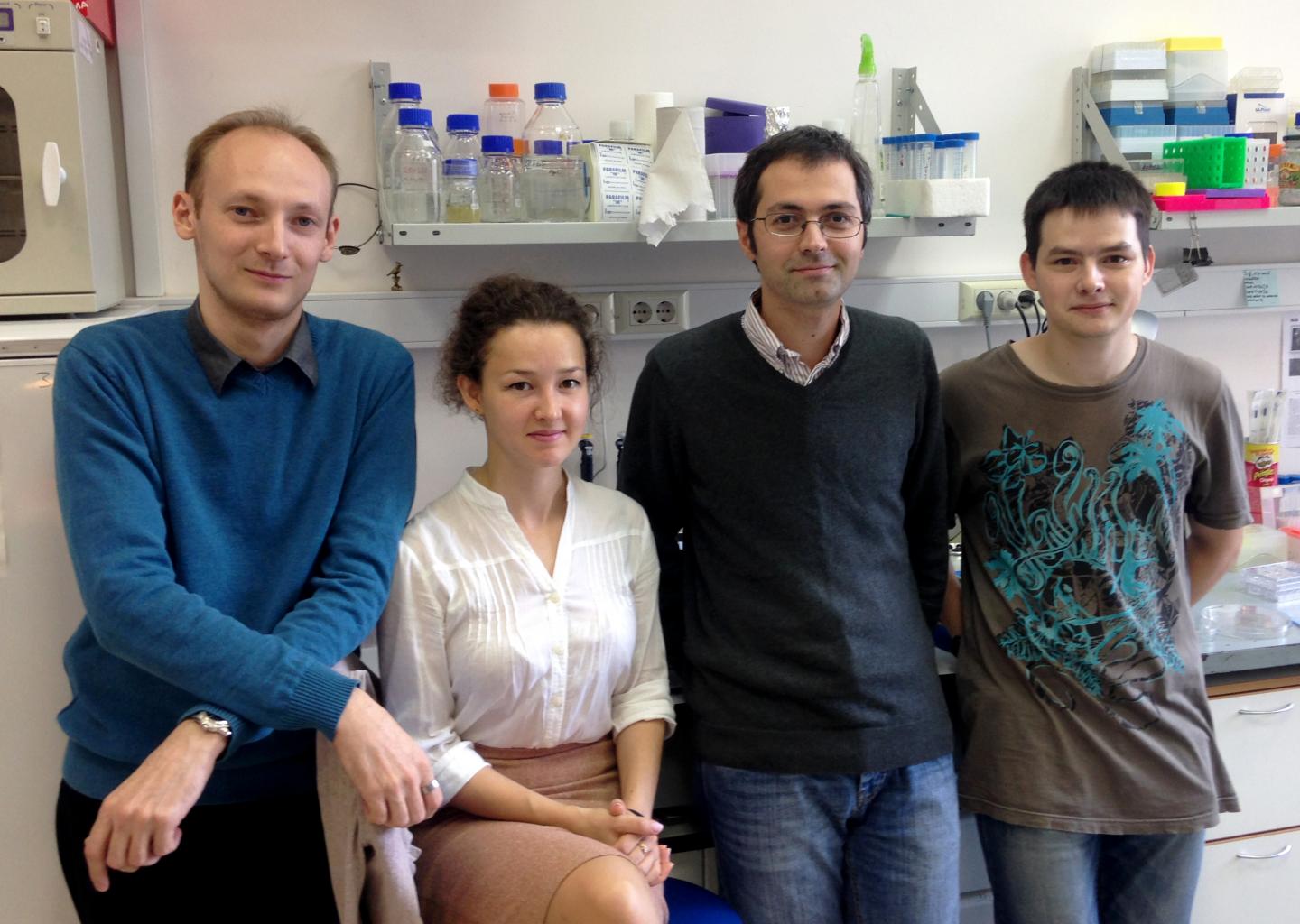
Credit: Omar Kantidze

Researchers have discovered that the spatial organization of the genome can be altered using small molecule compounds which are considered as promising anti-cancer drugs. This work opens up the prospect of developing a new class of anticancer epigenetic drugs that alter the 3D genome. The results were published in Nature Communications.

The properties of a living organism are encoded in its genome, the physical carrier of which in most cases is a DNA. Even though DNA is a linear molecule, in the cell nucleus it is found in a folded state, which means that genes and distant regulatory elements may be juxtaposed in physical space, forming complex regulatory networks. Special mechanisms controlling the functioning of human genes operate at the level of DNA packaging. These mechanisms are exactly what the authors of the study investigate.

In this work, the scientists were the first to demonstrate that the spatial orgnization of the genome (3D genome) can be altered using small molecules capable to penetrate into living cells. Curaxins are a class of chemical compounds that exhibit anticancer activity, i.e. they kill cancer cells and suppress the development of malignant tumours. These anti-cancer agents were developed by the American co-authors of the article approximately ten years ago. The laboratory of Professor Katerina Gurova (Roswell Park Comprehensive Cancer Center, United States) had previously demonstrated that curaxins can specifically kill cancer cells. A drug from this group is currently undergoing the first phase of clinical trials.

“We used a compound from the curaxin family. It binds to DNA and alters its physical properties in such a way that a protein factor important for maintaining the spatial structure of the genome is detached from the DNA. This leads to significant changes in the 3D genome, suppressing a number of genes, primarily oncogenes,” says supervisor of the research, professor Sergey Razin, head of the Functional Genomics Department at the Institute of Gene Biology of the Russian Academy of Sciences.

“This study could stimulate the search for new drugs that alter gene expression by changing the spatial genome organization,” adds one of the article’s authors, Omar Kantidze, head of the Genome Stability Lab at the Institute of Gene Biology, RAS.

The search for so-called epigenetic drugs has become a “hot trend.” However, no small molecules that directly affect the 3D genome were previously known. The results of this work outline a new approach to the development of epigenetic drugs.

###

The work was performed in cooperation with researchers from Lomonosov Moscow State University, Shemyakin-Ovchinnikov Institute of Bioorganic Chemistry of the Russian Academy of Sciences, Roswell Park Comprehensive Cancer Center (USA) and Fox Chase Cancer Center (USA).

Media Contact
Omar Kantidze
[email protected]

Related Journal Article

http://dx.doi.org/10.1038/s41467-019-09500-7

Tags: BiochemistryBiologycancerCell BiologyGeneticsMedicine/Health
Share12Tweet8Share2ShareShareShare2

Related Posts

Scientists Achieve Breakthrough in Molecular ‘Sandwich’ Assembly — Chemistry

Scientists Achieve Breakthrough in Molecular ‘Sandwich’ Assembly

May 21, 2026
Advancing In Vivo and In Situ Monitoring: Science Bulletin Highlights Host-Based Antifouling Gold Nanotube Sensor for Selective Detection of Mechanically Sensitive Serotonin Release in Intestinal Mucosa — Chemistry

Advancing In Vivo and In Situ Monitoring: Science Bulletin Highlights Host-Based Antifouling Gold Nanotube Sensor for Selective Detection of Mechanically Sensitive Serotonin Release in Intestinal Mucosa

May 20, 2026

How Magnetic Orientation Could Influence the Building Blocks of Life

May 20, 2026

Breaking a 200-Year-Old Belief: Novel Surface Design Achieves Two Distinct Wetting States on One Substrate

May 20, 2026
Please login to join discussion

POPULAR NEWS

  • blank

    New Study Reveals Plants Can Detect the Sound of Rain

    734 shares
    Share 293 Tweet 183
  • ESMO 2025: mRNA COVID Vaccines Enhance Efficacy of Cancer Immunotherapy

    309 shares
    Share 124 Tweet 77
  • Research Indicates Potential Connection Between Prenatal Medication Exposure and Elevated Autism Risk

    847 shares
    Share 339 Tweet 212
  • Breastmilk Balances E. coli and Beneficial Bacteria in Infant Gut Microbiomes

    58 shares
    Share 23 Tweet 15

About

We bring you the latest biotechnology news from best research centers and universities around the world. Check our website.

Follow us

Recent News

Amino Acid Clock Reveals Insights into Aging

Branched-Chain Amino Acids: Key in Obesity?

Transplantable Large-Scale Functional Human Gut Tissues

Subscribe to Blog via Email

Enter your email address to subscribe to this blog and receive notifications of new posts by email.

Join 82 other subscribers
  • Contact Us

Bioengineer.org © Copyright 2023 All Rights Reserved.

Welcome Back!

Login to your account below

Forgotten Password?

Retrieve your password

Please enter your username or email address to reset your password.

Log In
No Result
View All Result
  • Homepages
    • Home Page 1
    • Home Page 2
  • News
  • National
  • Business
  • Health
  • Lifestyle
  • Science

Bioengineer.org © Copyright 2023 All Rights Reserved.