


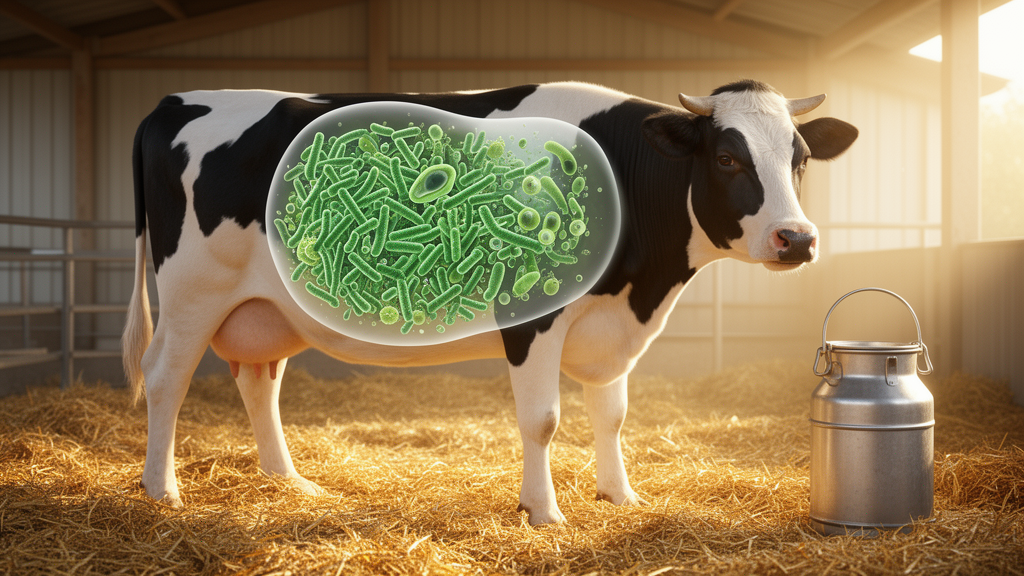
A new longitudinal study of periparturient Holstein cows points to the rumen microbial community as one piece of the answer, reporting that prepartum differences in rumen community structure were associated with subsequent serum metabolic trajectories and with milk-yield phenotype, even though measured volatile fatty acid concentrations did not differ significantly between high- and low-yielding animals.
The study, published in BMC Microbiology, addressed a gap the authors identify in previous rumen microbiome research: most work has compared healthy with diseased animals, leaving variation in milk yield among healthy cows largely unexplained. To probe that variation, the researchers enrolled eighty clinically healthy Holstein cows and stratified them by average milk yield across days 3 to 21 postpartum. Cows falling in the upper and lower quartiles formed the high-yield and low-yield groups, twenty animals each, with milk yield serving as a descriptive grouping variable rather than a manipulated factor.
Sampling was intensive and longitudinal. Blood, ruminal digesta, and postpartum milk samples were collected at 21 days before calving and at days 1, 3, 7, 14, and 21 relative to calving, capturing the metabolic turbulence of the transition period, when parturition, lactogenesis, and negative energy balance converge. This repeated-measures design allowed the team to track how rumen microbes, fermentation products, and blood metabolites changed together across the peripartum window.
The fermentation results were notably null. Ruminal volatile fatty acid concentrations, the rumen microbiome’s main energetic contribution to the host, showed no intergroup differences following parturition, with q values of 0.85 to 0.93, and prepartum concentrations were also comparable between groups. In other words, the classic explanation for yield variation, simply producing more ruminal VFA, was not supported in these healthy animals.
Microbial diversity told a subtler story. Prepartum, the high-yielding cows displayed elevated ruminal microbial alpha diversity and greater relative abundances of the phylum Bacteroidota and the genus Prevotella. However, these distinctions became marginal after multiple-testing correction, with q values of 0.059 for diversity and 0.21 to 0.94 for the taxonomic abundances. Rumen microbial community structure, assessed as a whole, did differ between the groups before calving, suggesting a compositional signature that single taxon comparisons alone did not capture robustly.
A central methodological contribution lies in how the team handled microbe-metabolite associations. The number of associations surviving Benjamini-Hochberg correction rose from 2 out of 280 prepartum pairs to 32 out of 280 postpartum pairs, and 10 out of 280 associations persisted after further adjustment for sampling day. The authors built their subsequent interpretations only on these retained associations, a conservative approach that guards against overinterpreting spurious correlations in high-dimensional microbiome data.
Across all experimental animals, two prepartum microbial measures correlated with later production: higher prepartum Shannon diversity and greater relative abundance of F082 were each associated with elevated subsequent milk yield, at q values of 0.007 and 0.045 respectively. Because these associations were measured before calving and related to yield measured afterward, they raise the possibility that the prepartum rumen community helps shape, or at least flags, productive potential in early lactation.
Blood metabolites added a metabolic dimension. Group-specific temporal patterns emerged for postpartum non-esterified fatty acid and beta-hydroxybutyrate, and the authors present these kinetic profiles descriptively. The authors present these kinetic profiles descriptively, linking them to the prepartum differences in rumen community structure rather than claiming the microbes caused the metabolic patterns.
The researchers are careful about causality. In their conclusions they state that prepartum differences in rumen community structure were associated with subsequent differences in serum metabolic trajectories and with the selected milk-yield phenotype, whereas measured VFA concentrations did not differ significantly. They hypothesize that these prepartum microbial differences contribute to the observed postpartum patterns, but emphasize that this requires validation in independent cohorts before any causal or management interpretation is warranted.
For now, the study offers a measured but intriguing picture: among healthy cows, the seeds of yield variation may be visible in the rumen weeks before lactation peaks, not in the raw concentration of fermentation acids but in the composition and diversity of the microbial community itself, and in the metabolic trajectories that follow. Confirming those signals in larger, independent herds will determine whether rumen microbiome profiles could eventually serve as early indicators of productive potential in the transition period.
Subject of Research: Associations between rumen microbiome, fermentation, serum metabolites and milk-yield variation in periparturient Holstein cows
Article Title: Longitudinal analysis reveals associations of rumen microbial fermentation and serum metabolic indices with milk-yield variation in periparturient Holstein cows
Article References: Wu, W., Wang, E., Ren, W., Yang, L., Wang, T., Sun, W., Zhen, Y., & Liu, H. (2026). Longitudinal analysis reveals associations of rumen microbial fermentation and serum metabolic indices with milk-yield variation in periparturient Holstein cows. BMC Microbiology. https://doi.org/10.1186/s12866-026-05799-7
Image Credits: AI Generated
DOI: 10.1186/s12866-026-05799-7
Keywords: rumen microbiome, dairy cattle, Holstein cows, periparturient period, milk yield, volatile fatty acids, serum metabolites, NEFA, BHBA, microbial diversity, longitudinal study, BMC Microbiology
News Source: Morgan Morrow. (October 29, 2026). Rumen Microbes Linked to Milk Yield Differences in Healthy Holstein Cows. Scienmag.



