• HOME
  • NEWS
  • EXPLORE
    • CAREER
      • Companies
      • Jobs
    • EVENTS
    • iGEM
      • News
      • Team
    • PHOTOS
    • VIDEO
    • WIKI
  • BLOG
  • COMMUNITY
    • FACEBOOK
    • INSTAGRAM
    • TWITTER
Saturday, June 27, 2026
BIOENGINEER.ORG
No Result
View All Result
  • Login
  • HOME
  • NEWS
  • EXPLORE
    • CAREER
      • Companies
      • Jobs
        • Lecturer
        • PhD Studentship
        • Postdoc
        • Research Assistant
    • EVENTS
    • iGEM
      • News
      • Team
    • PHOTOS
    • VIDEO
    • WIKI
  • BLOG
  • COMMUNITY
    • FACEBOOK
    • INSTAGRAM
    • TWITTER
  • HOME
  • NEWS
  • EXPLORE
    • CAREER
      • Companies
      • Jobs
        • Lecturer
        • PhD Studentship
        • Postdoc
        • Research Assistant
    • EVENTS
    • iGEM
      • News
      • Team
    • PHOTOS
    • VIDEO
    • WIKI
  • BLOG
  • COMMUNITY
    • FACEBOOK
    • INSTAGRAM
    • TWITTER
No Result
View All Result
Bioengineer.org
No Result
View All Result
Home NEWS Science News Chemistry

RUDN University scientist suggested a simple model of dense plasma spectral properties

Bioengineer by Bioengineer
October 8, 2020
in Chemistry
Reading Time: 3 mins read
0
IMAGE
Share on FacebookShare on TwitterShare on LinkedinShare on RedditShare on Telegram

IMAGE

Credit: RUDN University

A scientist from RUDN University suggested a new physical model to describe the optical properties of dense plasma. The model was tested on available experimental data and does not require complex calculations. The work was published in the Annals of Physics journal.

Plasma is the fourth state of matter, along with solid matter, liquid, and gas. High-density (up to ~1 g/cm3) plasma is used in many technical and experimental installations such as heavy-current electrical discharge devices, control fusion targets, or laser targets that are used to study the properties of matter under extreme pressure.

An important feature of plasma is its light absorptance coefficient. Its value is to a great extent dependent on the photo effect (the transfer of energy from the photons to the electrons of a substance) and light absorptance in optical lines. Both of these processes, in turn, are due to the so-called microfield–an electric field inside plasma produced by the chaotic thermal movement of ions and free electrons. This field can fluctuate from its average value in time and space, and knowing its characteristics is important for solving numerous scientific and technical tasks.

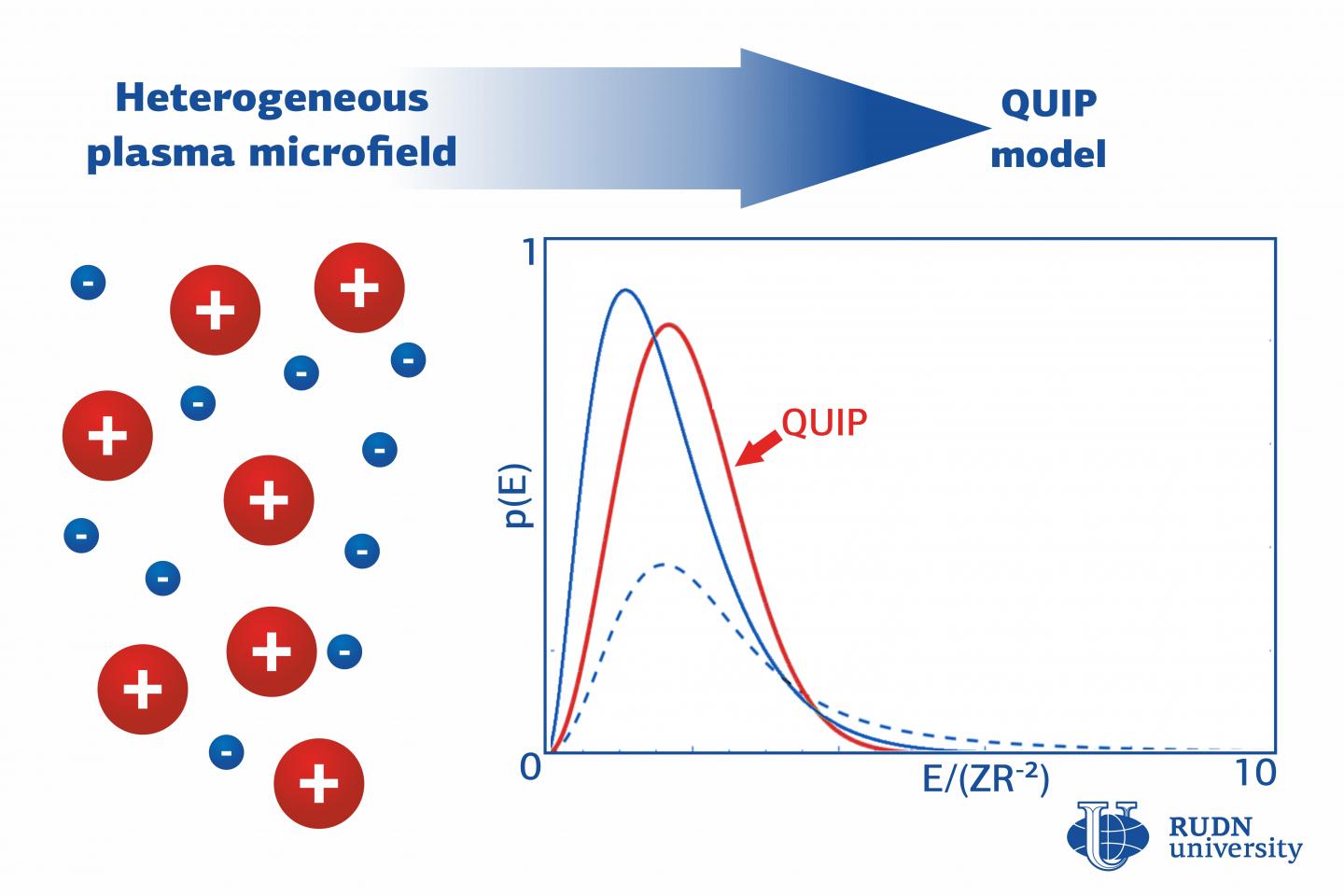
“We have analyzed all models described in scientific literature and identified their disadvantages. Namely, these models provide for the infinite density of the electric field energy in an atomic cell which contradicts the laws of physics. The only model that doesn’t have these disadvantages is the Quasi Independent Particle model or QUIP. We developed a generalized version of this model that takes into account the inhomogeneity of plasma microfield. This helped us extrapolate the model to high-density plasma for which homogeneous microfield approximations cannot be used. The generalized QUIP model is very simple and does not require complex calculations, because all formulas are presented in an explicit manner,” said Alexander Belov, a Candidate of Physics and Mathematics and a senior lecturer at the Department of Applied Informatics and Probability Theory, RUDN University.

To confirm a theoretical model, one has to test it against experimental results. For this purpose, the team chose experiments on the fluorescence of laser-based plasma that have been going on since the 1980s. In these experiments, tiny glass bubbles were filled with a mix of deuterium, argon, krypton, neon, and other gases, covered with aluminum coating and then heated with a powerful multi-beam laser system. As a result, plasma with high temperature and density was formed inside the bubbles and emitted a series of lines in the X-ray range.

“The number of observable spectral lines can be theoretically predicted by a model. In the majority of works, this parameter was neither calculated nor compared to experimental data. Our analysis shows that all models except for QUIP gave wrong predictions that did not match experimental results. Therefore, our model is better at describing the experiment. This test is a convincing proof of the advantage that the generalized QUIP model has over other known models,” added Alexander Belov.

Description of heterogeneous plasma microfield and optical properties of plasma by the QUIP model

###

Media Contact
Valeriya Antonova
[email protected]

Related Journal Article

http://dx.doi.org/10.1016/j.aop.2020.168275

Tags: Algorithms/ModelsMathematics/StatisticsMolecular PhysicsParticle Physics
Share12Tweet8Share2ShareShareShare2

Related Posts

AI and Physics Collaborate to Design Advanced Hydrogen Storage Materials

June 25, 2026

International Team Including Dresden Scientists Develops Novel Designer Proteins for Advanced Study of Living Tissue

June 25, 2026

New Study Uncovers Key Factors Driving Water Chemistry in Nanoscale Environments

June 25, 2026

Plasma Technology Extends Catalyst Lifespan in Hydrogen Production

June 24, 2026
Please login to join discussion

POPULAR NEWS

  • Saying Goodbye to PGY-6: Pediatric Fellowship Realities

    103 shares
    Share 41 Tweet 26
  • Multi-Hospital Study Reveals Long Covid Burden Is Twice as High as Current Estimates

    92 shares
    Share 36 Tweet 23
  • Detection of EDCs in Breast Milk and Infant Urine Up to Six Months Highlights Early Exposure Risks

    77 shares
    Share 31 Tweet 19
  • New Drug Candidate Developed at McMaster Shows Potential for Treating Brain Cancer

    58 shares
    Share 23 Tweet 15

About

We bring you the latest biotechnology news from best research centers and universities around the world. Check our website.

Follow us

Recent News

Tracking Lanthanide-Labeled Microplastics in Plants

POSTECH Researchers Slash Cost of Reconstituted Cell-Free Systems by 95%

AI and Physics Collaborate to Design Advanced Hydrogen Storage Materials

Subscribe to Blog via Email

Success! An email was just sent to confirm your subscription. Please find the email now and click 'Confirm' to start subscribing.

Join 82 other subscribers
  • Contact Us

Bioengineer.org © Copyright 2023 All Rights Reserved.

Welcome Back!

Login to your account below

Forgotten Password?

Retrieve your password

Please enter your username or email address to reset your password.

Log In
No Result
View All Result
  • Homepages
    • Home Page 1
    • Home Page 2
  • News
  • National
  • Business
  • Health
  • Lifestyle
  • Science

Bioengineer.org © Copyright 2023 All Rights Reserved.