• HOME
  • NEWS
  • EXPLORE
    • CAREER
      • Companies
      • Jobs
    • EVENTS
    • iGEM
      • News
      • Team
    • PHOTOS
    • VIDEO
    • WIKI
  • BLOG
  • COMMUNITY
    • FACEBOOK
    • INSTAGRAM
    • TWITTER
Sunday, June 14, 2026
BIOENGINEER.ORG
No Result
View All Result
  • Login
  • HOME
  • NEWS
  • EXPLORE
    • CAREER
      • Companies
      • Jobs
        • Lecturer
        • PhD Studentship
        • Postdoc
        • Research Assistant
    • EVENTS
    • iGEM
      • News
      • Team
    • PHOTOS
    • VIDEO
    • WIKI
  • BLOG
  • COMMUNITY
    • FACEBOOK
    • INSTAGRAM
    • TWITTER
  • HOME
  • NEWS
  • EXPLORE
    • CAREER
      • Companies
      • Jobs
        • Lecturer
        • PhD Studentship
        • Postdoc
        • Research Assistant
    • EVENTS
    • iGEM
      • News
      • Team
    • PHOTOS
    • VIDEO
    • WIKI
  • BLOG
  • COMMUNITY
    • FACEBOOK
    • INSTAGRAM
    • TWITTER
No Result
View All Result
Bioengineer.org
No Result
View All Result
Home NEWS Science News Chemistry

RUDN University chemists obtained new material for antibacterial food coatings

Bioengineer by Bioengineer
September 30, 2019
in Chemistry
Reading Time: 3 mins read
0
IMAGE
Share on FacebookShare on TwitterShare on LinkedinShare on RedditShare on Telegram

IMAGE

Credit: RUDN University

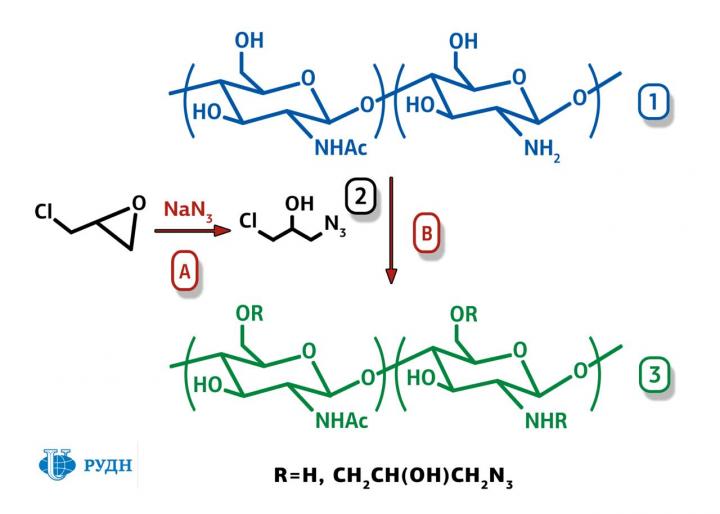
RUDN University chemists have developed a simple and convenient method for producing derivatives of the natural polymer chitosan. These derivatives are non-toxic and have a pronounced antibacterial activity at the level of modern antibiotics. These substances can be used in the production of antibacterial protective films for food. The article is published in the journal Food Chemistry.

Preservatives are widely used in the food industry. They are necessary to extend the shelf life of products. On the other hand, preservatives reduce food quality. Some of them can cause allergies (benzoic acid) or be toxic (nitrates, nitrites). Synthetic waxy substances used to coat fruits can be carcinogenic (biphenyl is prohibited in the US and EU). This explains the importance of finding new preservatives that are effective and safe.

Chitosan is a natural polymer derived from chitin, the main component of insect and crustacean shells. It has antibacterial properties and is already used in the food industry for packaging and coating products with a protective film. However, its activity is much inferior to antibiotics.

To obtain non-toxic and highly active derivatives of chitosan, RUDN University chemists Andreii Kritchenkov and Margarita Kurasova and their colleagues have modified chitosan with organic azides by “sewing” them to the polymer chain. Azides are derivatives of hydrazoic acid HN3. Both organic and inorganic azides are toxic, but their compounds with chitosan are not poisonous. Antibacterial activity of the obtained substances, azido chitosan, was significantly higher than that of chitosan.

The experiment showed that samples of polymers based on chitosan had antibacterial activity at the level of antibiotics. The researchers compared this parameter for azido chitosan with the two most common antibiotics – ampicillin and gentamicin.

Antibacterial activity was determined by diffusion into the agar (nutrient) layer. A disk of filter paper impregnated with the test substance (or comparison antibiotic) was placed on the agar layer sown with a bacterial culture. The substance penetrates the agar, killing bacteria or slowing their reproduction. As a result, a growth suppression zone is formed around the disk, which differs from the rest of the agar surface visually. The value of an antibacterial activity is estimated by the diameter of the formed zones. Toxicity was determined by a standard colorimetric test.

An obtained derivative of chitosan – azido chitosan – cleaned Staphylococcus aureus from a zone of 26 mm in diameter (the indicator for ampicillin was 30 mm), and of 18 mm for Escherichia coli (in gentamycin it was 22 mm).

That is, the polymer has almost the same antibacterial activity as antibiotics. This is extremely important, because the use of antibiotics as components of antibacterial films is highly unacceptable because it leads to the emergence of resistant strains of bacteria. Chitosan compounds do not have this disadvantage.

New chitosan derivatives can be used as harmless and effective preservatives to create protective films for food on their basis.

###

Article:

Novel non-toxic high efficient antibacterial azido chitosan derivatives with potential application in food coatings.

Food Chemistry

15 December 2019, Volume 301, 125247

https://doi.org/10.1016/j.foodchem.2019.125247

Research area: chemistry

RUDN University

Media Contact
Ekaterina Mareeva
[email protected]

Related Journal Article

http://dx.doi.org/10.1016/j.foodchem.2019.125247

Tags: Chemistry/Physics/Materials SciencesMaterialsPolymer Chemistry
Share12Tweet8Share2ShareShareShare2

Related Posts

Conducting Charge Along Linear Carbon Chains — Chemistry

Conducting Charge Along Linear Carbon Chains

June 13, 2026
Thiolated Biochar Enhances Soil’s Ability to Retain Toxic Mercury Amid Climate-Induced Wet-Dry Cycles — Chemistry

Thiolated Biochar Enhances Soil’s Ability to Retain Toxic Mercury Amid Climate-Induced Wet-Dry Cycles

June 12, 2026

AI Advances the Design of Enhanced Biochar Catalysts to Combat Antibiotic Pollution

June 12, 2026

Anti-Inflammatory Molecule Demonstrates Promise in Parkinson’s Treatment in Mouse Study

June 12, 2026
Please login to join discussion

POPULAR NEWS

  • ESMO 2025: mRNA COVID Vaccines Enhance Efficacy of Cancer Immunotherapy

    325 shares
    Share 130 Tweet 81
  • Saying Goodbye to PGY-6: Pediatric Fellowship Realities

    99 shares
    Share 40 Tweet 25
  • Multi-Hospital Study Reveals Long Covid Burden Is Twice as High as Current Estimates

    91 shares
    Share 36 Tweet 23
  • Common Food Preservatives Associated with Elevated Blood Pressure and Increased Heart Disease Risk

    59 shares
    Share 24 Tweet 15

About

We bring you the latest biotechnology news from best research centers and universities around the world. Check our website.

Follow us

Recent News

Admission Creatinine Predicts Outcomes in Elderly ICU

Unraveling PET-MPs’ Role in Inflammatory Bowel Disease

GPR84 Drives Lung Inflammation via ZBP1-PANoptosome Activation

Subscribe to Blog via Email

Enter your email address to subscribe to this blog and receive notifications of new posts by email.

Join 82 other subscribers
  • Contact Us

Bioengineer.org © Copyright 2023 All Rights Reserved.

Welcome Back!

Login to your account below

Forgotten Password?

Retrieve your password

Please enter your username or email address to reset your password.

Log In
No Result
View All Result
  • Homepages
    • Home Page 1
    • Home Page 2
  • News
  • National
  • Business
  • Health
  • Lifestyle
  • Science

Bioengineer.org © Copyright 2023 All Rights Reserved.