• HOME
  • NEWS
  • EXPLORE
    • CAREER
      • Companies
      • Jobs
    • EVENTS
    • iGEM
      • News
      • Team
    • PHOTOS
    • VIDEO
    • WIKI
  • BLOG
  • COMMUNITY
    • FACEBOOK
    • INSTAGRAM
    • TWITTER
Sunday, July 12, 2026
BIOENGINEER.ORG
No Result
View All Result
  • Login
  • HOME
  • NEWS
  • EXPLORE
    • CAREER
      • Companies
      • Jobs
        • Lecturer
        • PhD Studentship
        • Postdoc
        • Research Assistant
    • EVENTS
    • iGEM
      • News
      • Team
    • PHOTOS
    • VIDEO
    • WIKI
  • BLOG
  • COMMUNITY
    • FACEBOOK
    • INSTAGRAM
    • TWITTER
  • HOME
  • NEWS
  • EXPLORE
    • CAREER
      • Companies
      • Jobs
        • Lecturer
        • PhD Studentship
        • Postdoc
        • Research Assistant
    • EVENTS
    • iGEM
      • News
      • Team
    • PHOTOS
    • VIDEO
    • WIKI
  • BLOG
  • COMMUNITY
    • FACEBOOK
    • INSTAGRAM
    • TWITTER
No Result
View All Result
Bioengineer.org
No Result
View All Result
Home NEWS Science News Chemistry

RUDN University biologist tested the resistance of bioplastics to aggressive environment

Bioengineer by Bioengineer
September 6, 2025
in Chemistry
Reading Time: 2 mins read
0
IMAGE
Share on FacebookShare on TwitterShare on LinkedinShare on RedditShare on Telegram

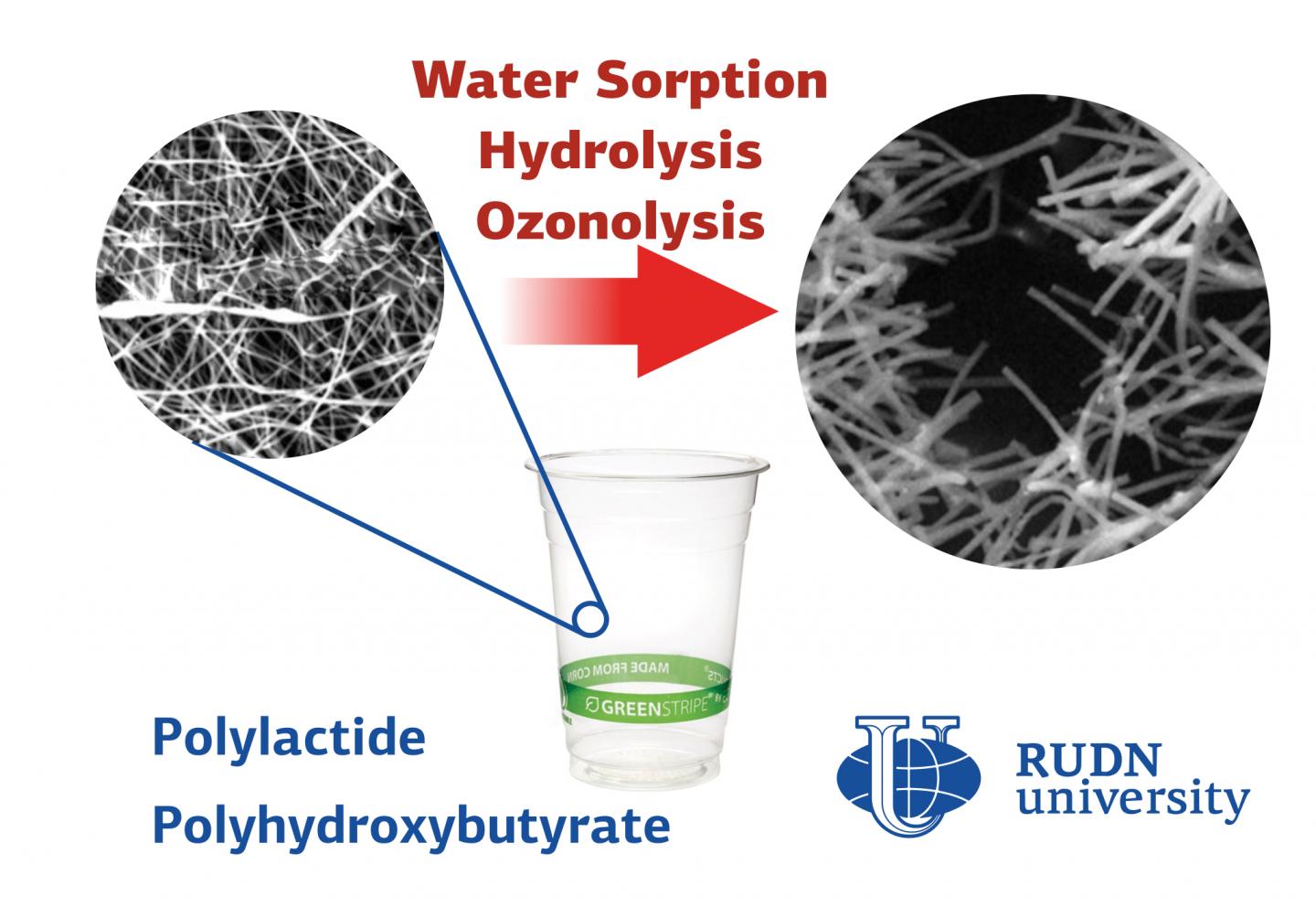
RUDN University biologist studied the aggressive impact of environmental factors (water, salts, and ozone) on ultrathin nanofibers of biopolymers. The results will help choosing suitable bioplastic depending on the use; for example, for medical implants, biodegradable packaging or filters for water cleaning. The results are published in the journal Polymers.

Bioplastics are an alternative to ordinary plastics. They are obtained from waste of plant and food industry. The safe composition allows using them as filters for gases and liquids, as “sponges” for cleaning reservoirs and medical implants. Depending on the field of use, bioplastics are exposed to different environmental factors — light, water, temperature, and the physiological environment. It is still not known how the external environment affects the nanostructure of bioplastics products. The RUDN University biologist found out how the environment affects the nanofibers of two plastics of organic origin: polylactide and polyhydroxybutyrate.

“We obtained the electrospun ultrathin fibers based on thermoelastic biopolyesters. Both of them produced from the naturally abundant renewable resources, namely, polylactide and polyhydroxybutyrate. But our main aim was not to obtain the fibers themselves, but to determine whether their properties are preserved under the impact of aggressive environmental factors”, Alexandre Vetcher, PhD, Deputy Director of the Scientific-educational centre “Nanotechnologies” of RUDN University

Biologists obtained six types of fibers from polyhydroxybutyrate powder and polylactide granules by electrospinning method. The polymer solution was placed in a high-voltage electrostatic field, which “pulled” the solution into thin jets. After cooling, they turned into fibers. Six types of finished fibers differed in the content of polymers in the composition-pure polylactide and polyhydroxybutyrate and their blends in different ratios.

RUDN University biologists have studied the impact of water, physiological environment (internal environment of the body) and ozone on the resulting nanofibers. It turned out that the water vapor absorption depends on the polymer structure. The higher the proportion of polylactide, the more water the fibres absorb: up to 1% of the sample weight. Scientists used a phosphate buffer to simulate the internal environment of a living organism. Polylactide fibers lost more than 50% of their mass in solution over 21 days, and samples with a high polyhydroxybutyrate content lost less than 15%. Also, polymers with a high content of polylactide absorbed ozone molecules more quickly when treated with a stream of this gas and as a result of such intense oxidation they were destroyed. Ozone penetrated the fibers with a 50:50 ratio of the two polymers the fastest.

“We demonstrated that biodegradable nanofibers, which are characterized by a crystalline structure, are more resistant to decomposition by water and ozone. Now it is necessary to test these materials for resistance to UV light and microorganisms in order to determine the optimal applications for each type of fiber”, Alexandre Vetcher, PhD, Deputy Director of the Scientific-educational centre “Nanotechnologies” of RUDN University.

###

Media Contact
Valeriya Antonova
[email protected]

Related Journal Article

http://dx.doi.org/10.3390/polym13060941

Tags: Chemistry/Physics/Materials Sciences
Share12Tweet8Share2ShareShareShare2

Related Posts

Blue Light and Chemistry Simplify Complex Drug Production Steps

Blue Light and Chemistry Simplify Complex Drug Production Steps

July 10, 2026
New Discovery Promises Brighter, More Energy-Efficient Digital Displays

New Discovery Promises Brighter, More Energy-Efficient Digital Displays

July 10, 2026

New Crystalline 3D Frameworks Linked by Spiroborates Developed

July 10, 2026

IBEC Joins Major European Grant on Living Matter Physics

July 10, 2026
Please login to join discussion

POPULAR NEWS

  • Detection of EDCs in Breast Milk and Infant Urine Up to Six Months Highlights Early Exposure Risks

    77 shares
    Share 31 Tweet 19
  • New Drug Candidate Developed at McMaster Shows Potential for Treating Brain Cancer

    58 shares
    Share 23 Tweet 15
  • KTU Researchers Explore Ultrasound’s Role in Enhancing Blood Flow Beyond Diagnostics

    53 shares
    Share 21 Tweet 13
  • 高齢者の骨粗鬆症治療の持続性比較

    51 shares
    Share 20 Tweet 13

About

We bring you the latest biotechnology news from best research centers and universities around the world. Check our website.

Follow us

Recent News

Long-Term Kidney Outcomes After Living Donation in Older Adults Explored

Living Alone and Poverty Heighten Risks for Older Nigerians in Cities

YEARS Algorithm Enhances Pulmonary Embolism Diagnosis in Cancer Patients

Subscribe to Blog via Email

Enter your email address to subscribe to this blog and receive notifications of new posts by email.

Join 85 other subscribers
  • Contact Us

Bioengineer.org © Copyright 2023 All Rights Reserved.

Welcome Back!

Login to your account below

Forgotten Password?

Retrieve your password

Please enter your username or email address to reset your password.

Log In
No Result
View All Result
  • Homepages
    • Home Page 1
    • Home Page 2
  • News
  • National
  • Business
  • Health
  • Lifestyle
  • Science

Bioengineer.org © Copyright 2023 All Rights Reserved.