Adeno-associated virus vectors have become one of the most versatile delivery platforms in gene therapy, capable of infecting a wide range of tissues and underpinning approved treatments for retinal and neuromuscular diseases. Their usefulness, however, is bounded by a strict physical constraint: the AAV capsid can package only about 4.7 kilobases of genetic cargo. Many disease-relevant genes, including those implicated in Duchenne muscular dystrophy, hemophilia A, retinal degeneration and deafness disorders, exceed that threshold, so a single vector cannot carry them intact. Dual-AAV strategies sidestep the limit by splitting a large transgene across two separate vectors that are manufactured independently, purified, and then co-formulated in defined proportions so that both genomes recombine inside the target cell to yield a mature transcript.
That manufacturing approach creates a stubborn analytical problem. The two vectors in a dual-AAV drug product are typically similar in size, sometimes differing by only a few hundred nucleotides, which makes them nearly indistinguishable to the techniques routinely used to measure genome or capsid content. Qualitative PCR, digital droplet PCR, enzyme-linked immunosorbent assay and conventional analytical ultracentrifugation can report aggregate genome or capsid content, but they struggle to resolve and quantify individual vector species within the same formulation. Newer tools such as charge detection mass spectrometry and mass photometry can distinguish empty, partial and full capsids, yet published demonstrations of their use on mixed AAV samples are lacking and access to the instruments remains limited. A research team at Regeneron Pharmaceuticals has now introduced a method designed specifically to close this gap.
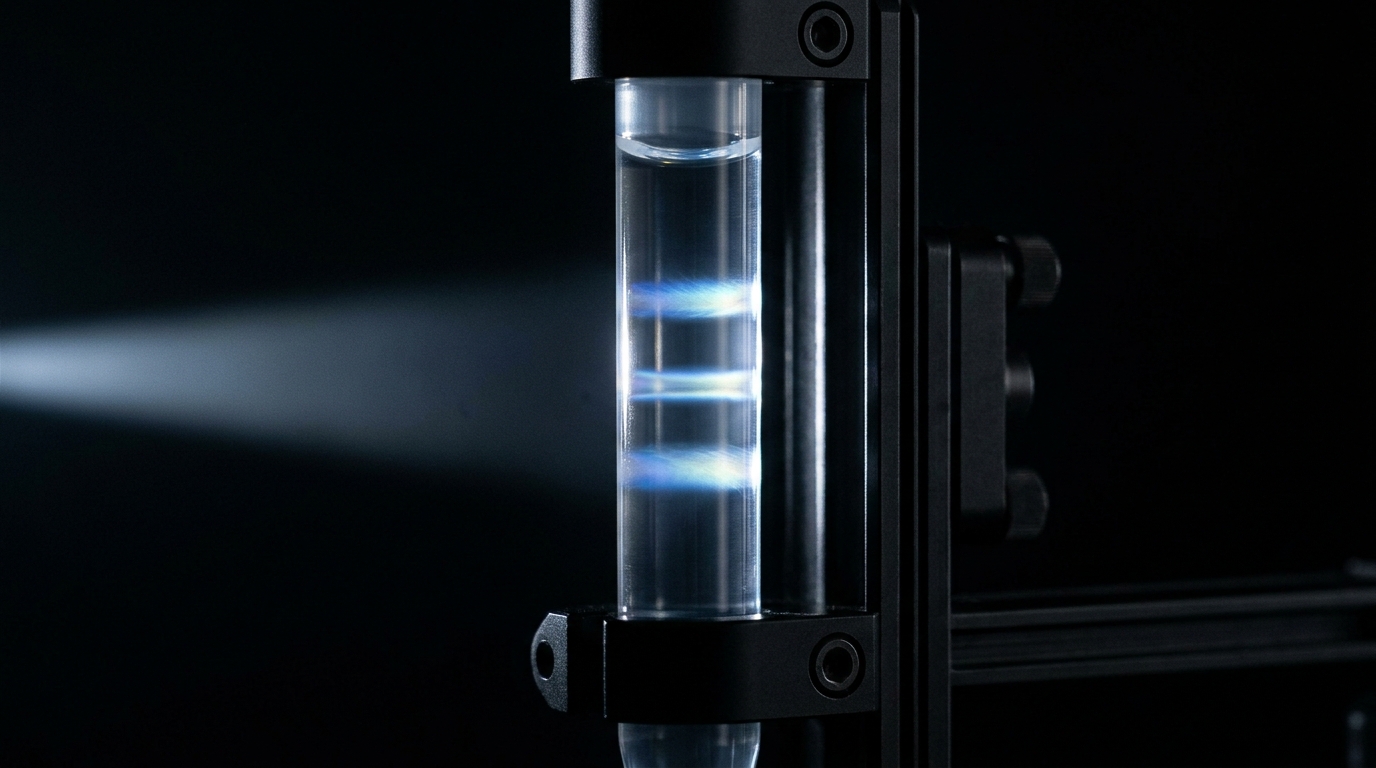
Writing in Gene Therapy, the researchers describe a density gradient equilibrium analytical ultracentrifugation, or DGE-AUC, workflow that separates AAV capsids on the basis of buoyant density rather than hydrodynamic behavior. Where sedimentation velocity AUC primarily reports how fast particles move through a centrifugal field, equilibrium density gradient methods allow particles to band at positions determined by their density, exploiting even minor differences in genome content. In a dual-AAV product whose two full capsids differ mainly in genome length, that distinction is decisive. The team’s initial sedimentation velocity experiments on a representative dual-AAV drug product could not resolve the two full capsid populations at all, because their sedimentation coefficients were too similar, while conventional cesium chloride DGE-AUC achieved only low-resolution separation.
The breakthrough came from a systematic survey of gradient-forming salts. Resolution between two macromolecular species in a density gradient is inversely proportional to a constant known as βeff, so salts that form shallower gradients should spread similar particles farther apart. Testing cesium chloride, rubidium chloride, rubidium bromide and cesium formate, the investigators found that rubidium chloride delivered the greatest separation between the 3′ Full and 5′ Full capsid peaks, reaching a resolution of approximately 1.5, compared with roughly 0.7 for cesium chloride. Cesium formate also separated the two capsids well but caused a loss of absorbance signal that suggested AAV destabilization, so it was excluded. Rubidium chloride was selected as the optimal salt and carried forward into a formal optimization campaign.
That campaign followed an analytical Quality by Design framework using Design of Experiments. The team identified rotor speed and initial salt density as the critical method parameters, since rotor speed shapes the steepness of the gradient and therefore peak breadth, while starting density governs where the AAV peaks sit within the solution column. Densities between 1.38 and 1.39 grams per milliliter placed both full capsid peaks near the midpoint of the column, away from boundary effects that can distort peak area measurements, and a rotor speed window of 34,000 to 38,000 rpm produced well-resolved, reproducible profiles. Speeds above 40,000 rpm caused operational problems including ultracentrifuge leaks, while lower speeds broadened the peaks. AAV load was also tuned, with an input concentration corresponding to an OD230 of 0.15 chosen after tests showed that the 0.1 to 0.2 range gave the highest resolution, around 1.7, and both lower and higher loads reduced separation efficiency to roughly 1.3 to 1.4.
A two-factor, two-level full factorial screening design followed by a custom DoE plan in JMP Pro 17 defined the optimized conditions: a rotor speed of 37,300 rpm and a rubidium chloride density of 1.3856 grams per milliliter. Verification with six replicate runs confirmed the predictions, yielding a resolution of 1.63 ± 0.01 between the two full capsid peaks, in close agreement with the statistically predicted value of 1.62 ± 0.02. The relative standard deviation across replicates was 1.1 percent for the 5′ Full measurement and 0.8 percent for the 3′ Full measurement, and the midpoint of the two peaks landed within 0.005 centimeters of its expected position. These results demonstrated that the statistical optimization had produced a method with high-resolution separation, quantitation precision and reproducibility suitable for routine drug product characterization.
The method’s quantitative performance was then validated across the analytical range. Linearity was assessed by loading samples at OD230 values of 0.049, 0.075, 0.12, 0.15 and 0.18, corresponding to 33, 50, 80, 100 and 120 percent of the target load. Three response models were examined: total peak area, 5′ Full peak area and 3′ Full peak area, each plotted against OD230. All three showed strong linear correlations with R² values of 0.98, and percent full values deviated by less than ±3 percent from expected. Because AAV samples vary widely in the fraction of capsids that are actually full, the team converted the detection thresholds into vector genome units, establishing an LOD of 1.35 × 10¹¹ vg and an LOQ of 4.09 × 10¹¹ vg for the total peak area model, thresholds that remain valid regardless of capsid fullness.
Accuracy was tested with dual-AAV mixtures prepared at defined genomic titer ratios of 20:80, 40:60, 50:50, 60:40 and 80:20 for 3′ Full to 5′ Full. Measured proportions closely matched the expected values across the full composition range, with correlation coefficients exceeding 0.99 for both capsid species. Peak shape and position remained consistent regardless of mixture composition, indicating no interaction effects between the co-formulated vectors. The method therefore quantifies each vector reliably even when one component dominates the formulation, a scenario relevant to real drug products where manufacturing variability can shift the balance between the two vectors.
Beyond compositional analysis, the assay proved sensitive to vector-specific stability. When a dual-AAV mixture was thermally stressed at 37 °C for 14 days, sedimentation velocity AUC first showed an overall decline in full capsids from 76.1 percent to 62.2 percent, with partial particles rising from 2.2 percent to 7.3 percent and empty particles from 21.7 percent to 30.6 percent, a redistribution consistent with loss of encapsidated DNA or degradation of full particles. Applying the optimized DGE-AUC method to the same material revealed a more specific picture: the 3′ Full to 5′ Full ratio shifted from 52.9:47.1 at baseline to 40.1:59.9 after stress, indicating preferential depletion of the 3′ Full species. Because the 3′ construct approaches the AAV packaging limit, the authors suggest that capsids carrying near-capacity genomes may be more susceptible to thermal perturbation, resulting in disproportionate loss relative to smaller vectors.
The researchers note that this level of detail would be difficult to obtain with common genome-content assays such as qualitative PCR or digital droplet PCR, which do not distinguish intact capsid populations within a co-formulated product. The capability enables direct monitoring of vector-specific stability during stress or storage studies, with potential implications for quality and potency assessment of dual-AAV drug products. The approach was also successfully applied to a representative triple-AAV mixture, suggesting general applicability to more complex multi-vector compositions, although the authors caution that resolving power ultimately depends on the magnitude of the genome length difference between full capsids, with limited separation expected for near-identical genomes. Rubidium chloride additionally offers practical advantages over cesium chloride, including reduced health and environmental risks, and the authors suggest that rubidium-based gradients could eventually support preparative applications such as enriching partially filled capsid species or removing single-stranded DNA impurities, though such uses would require further investigation. Only thermal stress was examined in the present study; the team plans to evaluate additional conditions including pH excursion, mechanical agitation, freeze-thaw cycling, oxidative stress and photostability. The FDA’s recent approval of Otarmeni, described as the first dual-AAV-based gene therapy for OTOF-related hearing loss, underscores the growing clinical relevance of mixed-vector products and the analytical methods needed to characterize them.
Subject of Research: An optimized density gradient equilibrium analytical ultracentrifugation method using rubidium chloride to separate and quantify the two vectors in dual-AAV gene therapy drug products.
Article Title: High-resolution separation and quantification of dual-AAV drug products by density gradient equilibrium analytical ultracentrifugation
Article References: Choudhary, D., Therien, C., Howie, D. A., Matousek, W., Rosconi, M. P., & Pyles, E. A. (2026). High-resolution separation and quantification of dual-AAV drug products by density gradient equilibrium analytical ultracentrifugation. Gene Therapy. https://doi.org/10.1038/s41434-026-00649-7
Image Credits: AI Generated
DOI: 10.1038/s41434-026-00649-7
Keywords: AAV vectors, dual-AAV drug products, analytical ultracentrifugation, density gradient equilibrium, rubidium chloride, gene therapy, Quality by Design, capsid quantification, vector stability, thermal stress, packaging capacity, method validation
News Source: Juliet Wilcox. (November 6, 2026). Rubidium chloride ultracentrifugation resolves and quantifies dual-AAV gene therapy vectors. Scienmag.