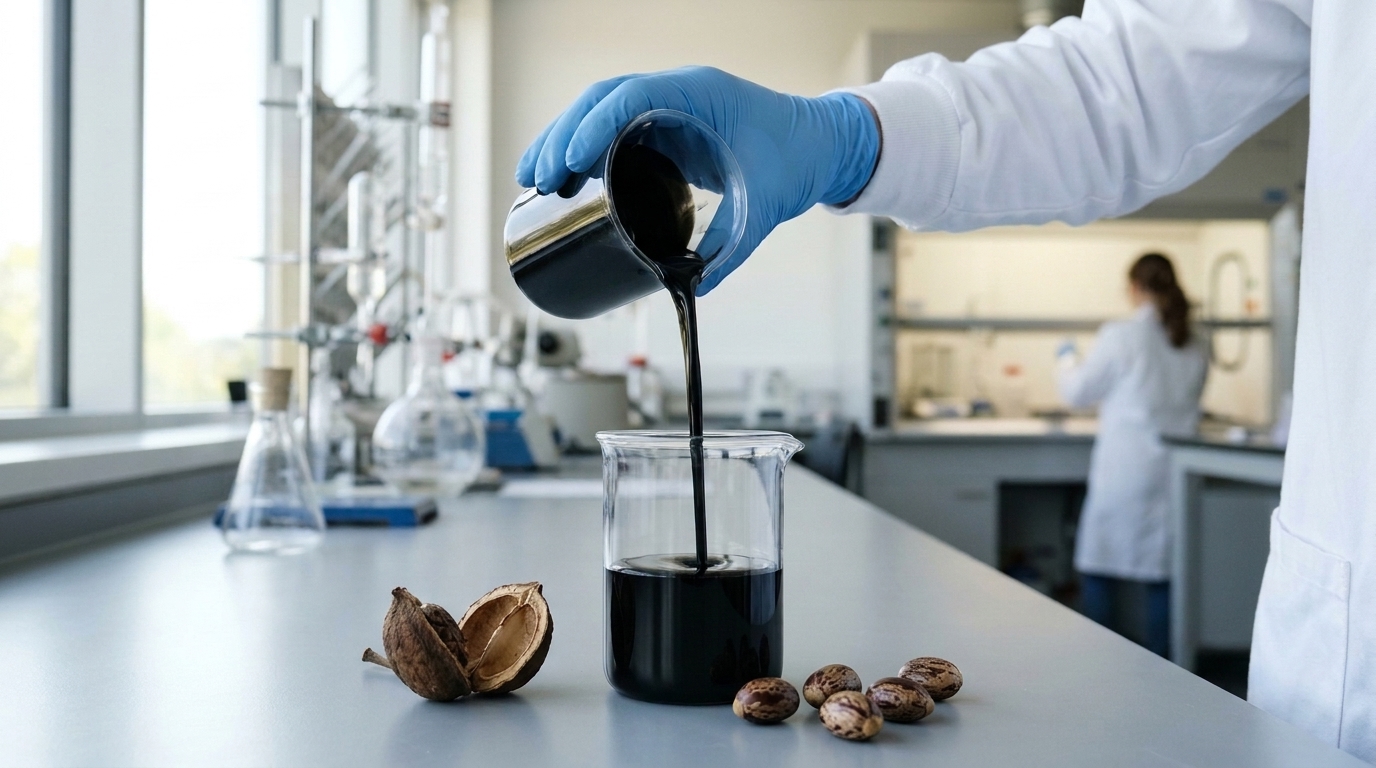
Researchers in Indonesia have turned an agricultural nuisance into a working industrial chemical: rubber seed oil, pressed from kernels that plantations usually discard, has been converted into a methyl ester sulfonate (MES) dispersant that keeps coal-water slurry flowing at a fraction of the dosage demanded by the commercial incumbent, sodium lignosulfonate (SL). In the study, published in Cleaner Engineering and Technology, a slurry made from hydrothermally treated coal reached an apparent viscosity of 888 mPa·s at a shear rate of 100 s⁻¹ with only about 2.5 g/L of the bio-derived dispersant, matching the performance of an interpolated SL dosage of roughly 7.1 g/L — an approximately 2.8-fold reduction in chemical input. Both values sit below the 1000 mPa·s guideline commonly applied to slurry-fed gasification feed.
The feedstock is abundant and currently unpriced. Global natural rubber production exceeds 14 million tonnes annually, with Southeast Asia supplying more than 85%, and rubber seeds account for roughly 15–20 wt% of total fruit biomass — several million tonnes of residual seed material each year. The kernels contain 40–50 wt% oil, yet the seeds are frequently left to decay or be incinerated because downstream uses are limited.
The synthesis follows established oleochemical unit operations. Dried, ground kernels were mixed with deionized water at a 1:4 kernel-to-water ratio and mechanically pressed, yielding about 200 mL of crude bio-oil from 2 kg of kernels. In the first reaction stage, 100 g of rubber seed oil was heated to 60 °C and treated with 1 g of KOH dissolved in methanol for 3 hours, producing fatty acid methyl ester (FAME). In the second stage, the FAME was sulfonated with preheated concentrated sulfuric acid at a 1:1.4 molar ratio (FAME:H₂SO₄), held at 55 °C for 300 minutes, then methanol-washed and neutralized with 20% NaOH to give the purified MES. Infrared spectroscopy confirmed the transformation: C–H bending at 1446 cm⁻¹ and a carbonyl stretch at 1740 cm⁻¹ verified retention of the ester backbone, while S=O stretching bands between 1100 and 1200 cm⁻¹ showed that sulfonate groups had been introduced, with sulfuric acid acting as the SO₃ donor.
Elemental and ash analyses revealed why the bio-dispersant is attractive for gasification duty. MES contained 37.1 wt% carbon and 1.84 wt% sulfur, against 21.7 wt% carbon and 5.52 wt% sulfur for SL — an S/C ratio roughly five times lower for the bio-based product. Ash content, measured by ASTM E1755 with the final temperature raised to 900 °C after incomplete combustion was observed at 600 °C, came to 14.22 wt% for MES versus 25.17 wt% for SL on a dry basis. Since excessive ash contributes to slagging, refractory degradation and fouling in slurry-fed gasifiers, and higher sulfur input raises acid gas removal duty, the authors argue the lower inorganic and sulfur load per unit of dispersing capacity offers operational benefits beyond rheology.
Surface-activity measurements explain the dosage advantage. In interfacial tension tests against n-hexadecane using a spinning drop tensiometer at 6000 rpm and 60 °C, the neat oil–water interface measured 15.1 mN/m. MES drove the interfacial tension down to a minimum of 0.0858 mN/m at 0.25 wt% (2.5 g/L) — a 99.4% reduction, or 176-fold decrease — whereas SL managed only a 29.1% reduction, to 10.7 mN/m at 1.50 wt% (15 g/L). The concentration at minimum interfacial tension was taken as the effective critical micelle concentration (CMC), giving 2.5 g/L for MES and 15.0 g/L for SL, a six-fold difference. Because MES is a low-molecular-weight amphiphile with a single anionic head group per alkyl chain, while SL is a polydisperse, polysulfonated aromatic macromolecule, the smaller molecule achieves far more interfacial coverage per unit mass.
The coal itself was upgraded before dispersant testing. Raw coal, crushed and sieved below 106 μm, was slurried at 50 wt% solids and hydrothermally treated in a 2-L autoclave at 200 °C and 250 °C (about 15 and 40 bar autogenous pressure) for 40 minutes. Treatment systematically altered composition: moisture fell from 15.14 wt% in the raw coal to 5.07% at 200 °C and 4.41% at 250 °C (air-dried basis), fixed carbon rose from 45.86 to 48.31 wt% (dry basis), and oxygen content declined from 26.74 to 25.38 wt% (dry ash-free basis). Atomic O/C and H/C ratios dropped from 0.30 and 0.93 to 0.28 and 0.89, and the fixed-carbon-to-volatile-matter ratio climbed from 0.90 to 1.01, indicating progressive coalification. The 250 °C sample, designated CH, combined the lowest equilibrium moisture, lowest O/C ratio and highest FC/VM ratio, and was selected for all slurry work.
Rheology tests at 55 wt% coal loading showed a non-monotonic, dosage-dependent response to MES. Apparent viscosity, measured with a Brookfield viscometer and interpolated to 100 s⁻¹, dropped sharply at low dosage and reached minima of approximately 922 mPa·s for raw-coal slurry and 882–888 mPa·s for treated-coal slurry across 2.5–5 g/L, before rising again at higher concentrations. The onset of the minimum coincides with the MES CMC of 2.5 g/L. Below the CMC, surfactant molecules adsorb onto coal particle surfaces, boosting electrostatic repulsion and curbing flocculation; above it, additional MES forms bulk micelles rather than modifying surfaces, so no further viscosity reduction occurs. SL, by contrast, showed a monotonic viscosity decline across 5–15 g/L for both coals, consistent with its CMC of 15.0 g/L sitting at the upper limit of the tested range, so adsorption kept increasing without micellization-induced reversal.
Zeta potential measurements corroborated the mechanism. Additive-free slurries measured about −39.4 mV (raw coal) and −43.9 mV (treated coal), near the lower boundary of the accepted good-stability range. Adding MES from 2.5 to 10 g/L raised the absolute zeta potential sharply, peaking at −74.4 mV at about 10 g/L before a slight decline at 15 g/L that the authors attribute to charge screening as ionic strength rises and to the onset of micellization. Treated-coal slurries consistently showed higher absolute values than raw-coal slurries across the MES range, exceeding the 60 mV excellent-stability threshold at most concentrations, which supports the idea that hydrothermal treatment — by stripping polar oxygen functionalities — enhances the coal surface’s affinity for the hydrophobic tail of MES. Because viscosity reduction tracked the zeta potential increase across dispersants and dosages, the authors identify electrostatic repulsion as the dominant stabilization mechanism under the conditions tested, while noting that steric contributions from the alkyl tail cannot be excluded without direct measurement of adsorbed layer thickness.
Static stability, assessed by a rod-penetration method at 15-minute intervals, told the same story. At 2.2 g/L MES — 88% of its CMC — both raw- and treated-coal slurries maintained penetration ratios above 80% after 2 hours, with the treated-coal formulation the most stable overall. At 12 g/L SL — 80% of its CMC — slurries improved only moderately over additive-free controls, which themselves sank below 65% penetration within 60 minutes for raw coal. The stability ranking ran: treated coal with MES, raw coal with MES, treated coal with SL, raw coal with SL, treated coal alone, raw coal alone.
The authors are candid about the limits of the proof-of-concept. Each formulation was prepared from a single batch, so batch-to-batch variability was not quantified and independent replication with formal statistical comparison is needed to confirm the reported magnitudes. The proposed enhanced MES–coal interaction on treated coal is inferred from correlated viscosity and zeta potential trends rather than direct adsorption isotherms or contact-angle measurements, and MES compositional characterization was limited — active matter titration and gas-chromatography fatty-acid profiling remain to be done. Environmental and economic benefits are discussed qualitatively, pending a full life-cycle and techno-economic assessment covering residue collection logistics, bio-oil recovery efficiency and synthesis costs. The work aligns with sustainable development goals 7, 12 and 13, and offers a feasibility basis for pilot-scale validation of a dispersant that turns plantation waste into gasifier-ready chemistry.
Subject of Research: Conversion of rubber seed oil into a bio-based methyl ester sulfonate dispersant for coal-water slurry applications
Article Title: Valorization of Rubber Seed Oil into a Bio-Based, Low-Ash Dispersant for Enhanced Coal-Water Slurry Performance
Article References: Halim, N., Akbar, B., Handayani, I., Hasan, S. L., Karnowo, Rasyid, M. A., & Sanwani, E. (2026). Valorization of rubber seed oil into a bio-based, low-ash dispersant for enhanced coal-water slurry performance. Cleaner Engineering and Technology, 35, Article 101354. https://doi.org/10.1016/j.clet.2026.101354
Image Credits: AI Generated
DOI: 10.1016/j.clet.2026.101354
Keywords: rubber seed oil, methyl ester sulfonate, coal-water slurry, hydrothermal dewatering, sodium lignosulfonate, critical micelle concentration, zeta potential, low-rank coal, waste valorization, gasification, anionic surfactant, interfacial tension
News Source: Alan Morgan. (November 5, 2026). Rubber Seed Waste Becomes a Low-Ash Dispersant That Slashes Coal Slurry Viscosity. Scienmag.